Arooj Ishtiaq
June 15, 2026 • Updated July 8, 2026
17 mins Read
73% of video ads fail in the first three seconds. Not because the product is bad or the budget is too small, but because the hook does not stop the scroll. Your offer, your social proof and your CTA, none of it gets seen if the first three seconds lose the viewer.
This is a curated library of 50 proven best ad hooks for social media ads drawn from real ad performance data across DTC brands, performance marketers, and platform testing.
If you need the visual assets to make these hooks land, ImagineArt's AI ad studio generates campaign-ready product visuals, lifestyle imagery, and UGC-style content at the speed your creative testing requires.
What Is an Ad Hook and Why Does It Determine Everything
An ad hook is the first two to three seconds of your ad. It is the part of your ad creative that determines whether someone stops scrolling or keeps going. It is not a headline, a tagline, or a brand statement. It is a trigger: something that interrupts the automatic behavior of scrolling and makes the viewer's brain say "wait."
Everything else in your ad, the product demonstration, the social proof, the offer, and the call to action, only matters if the hook earns enough attention to be seen. A weak hook with a great offer still loses. A great hook with a mediocre offer still wins traffic.
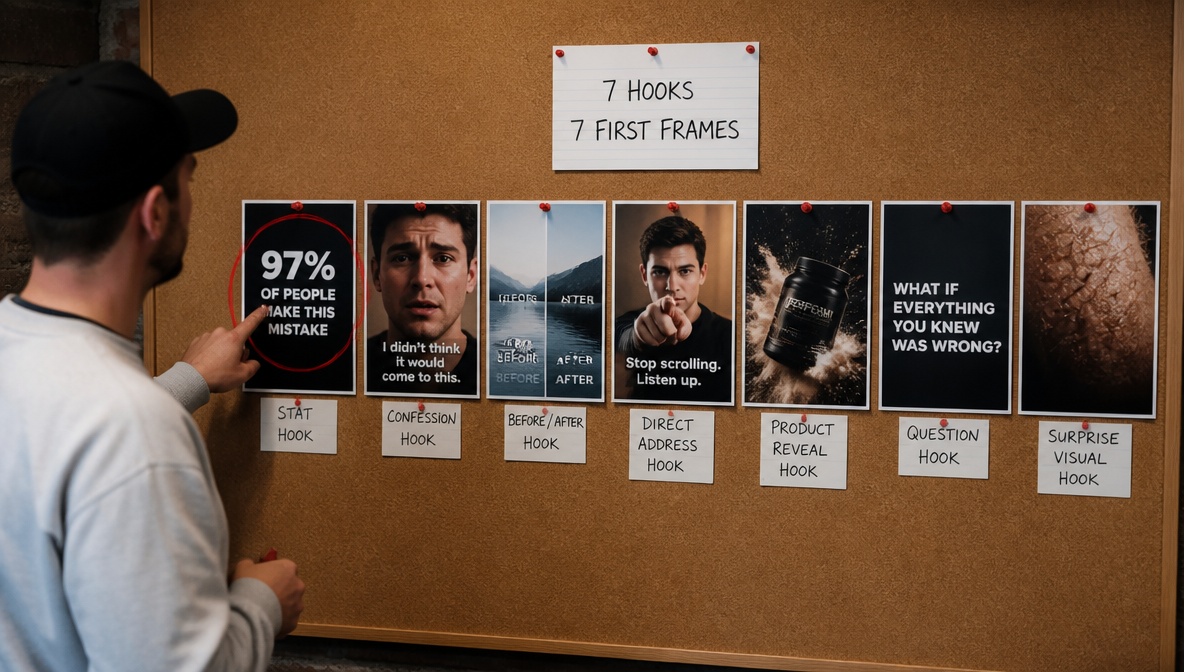
The 7 Types of Ad Hooks and the Psychology Behind Each
Understanding why a hook type works is what lets you adapt a formula rather than just copy a format. These seven types cover the full range of psychological mechanisms behind high-performing social media ad hooks.
1. Curiosity gap: Opens an information gap that the viewer needs to close. The brain is compelled to keep watching to resolve the incomplete loop. Most effective when the implied information feels genuinely relevant to the viewer's situation.
2. Pattern interrupt: Violates the viewer's expectations of what an ad or social media post looks like. The brain disengages from automatic scroll behavior to make sense of something that does not fit the pattern.
3. Direct address: Speaks to a specific person in a specific situation. The higher the specificity, the better the filter: you lose broad reach but gain deep relevance with exactly the customer you want.
4. Social proof and authority: Borrows credibility from a number, a person, or an institution. The source of the proof matters more than the volume of it. Specific and falsifiable beats vague and impressive.
5. Consequence and urgency: Makes the cost of not paying attention feel immediate and real. Most effective when the consequence is genuinely relevant to the viewer's situation rather than manufactured scarcity.
6. Visual and physical interruption: Uses a physical prop, an unexpected visual technique, or a physics-defying moment to stop the scroll before a single word is spoken or read.
7. UGC-style and authentic moment: Content that does not look like an ad. Native-feeling interactions that mirror how people actually discover and share products, including text exchanges, friend recommendations, unboxing reactions.
56 Ad Hooks for Social Media Ads Organized by Type
These hooks are drawn from DTC testing data, performance community testing, and published ad research. Every hook is written as a usable template with brackets for customization.
Curiosity Gap Ad Hooks for Social Media Ads
Curiosity gap hooks work by opening a question the viewer needs to close. The brain's need to resolve incomplete information keeps viewers watching past the critical first three seconds. These perform particularly well on Facebook where slightly longer attention spans support information-driven hooks.
1. "Most people don't know this about [topic they care about]."
2. "The reason [common thing] keeps failing you isn't what you think."
3. "I stumbled onto something by accident that changed how I [outcome]."
4. "We tested [X] vs [Y] for 90 days. The results surprised us."
5. "There's a reason [admired brand or person] does [specific thing] this way."
6. "Nobody talks about this, but [industry thing] has a [serious problem or hidden advantage]."
7. "What [expert or consultant] won't tell you about [topic]."
8. "[Common belief about topic] is actually wrong. Here's what's really happening."
Platform fit: Facebook, YouTube Shorts, LinkedIn. Works with sound-off if paired with on-screen text showing the question.
Pattern Interrupt Ad Hooks for Social Media Ads
Pattern interrupt hooks work by violating what the viewer expects an ad or social post to look like. These are highest-performing on TikTok and Instagram Reels where feed saturation means anything that breaks the visual rhythm stops thumbs mid-scroll.
9. "Don't buy [your product category] until you watch this."
10. "I'm going to tell you something my competitors hate me for saying."
11. "This is the worst [type of product] I've ever seen. Here's why I bought it."
12. "Stop doing [common thing your audience does]. Do this instead."
13. "I wasted $[amount] on [topic]. Here's what I'd do differently."
14. "You've been [doing common thing] wrong your whole life."
15. "Hot take: [something your audience believes] is actually [counterintuitive position]."
16. "Good-bye [old category thing]. These are the new [product] to [use/wear/try]."
Platform fit: TikTok, Instagram Reels. Must deliver the payoff within three seconds or viewers disengage.
Direct Address Ad Hooks for Social Media Ads
Direct address hooks speak to a specific person in a specific situation. The more granular the description, the more intensely someone in that situation self-identifies. These outperform broad hooks on Facebook and LinkedIn where interest-based targeting already narrows the audience.
17. "If you're a [specific role] at a [specific type of company], this is for you."
18. "Are you still [doing old thing]? Here's why you should switch."
19. "This is what [target customer] looks like three months after [using/doing this]."
20. "[Specific profession]: you're leaving money on the table every time you [do common thing]."
21. "If [specific painful situation] sounds familiar, keep watching."
22. "To every [target customer] who's tried [common solution] and it didn't work."
23. "This one's for the [specific person] who's been told [limiting thing]."
24. "[Specific situation] used to be hard. It doesn't have to be."
Platform fit: Facebook, LinkedIn, YouTube pre-roll. Pair with precise audience targeting to ensure the self-identification lands with the right viewer.
Social Proof and Authority Hooks
Social proof hooks borrow credibility from numbers, recognized names, or institutions. Specific and falsifiable proof outperforms vague superlatives every time. The Notion ad featuring Cursor's CEO is the clearest current example: a respected peer vouching for a product carries weight that brand copy cannot manufacture.
25. "[Specific type of customer] went from [X] to [Y] in [timeframe] using this."
26. "[Well-known company or person] uses this exact [method, product, or approach]."
27. "We've worked with [number] of [customer type]. This is the one thing that separates the ones who succeed."
28. "After [number] years doing [thing], here's the honest truth."
29. "Our clients see [specific metric] on average. Here's how."
30. "[Number] people bought this in [short timeframe]. Here's why."
31. "I asked [number] [experts or customers] the same question. The answers were revealing." 32. "Sensitive [problem]? Switch to [product]. [Specific timeframe] to see results."
Platform fit: All platforms. Pair with strong product visuals. ImagineArt's AI image generator generates product-level visuals for social proof hook backgrounds.
Consequence and Urgency Ad Hooks for Social Media Ads
Consequence hooks make the cost of inaction immediate and personal. They work by converting a potential future loss into a present-tense emotional trigger. Samsung's "Time for a comeback? Reignite your resolution" hook is a real example of this working at scale: 5.9 million views, $52K in spend.
33. "If you're doing [thing], you're losing [specific thing] every [time period]."
34. "[Trend] is happening right now. Most [audience] are not prepared."
35. "The window to [benefit] is closing. Here's what to do before it does."
36. "[Thing your audience is doing] is about to cost them. Here's the warning sign."
37. "In [timeframe], [something important to your audience] will change. Here's how to get ahead."
38. "[Common mistake] is the number one reason [your target customer] fails to achieve [goal]."
39. "If you wait until [trigger event] to [take action], it will be too late."
40. "Time for a comeback? [Specific goal]. Here's how."
Platform fit: Facebook and YouTube for longer-form urgency. Instagram Reels for fast-cut urgency. Pair with video ad content from ImagineArt's AI video generator.
Visual and Physical Interruption Hooks
These hooks stop the scroll before a word is spoken. They work on the brain's novelty detection system. When something physically unexpected appears in the first frame, the automatic scroll behavior disengages. These are highest-performing on TikTok and Instagram Reels.
41. Post-it note reveal: A question written on a post-it covers the product. Pull it off to reveal the product. Creates instant curiosity while keeping the product as the reveal.
42. Blurred focus technique: Start with blurred text on paper, then slowly bring it into sharp focus. The brain's need to resolve unclear information keeps viewers watching.
43. Reverse drop effect: Drop the product, then reverse the footage so it "magically" flies back into the creator's hand. Physics-defying moments trigger involuntary attention.
44. Sunglasses text reflection: Film a creator wearing sunglasses with your key message displayed on a laptop behind the camera. Zoom into the reflection in the lens.
45. Megaphone announcement: A physical megaphone used for a PSA, sale announcement, or product launch. The prop signals importance before any words land.
46. Phone screen magic: Text appears on a phone screen surrounded by the product. Works especially well for app-based products or digital services.
47. Whiteboard explainer opener: A hand begins drawing on a whiteboard in the first frame. Educational and product-explainer brands use this to establish credibility and earn watch time.
48. Chase sequence: The creator literally chases the product: a coffee cup, a skincare bottle, a sneaker. The absurdity creates instant memorability and positions the product as desirable. (Widely documented in DTC performance data.)
Platform fit: TikTok and Instagram Reels primarily. For visual hook creation, ImagineArt's UGC ad generator and AI ad studio produce the product visuals and campaign assets behind these formats.
UGC-Style and Authentic Moment Hooks
These hooks work because they do not look like ads. They mirror how people actually discover and share products, which lowers the viewer's resistance and produces native-feeling content that platforms algorithmically favor. These are the highest-performing format for Meta DTC campaigns.
49. Fake text exchange discovery: Creator receives a text asking about their product and records a voice note explaining where she got it. Mirrors actual social discovery behavior and produces native-feeling content.
50. Man on the street: Approach someone searching for your product type. Hand them your product as the solution. Works best for products with high retail visibility.
51. Unboxing reaction: "I can't believe this is the [product] I got. I've heard so many good things about this company."
52. Multi-creator mashup: Multiple creators with your product appear in rapid succession. Social proof amplification through volume and diverse representation.
53. TikTok comment skeptic: A real negative comment appears as an on-screen overlay. The creator responds directly to the criticism, which transitions into a product demonstration. Negativity psychology drives engagement and turns skepticism into proof.
54. Story time journal: Creator writes about discovering the product in a journal and circles the brand name with a marker. Creates personal connection while emphasizing organic discovery.
55. Influencer authentic opener: "Guys, I am very excited about [product]." No scripted intro, no brand messaging, just genuine enthusiasm.
56. Founder journey opener: "We gave ourselves one year to get this from idea to finished product." Positions the brand as a story the viewer can root for rather than a sales pitch to evaluate.
Platform fit: Meta (Facebook and Instagram) for UGC and testimonial formats. TikTok for comment skeptic and trend-integrated hooks.
10 Ad Hooks for Social Media Ads Templates
These templates show each hook formula applied to a specific industry. Adapt the brackets to your product and audience.
| Industry | Hook Template | Type |
|---|---|---|
| E-commerce / DTC | "Don't buy [product category] until you watch this." | Pattern interrupt |
| Fashion and beauty | "Good-bye [old category]. These are the new [product] to [wear/use]." | Trend disruption |
| Food and beverage | "I've been making [recipe/drink] wrong for years. Found out by accident." | Curiosity gap |
| SaaS and tech | "If you're still doing [manual task] by hand, you're wasting [X hours] a week." | Consequence + direct address |
| Finance and professional services | "After [number] years working with [customer type], here's the number one mistake I still see." | Authority + consequence |
| Fitness and wellness | "Stop doing [common exercise]. It's not doing what you think it is." | Pattern interrupt |
| Home services | "The reason most [city] homeowners overpay for [service] isn't the contractor. It's this." | Curiosity gap + direct address |
| Education and coaching | "To every [student/founder/creator] who's tried [common approach] and it didn't work." | Direct address |
| Seasonal and retail | "The window to [benefit] is closing. Here's what to do before it does." | Urgency |
| Marketing and agencies | "We audited [number] landing pages last year. [X percent] had the same conversion-killing mistake." | Social proof + consequence |
For fashion and beauty content specifically, the fashion ads guide on ImagineArt covers the visual formats and creative approaches that perform best across these hook types in fashion campaigns.
Platform-Specific Hook Strategy
The same hook performs differently across platforms because each platform has a different scroll speed, audience expectation, and content format. Adapting your hook to the platform is not optional. It directly affects whether the algorithm distributes your ad.
| TikTok | Instagram Reels | YouTube Shorts | ||
|---|---|---|---|---|
| Attention window | 1 to 2 seconds | 2 to 3 seconds | 3 to 5 seconds | 5 seconds |
| Best hook type | Pattern interrupt, trend-native, comment skeptic | Lifestyle-integrated UGC, visual interruption | Curiosity gap, consequence, educational | Tutorial opener, transformation arc, question-first |
| Audio | Critical: native sound drives performance | Important | Less critical, many viewers on mute | Important, often watched with sound |
| Text overlay | Fast and punchy | Clean and lifestyle-appropriate | Longer form acceptable | Clear question or statement |
| Content feel | Raw, native, imperfect | Slightly more polished than TikTok | More educational, longer builds acceptable | Tutorial structure, clear promise |
For a deeper comparison of which video models produce the best short-form ad content for each platform, the best AI video generators for social media and best AI video generators for YouTube Shorts guides cover the landscape.
For a full overview of all current AI video models available for ad production, the best AI video generators guide covers the category.
For music-driven ad formats and brand video content, the best AI music video generators guide covers how to produce campaign-quality music-synced content.
Weak vs Strong Hook Comparison Table
The difference between a weak and a strong hook is rarely about length. It is about specificity, intensity, and the presence of a psychological mechanism.
| Weak Hook | Strong Hook | What Changed |
|---|---|---|
| "Check out our new product" | "Don't buy [category] until you watch this" | Added pattern interrupt and implied revelation |
| "Our skincare really works" | "Sensitive gums? Switch to [product]. Healthier gums in one week." | Named the pain point, added specific timeframe, removed vague claim |
| "A man runs down the street" | "A man sprints at full speed, chest forward, barely holding his balance on wet pavement" | Specific verbs, physical detail, intensity modifiers |
| "Sale on now" | "The window to [benefit] is closing. Here's what to do before it does." | Replaced generic urgency with specific consequence framing |
| "Lots of customers love us" | "[Number] people bought this in 48 hours. Here's why." | Time compression, specific number, implied social proof mystery |
How to Test Ad Hooks for Social Media Ads?
Finding the best hook for your specific audience is an empirical question, not a creative judgment. The testing protocol that works:
- Run 3 to 5 hook variations against identical body content with equal budget distribution. Keep everything after the first three seconds the same: same offer, same CTA, same product demonstration. Only the hook changes.
- Measure the 3-second view rate as the primary hook metric, not completion rate. After each variation accumulates at least 1,000 impressions, compare rates. The winning hook gets the majority of budget. The losing hooks tell you which psychological mechanisms do not resonate with your specific audience.
- High-performing ad hooks for social media ads experience a 37 % performance drop after approximately 7 days due to creative fatigue. Build a weekly refresh cycle into your creative calendar and test new hooks against your current best performer before the decline begins.
The how to handle ad fatigue and refresh ad creative guide covers exactly how to build that refresh process.
For deeper analysis of which creative elements are driving performance beyond the hook, the ad creative analysis guide covers how to read what the data is actually telling you.
For motion control and animation-driven ad content, the best AI video models for motion control and animation guide covers which models handle dynamic ad formats best.
Common Ad Hook Mistakes That Kill Performance
- Leading with a logo or brand name. Nobody in a scrolling feed stops for a logo. Your hook should be the first thing seen, not a branded introduction.
- Slow intro or fade. Platforms reduce reach when viewers drop off early. A two-second fade kills distribution before the hook even lands.
- Being clever instead of clear. Clever hooks require cognitive effort. In a fast-scrolling feed, thinking means scrolling past. Your viewer must understand what is happening immediately.
- No pattern interruption. If your ad looks like every other ad in the feed, it gets scrolled past like every other ad. Something in the first frame must be unexpected.
- Hook that takes longer than 3 seconds to pay off. The payoff of the hook must arrive within three seconds. If the reveal or punchline takes longer, you have already lost most viewers.
- Same hook across all platforms. TikTok and Facebook require fundamentally different hook approaches. Repurposing the same opening across platforms without adaptation wastes budget.
- Clickbait that does not deliver. High click rates without conversions destroy ROAS and signal quality. If your hook promises something, the rest of the ad must deliver it immediately.
- No visual element. Many viewers watch with the sound off. If your hook relies entirely on audio, you are invisible to a significant portion of your audience. Dynamic on-screen text is not optional.
Conclusion
The 50 hooks in this library cover every psychological mechanism that drives scroll-stopping performance on social media. Test them by type first to identify which mechanism your audience responds to most, then adapt the formula to your specific product and customer.
Build the visual assets behind your hooks with ImagineArt's AI ad studio and UGC ad generator, both of which generate campaign-ready creative at the speed systematic hook testing demands. For prompt ideas that work across AI image and video generation for ad assets, the creative AI art prompts guide covers approaches across every ad content category.
For free tools to start producing video hook assets without a budget, the top free AI image to video tools guide covers what is available at no cost.
Frequently Asked Questions
How long should a social media ad hook be?
Two to three seconds is the window. On TikTok you have approximately one to two seconds before viewers scroll. The hook must complete its psychological trigger within that window, whether that is delivering the pattern interrupt, opening the curiosity gap, or naming the specific person. Everything else in the first three seconds is dead time.
Should ad hooks be different for video and static ads?
Yes. Video hooks rely on motion, unexpected visual elements, and audio triggers. Static ad hooks work entirely through the visual composition and the text overlay or headline. The psychological mechanisms (curiosity gap, pattern interrupt, direct address) apply to both, but the execution is entirely different. For static ad creative production, ImagineArt's AI image generator generates platform-ready static ad visuals.
How many hooks should I test at once?
Three to five is the optimal range. Fewer than three gives you insufficient data to identify which mechanism is winning. More than five makes budget allocation and learning attribution harder to manage cleanly.
What metric tells me if my hook is working?
The 3-second view rate is the primary hook metric. It measures the percentage of viewers who saw the first frame and watched past three seconds. Completion rate tells you about the full ad. Hook rate tells you specifically about the opening. These are different things and require separate optimization decisions.
Which platforms respond best to UGC-style hooks?
Meta (Facebook and Instagram) shows the strongest performance for UGC-style and authentic moment hooks. The native, non-ad feel aligns with how content is consumed in those feeds. TikTok responds well to trend-native and comment-driven formats. YouTube responds better to educational openers and transformation arcs.
Arooj Ishtiaq
Arooj is a SaaS content writer specializing in AI models and applied technology. At ImagineArt, she creates sharp, product-focused content that helps creators and businesses understand, adopt, and get real value from AI tools.