
Syed Anas Hussain
June 15, 2026 • Updated June 18, 2026
14 mins Read
Every quarter I search "best hooks for video ads" and get the same 12 articles with the same list in the same order. Bold claim. Curiosity gap. Question hook. Problem-solution. They're not wrong. They're just not useful.
Nobody's telling you which hook type works for which product, which platform, or which audience temperature. And nobody's talking about the hooks that look incredible in a creative brief and then quietly die on placement — which is the most expensive category to learn about through experience. This is the guide I wish existed.
What Changed in 2026 — And Why Your Old Hooks Aren't Working
Hooks haven't changed. The people watching them have. Three shifts in viewer behaviour in the last two years have made previously reliable formats significantly weaker:
Audiences are more pattern-trained. The UGC "Hey guys, I just found something I need to tell you about" hook worked because it felt spontaneous. It's been replicated enough times that viewers now recognise the format and the scroll reflex fires before they consciously process it. The format still works. The execution needs to be sharper.
Muted-feed performance is the baseline, not the exception. More than 70% of social video is watched without sound. If your hook requires audio to land, it's being evaluated on its visual alone for the majority of your audience.
Short-form platforms have trained audiences to expect a faster payoff. A hook that used to buy 4 seconds of goodwill now buys 1.5. Whatever you're delivering — the result, the claim, the problem statement — needs to be front-loaded more aggressively than ever.
What This Means for How You Write Hooks
Behaviour has shifted, so the approach has to shift with it. The first frame has to work on mute, the hook has to land faster, and the format has to feel native enough that the scroll reflex doesn't fire before the viewer registers what they're watching.
The brands doing this well in 2026 are testing more variations, adapting formats to platform context, and using AI tools like ImagineArt AI Ad Studio to generate multiple video hook variants from a single brief — rather than committing production budget to one version and hoping it works. More on testing in the section below.
Here are the seven hook types that hold up under these conditions.
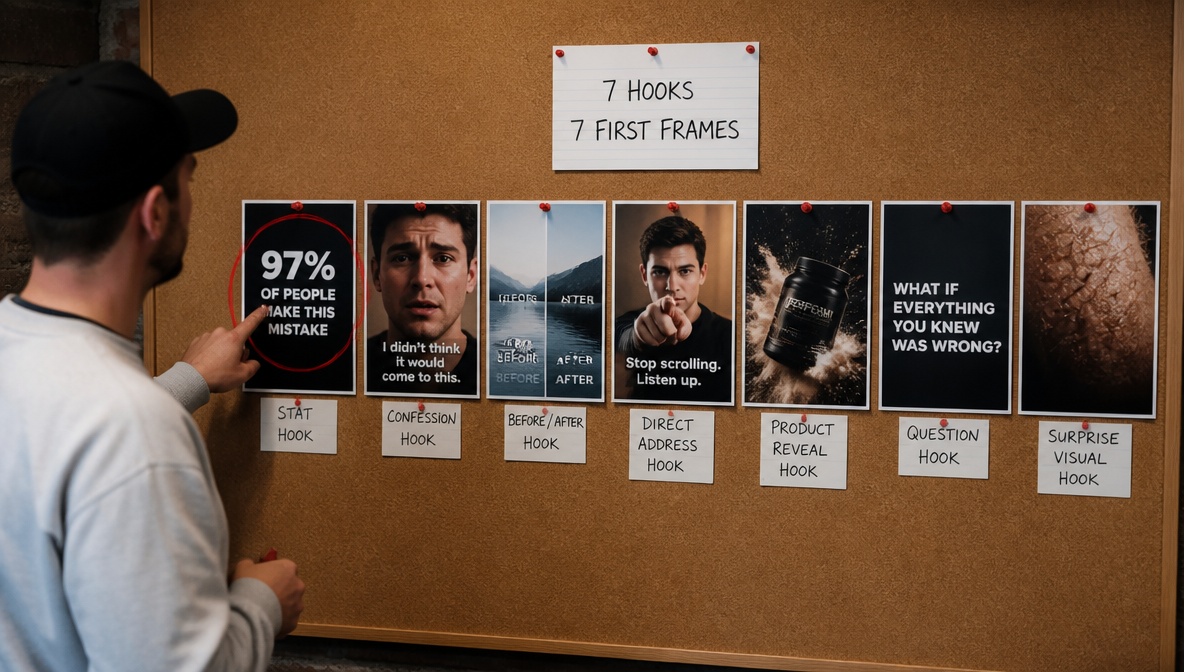
7 Hook Types That Actually Work (With Real Examples)
1. The Bold Claim Hook
Lead with a specific, surprising, provable result. Not a vague benefit — a number, a timeframe, a before/after stated plainly.
"We dropped our CPL from $34 to $8.70 in 11 days. Same audience. Same offer. Different opening."
"This one creative change took our hook rate from 14% to 41% in a week."
"I fired our UGC agency. ROAS went up."
Why it works: Specificity creates credibility. "Dramatically improved results" is a claim anyone can make. "$34 to $8.70 in 11 days" is a claim that makes you stop and read. The more specific the number, the more real it sounds.
Best for: Any product with a quantifiable result — SaaS, DTC with trackable outcomes, services with measurable before/after.
The failure mode: Overclaiming. If the number sounds too good it triggers skepticism instead of curiosity. Keep the claim surprising but believable.
2. The Curiosity Gap Hook
Create an open loop that requires watching to close. Plant a question the viewer has to stay for.
"Here's why every performance marketer I know switched from UGC to this — and what it cost the ones who waited."
"The reason your CPMs keep climbing has nothing to do with competition."
"Three seconds. That's all you get. Here's what the brands spending $50k/day actually do with them."
Why it works: Unresolved questions create mild cognitive discomfort. The brain wants to close the loop. If the question feels relevant and the implied answer is something they don't already know, they'll watch.
Best for: Education-adjacent products, tools, anything with a counterintuitive insight.
The failure mode: The curiosity gap that doesn't pay off. If you create a compelling open loop and deliver a generic answer, the viewer feels manipulated.
3. The Relatable Problem Hook (This Is Where UGC Lives)
Open with a problem statement your audience says to themselves but rarely hears said out loud.
"I used to spend $700 on ad creative every month and have absolutely nothing to show for it."
"My ads looked amazing. The data was always 'no.'"
"I've refreshed my ad manager at 11pm on a Sunday. Twice. In the same week."
Why it works: Recognition is instant. The viewer doesn't have to work to connect — they're already there. This is why UGC hooks performing well aren't about the person looking cool. They're about saying the exact thing the viewer is already thinking.
The UGC-specific note: The problem statement needs to be slightly personal and slightly embarrassing. "My campaigns weren't performing" is too corporate. "I was lying to my boss about why our ROAS was down" is the version that stops the scroll.
4. The Pattern Interrupt Hook
Something in the first frame that is visually or aurally unexpected enough to break the scroll reflex before the viewer consciously decides to watch.
- Extreme close-up of something tactile before any product context
- Hard cut to a bold statement on a solid colour background
- A physical demonstration of something that shouldn't work the way it does
- Text on screen: "Stop."
Why it works: The brain is designed to notice contrast and novelty. In a feed of similar-looking content, something structurally different gets noticed before the viewer makes a conscious evaluation.
The failure mode: Pattern interrupt without relevance. A surprising opening that has nothing to do with the product. The viewer stops, gets confused by the disconnect, and leaves.
5. The Social Proof Hook
Open with a result, a number, or a signal of social validation — outcome before explanation.
"32,000 brands use this to generate their ads. Here's what actually changed."
"4.8 stars from 11,000 reviews. This is the one everyone keeps sending me."
Why it works: Before a viewer decides if they care about your product, they care whether other people care. Social proof front-loads that signal before skepticism has a chance to form.
Best for: Products with genuine traction — real review numbers, real user counts.
The failure mode: Generic social proof. "Thousands of happy customers" is noise. "14,000 Shopify stores under $500k/year use this" is a signal.
6. The Direct Address Hook
Name the exact person you're talking to. Specific enough that the right audience feels personally identified.
"This is specifically for Shopify stores doing $10k to $50k per month who are stuck on that plateau."
"If you're running Meta ads on under $300/day, watch this before you increase your budget."
Why it works: Personalization stops the scroll more reliably than generic appeal. The hook rate might be lower than a broad-appeal hook — but hold rate, CTR, and CPA are usually stronger because you're self-selecting higher-intent viewers.
7. The Before/After Revelation Hook
Deliver the transformation in the first three seconds — result first, explanation later.
What this looks like as a video hook:
- A face in a clearly stressed state fills the frame. Hard cut to the same face, calm, composed, different environment. No setup. The contrast is the hook.
- Opening shot: a cluttered, chaotic desk. One second. Hard cut to the same desk, clean and organised. Text on screen: "One habit. Three weeks." Product reveal follows.
- A creator walks in looking exhausted, sits down heavily. Hard cut to them walking in energised, same location, different energy. Hold two seconds before any product context.
Why it works: You're giving away the ending before the middle — counterintuitive, but in a three-second window the ending is the hook. The viewer sees the resolution and stays to understand how it was reached.
The failure mode: A before/after that's too subtle. The visual contrast has to be immediately legible. If you need to explain what changed, the hook isn't doing its job.
UGC Hooks — What Actually Works in 2026UGC is one ad format among several. On the platforms in this guide — Meta, TikTok, Instagram Reels, YouTube, LinkedIn — the broad ad types are polished brand video, UGC-style creator content, direct response, and native-feel organic. Each has its own hook conventions. UGC is worth its own section because it's the format where hook execution is most frequently misunderstood.
For a complete production guide covering scripts, avatar selection, platform formats, and testing loops, How to Make UGC Ads with AI covers the full workflow.
What works in UGC hooks:
Opening line is the problem, not the introduction. "I'm going to tell you about X" is an introduction. "I spent six months doing X wrong before I figured out what was actually broken" is a problem — and problems stop the scroll.
The tone is slightly tired, not performatively excited. Genuine UGC performances have a quality of "I can't believe I'm saying this out loud" rather than "this product changed my life." The more energetically positive the opener, the more scripted it sounds.
Specificity over enthusiasm. "This product is amazing" converts worse than "I've used it every day for three weeks and the one thing that surprised me most was—"
What doesn't work anymore:
- The direct-to-camera "I need to tell you about this" with high energy. Overused. The audience now recognises it.
- Product reveals as the hook. Showing the product in the first 2 seconds before any context signals "this is an ad" faster than almost anything else.
- Opening with your name and credentials. Nobody in a social feed cares who you are in the first three seconds.
Hook Strategies by Platform — What Works Where
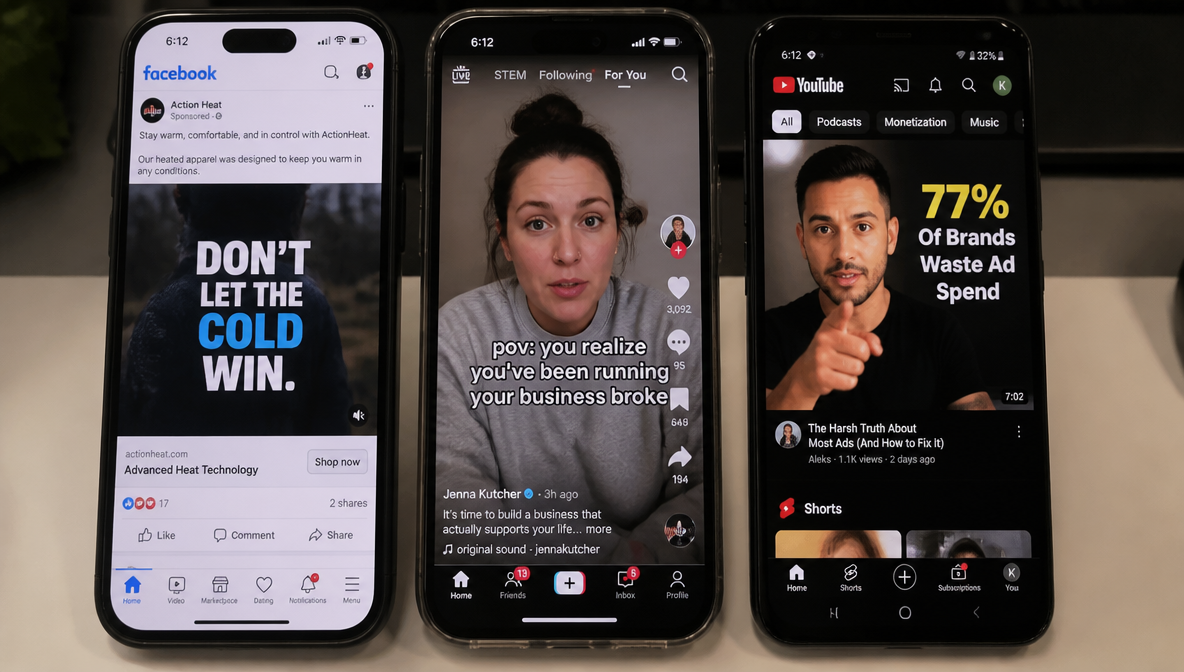
Different platforms have fundamentally different feed dynamics, audience mindsets, and content expectations. The same hook that stops the scroll on TikTok can feel jarring on LinkedIn and invisible on YouTube. Here's what actually works by platform.
Meta (Facebook & Instagram)
Audiences skew slightly older and more skeptical of direct marketing. Bold claim hooks and social proof hooks outperform. Text-on-screen hooks work well because a large share of Meta video is watched muted — your hook needs to land visually without audio. Curiosity gap hooks work well in the feed when the implied answer is clearly relevant to the viewer's situation. Pattern interrupt hooks perform on Instagram Reels specifically, where the feed is dense and visual novelty has high scroll-stop value.
TikTok
The audience expects entertainment first. Pure product hooks die faster here than on any other platform. Relatable problem hooks and curiosity gap hooks fit the native content format better — they feel like organic content rather than ads. Audio-on is more common on TikTok than any other platform, making voice-led hooks viable in a way they aren't on Meta. Pace matters more here: the hook needs to feel like it's already mid-story by second one.
YouTube (Skippable Pre-Roll)
You have five seconds before the Skip Ad button appears. The hook needs to create enough interest to prevent the skip — not just stop a passive scroll, but actively earn a decision to keep watching. Direct address hooks perform well because naming the specific viewer creates a personal stake before the skip option arrives. Bold claim hooks with specific numbers also work because the claim is provocative enough to hold attention through the skip moment. Avoid slow-build openers entirely — the skip reflex fires before the payoff.
Instagram Reels (separate from Meta feed)
Reels surfaces content algorithmically to cold audiences. The hook needs to work for viewers who have no prior brand awareness and no stated interest signal. Pattern interrupt hooks and before/after revelation hooks perform well because they don't require any context to be compelling. Native-feeling content — hooks that look like organic Reels rather than produced ads — outperform polished brand-style openers consistently.
The feed is professional context, not entertainment context. Direct address hooks perform best here: naming the specific role, industry, or problem creates immediate relevance before skepticism forms. Bold claim hooks work when the claim is specifically professional and measurable — "We reduced our sales cycle from 47 days to 19" lands; "Amazing results" doesn't. Keep the hook register professional — the tone that works on TikTok reads as out-of-place in a LinkedIn feed.
Pinterest is intent-driven — users are actively searching or browsing with a goal in mind. Before/after revelation hooks and social proof hooks work best because they align with the platform's core use pattern: people looking for evidence that something works. Visual transformation in the first frame — showing the result before the product — is the most effective opening for Pinterest video ads. Keep the hook clean and the result clear.
Universal principle across all platforms: Whatever hook type you use, it needs to feel native to the feed. The audience's expectation for the opening three seconds is set by the organic content surrounding your ad. An ad that breaks from that register signals "this is an ad" before the hook has a chance to work.
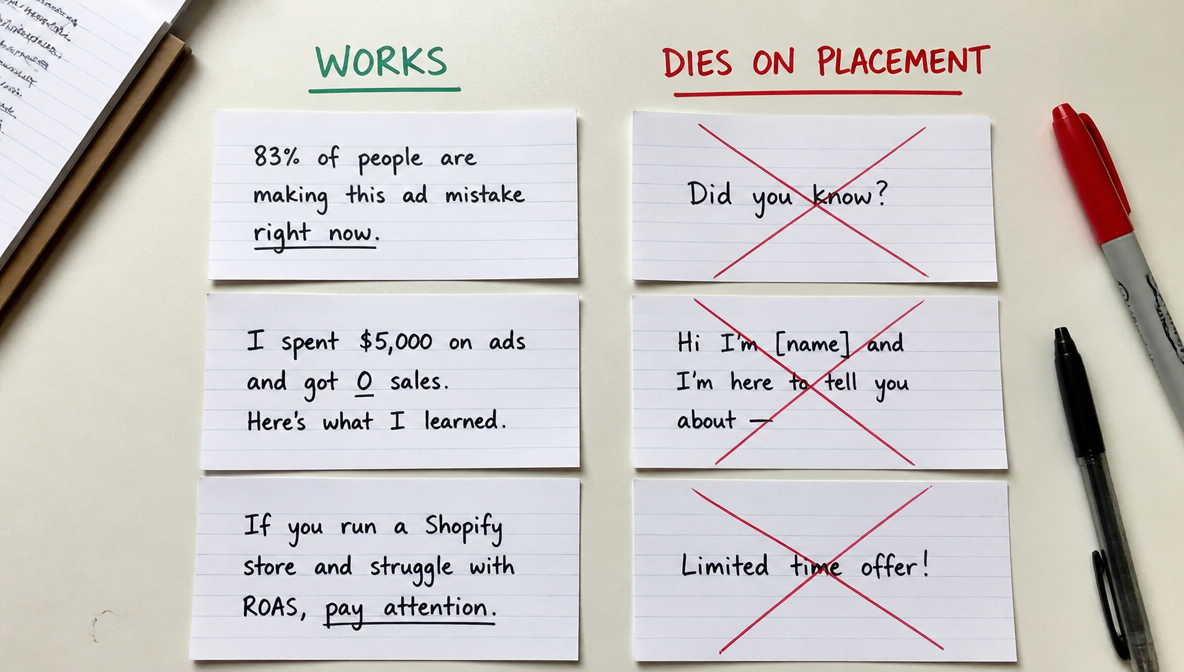
Hooks That Look Smart But Underperform
"Did you know?" — Sounds educational, feels approachable. Overused as an ad opener. Audiences have trained themselves to skip it.
The self-introduction. "Hi, I'm [name] and I'm here to tell you about—" Single fastest way to signal that what follows is scripted.
Vague transformation hooks. "I used to struggle with X. Now everything is different." Without specifics, this is noise. The specifics are the hook.
Urgency-first. "Limited time offer—" as the first words. Every ad in your category is using scarcity. Put urgency in the CTA, not the hook.
The obvious-pain question. "Tired of [pain point everyone has]?" Works when the pain point is specific and underarticulated. Fails when it's so broad the viewer thinks "obviously, who isn't?" and scrolls.
For more real examples with performance data, 20 Advertising Hook Examples That Actually Convert breaks down 20 real ads with the psychological mechanism and results behind each one.
For Instagram-specific hook strategy, Instagram Ad Hooks covers muted-feed dynamics, text overlay requirements, and Reels formats in detail. For carousel hooks alongside your video ads, 15 Best Carousel Hooks covers the swipe-format equivalent.
Once your hooks are live, What Is Hook Rate? and Hook Rate vs Hold Rate cover how to read the data and what to fix when the numbers are low.
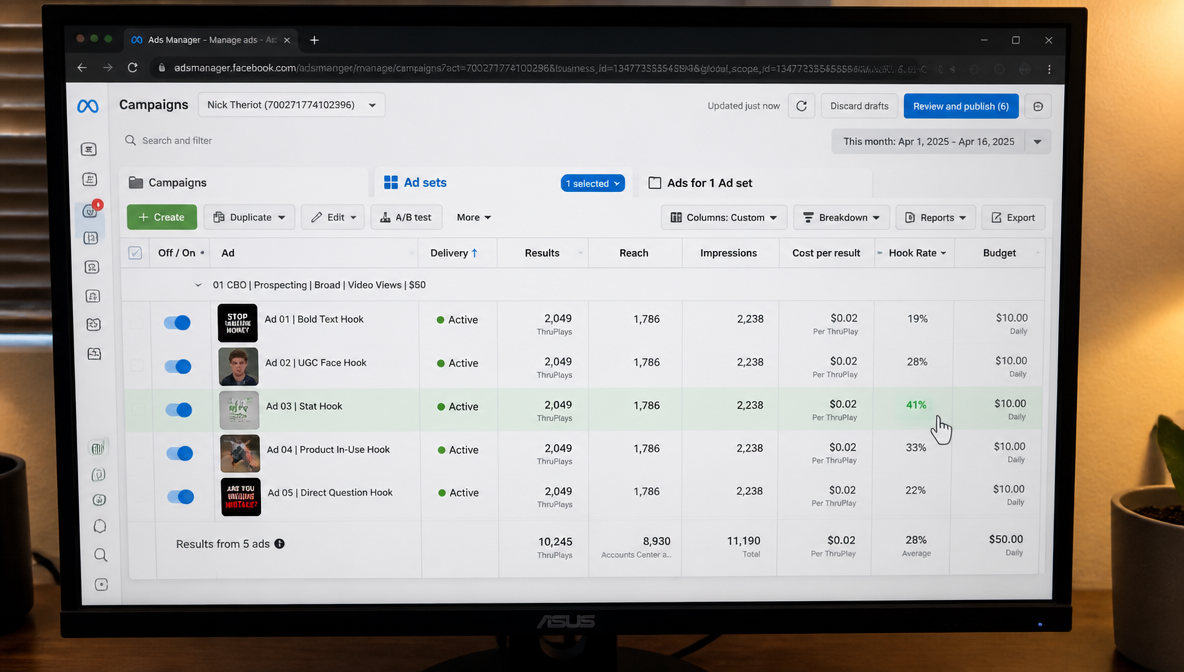
How to Test 5 Video Ad Hooks Before the Week Is Out
Knowing hook types is step one. Having hook data is step two — and the only way to get there is testing multiple variations simultaneously.
The production barrier has always been the bottleneck. Writing five hook variations takes 20 minutes. Producing five video variations with different openings used to take days.
AI Ad Studio removes that barrier. Drop in your product, write each hook variation as a separate prompt, generate — five production-ready ads in one afternoon. Then run them with equal budget against the same audience. The creative testing framework for reading the results properly matters here: keep every variable identical except the hook, run for 48–72 hours.
The winner becomes your control. The four losers tell you what your specific audience doesn't respond to — which is often more useful than knowing what they do.
Quick Reference: Hook Types by Use Case
| Hook Type | Best For | Avoid For |
|---|---|---|
| Bold Claim | Products with measurable results | Experiential/lifestyle products |
| Curiosity Gap | Education, tools, insights | Impulse-buy products |
| Relatable Problem | Any product solving a known pain | Products solving unknown problems |
| Pattern Interrupt | Visual/physical products | Abstract services |
| Social Proof | Products with real traction | Early-stage, low user count |
| Direct Address | Niche B2B, specific personas | Broad mass-market products |
| Before/After | Visual transformations | Invisible/internal benefits |
FAQs
Three things: it matches the native feel of the platform feed it's running in, it front-loads the most compelling element rather than building to it, and it works on muted video since 70%+ of social video is watched without sound. The hooks that fail in 2026 are the ones that looked authentic in 2022 but have since become recognisable formats — audiences now skip them reflexively.
The relatable problem hook consistently outperforms for UGC: open with the problem or failure state the viewer recognises, in a slightly tired tone rather than performative excitement. Specificity is the differentiator — 'I spent six months doing this wrong' converts better than 'This product is amazing.' Avoid opening with your name, your credentials, or the product itself.
On Meta, bold claim hooks and social proof hooks outperform because the audience is more skeptical of direct marketing. Text-on-screen hooks also work well since much of Meta video is watched muted. On TikTok, relatable problem hooks and curiosity gap hooks fit the native content format better. TikTok audiences expect entertainment first and are more likely to have audio on.
Three seconds is the threshold — that's when the platform registers a view and when the viewer makes the conscious decision to stay or scroll. Your most compelling element should land within those three seconds. For hooks with a setup that resolves in second 4 or 5, the visual in the first frame still needs to stop the reflex scroll before the setup can land.
Four that come up constantly in briefs but disappoint in data: 'Did you know?' (overused as an ad format), the self-introduction hook, vague transformation hooks without specifics, and urgency-first openers like 'Limited time offer.' These signal 'ad' before the viewer has decided to watch.
At minimum three, ideally five. Test them simultaneously with equal budget against the same audience — keep everything else identical to isolate the hook as the variable. 48–72 hours gives you enough hook rate data to identify the leader. The goal is to build a body of data about what your specific audience responds to.
Hook rate only tells you that people stopped. High hook rate with low hold rate means the hook made a promise the content didn't keep. High hook rate with low CTR means the creative entertained but didn't drive intent. Always read hook rate alongside hold rate and downstream metrics — never in isolation.
Syed Anas Hussain
Syed Anas Hussain is a computer scientist blending technical knowledge with marketing expertise and a growing passion for AI innovation. Curious by nature, he dives into new AI sciences and emerging trends to produce thoughtful, research-led content. At ImagineArt, he helps audiences make sense of AI and unlock its value through clear, practical storytelling.