
Syed Anas Hussain
April 20, 2026 • Updated June 10, 2026
11 mins Read
Your targeting is dialed in. Your budget is set. The campaign goes live — and nothing happens. Nine times out of ten, the creative is the problem. In 2026, understanding what an ad creative is and how to build one that converts is the difference between ad spend that works and ad spend that disappears.
What Is an Ad Creative?
An ad creative is every visual and written element a person sees when your ad appears in front of them — the image or video, the headline, the body copy, and the CTA button. All of it together is the creative.
What an ad creative includes:
| Element | What It Does |
|---|---|
| Visual (image / video / GIF) | Stops the scroll |
| Headline | Captures attention in one line |
| Body copy | Explains the offer |
| CTA | Tells people what to do next |
| Brand elements | Logo, colours, typography |
The core idea: your creative is your ad. Everything else is infrastructure.
Ad Creative vs Ad Copy: What Is the Difference?
This trips up a lot of marketers. They are not the same thing.
- Ad creative = the full visual and written package — everything the viewer sees
- Ad copy = specifically the text elements: headline, body text, CTA wording
Think of it this way: the creative stops the scroll. The copy closes the deal.
A scroll-stopping visual that says nothing converts no one. Strong copy buried inside a weak visual never gets read. The two work together — but they have different jobs.
| Ad Creative | Ad Copy | |
|---|---|---|
| Job | Capture attention | Communicate value and drive action |
| Elements | Image, video, design, layout | Headline, body text, CTA |
| Platform weight | Higher on TikTok, Instagram | Higher on Google Search, LinkedIn |
The 5 Types of Ad Creatives
1. Static Image Ads
Single image, headline, CTA. Fast to produce, easy to A/B test. Best for direct-response and time-sensitive offers.
2. Video Ads
The highest-engagement format. The first three seconds decide whether someone watches or skips. Best for product demos, storytelling, and mid-funnel campaigns.
3. Carousel Ads
Multiple images or videos in a swipeable format. Use when you have more than one message — multiple features, a process, or several use cases.
4. Native Ads
Match the visual language of the feed around them. Reduce the automatic skip response. Consistently outperform traditional display on engagement.
5. Interactive and Animated Ads
Polls, sliders, quizzes, animated loops. Increase time-on-ad and earn lower CPMs on Meta and TikTok.
Why Ad Creative Makes or Breaks Your Campaign
Audience targeting has become a commodity. Every brand on Meta or Google has access to the same lookalike audiences and interest stacks. What separates a 2% CTR from a 0.3% CTR is almost never targeting — it is the creative.
Two things kill campaign performance faster than anything else:
- Weak creative: Nielsen research puts creative's contribution to sales at around 47%. Precise targeting with a weak creative still wastes budget.
- Creative fatigue: The same creative shown repeatedly kills CTR, raises CPM, and tanks algorithm distribution. Winning brands refresh creatives faster — not spend more.
Creative Is Now Your Targeting Strategy
This is one of the biggest shifts in paid media in recent years — and most teams are still catching up.
After iOS 14.5, granular audience targeting became less reliable. Platforms like Meta and TikTok now optimise delivery based on who engages with your creative. If your ad resonates with CFOs, the algorithm finds CFOs. If it speaks to first-time founders, it finds them.
Your creative strategy is now your media buying strategy. Build the wrong creative, and no amount of audience segmentation fixes it.
What Makes a Good Ad Creative?
Top-performing creatives share a consistent set of characteristics. Here is what they get right.
Hook in the First 3 Seconds
On video, you have three seconds before someone scrolls. On static, you have one glance. Lead with the most compelling element — not your logo, not a tagline. The problem, the benefit, or the unexpected visual.
One Message Per Ad
Ads that try to say three things say nothing. Pick one core message per creative. Everything else — visual, copy, CTA — should support that one message.
Mobile-First Design
Over 60% of ad impressions happen on mobile. Text must be readable on a small screen. The key message and CTA should be visible without zooming. Design for the thumb, not the cursor.
Authenticity Over Polish
In 2026, authentic beats perfect. Real people, real product shots, and UGC-style video consistently outperform high-production brand content — especially on TikTok and Meta. Audiences can spot generic content instantly, and they scroll past it.
Visual Hierarchy
Guide the eye deliberately. The most important element should be largest or highest-contrast. Your CTA should stand out, not blend in.
Brand Consistency
Consistent use of your logo, colour palette, and visual style across creatives builds recognition. Someone who sees your ad enough times should recognise it before they read the brand name.
Recommended Read: How to do Ad Creative Analysis
What Makes Ad Creative Different for SaaS Companies
Consumer brands sell a feeling in two seconds. SaaS creative has to do something harder: make an invisible product tangible to a skeptical buyer.
The three challenges unique to SaaS:
- Your product is invisible. You cannot photograph software. The creative has to translate a feature into a visual that communicates value instantly.
- Your buyer is not impulse-purchasing. A $200/month tool involves a decision cycle and multiple stakeholders. Your creative earns a demo or trial — it does not close a sale.
- Your personas are specific. A CFO, a growth lead, and an ops manager all use your product differently. Generic creative speaks to none of them.
The result: SaaS teams need more creative variation, faster refresh cycles, and higher production volume than most in-house teams are set up to handle.
How to Spot and Fix Creative Fatigue
Creative fatigue is the silent budget killer. It happens when your audience has seen the same ad too many times and stops engaging. The algorithm interprets low engagement as poor performance — CPMs rise, reach drops, and you pay more for less.
Signs your creative has fatigued:
| Signal | What It Means |
|---|---|
| CTR dropping week-on-week | Audience is tuning out |
| Frequency above 3–4 | Same people seeing it too often |
| CPM rising with no budget change | Algorithm reducing distribution |
| Engagement rate falling | Creative no longer resonating |
How to fix it:
- Refresh the hook (first 3 seconds of video or the main visual on static) without changing the offer
- Test a new angle — same product, different pain point or persona
- Rotate creatives before fatigue hits, not after — most teams wait too long
- Build a content calendar with planned creative refresh cycles
How to Measure Ad Creative Performance
Views and likes are vanity metrics. These are the numbers that tell you whether your creative is actually working:
| Metric | What It Measures | Benchmark |
|---|---|---|
| Thumb-Stop Rate | % who paused on your ad for 3+ seconds | Aim for 30%+ |
| CTR (Click-Through Rate) | % who clicked after seeing the ad | 1.5%+ for prospecting |
| Hook Rate | % who watched past the first 3 seconds | 25–40% is strong |
| Conversion Rate | % of clicks that converted | Varies; 2%+ baseline for most |
| ROAS | Revenue generated per $1 spent | Depends on margin, but >2x is a starting point |
The diagnostic logic:
- High thumb-stop, low CTR: your visual hooks but your message or offer fails
- High CTR, low conversion: your ad promises something your landing page does not deliver
- Low thumb-stop: the creative is not stopping anyone — rebuild the hook
How to Build Ad Creatives In-House (Without an Agency)
Most SaaS teams default to hiring an agency the moment creative volume becomes a problem. In 2026, there is a faster and more cost-effective path: building your own in-house creative system using AI.
The Traditional In-House Problem
| Challenge | What Breaks |
|---|---|
| Designer bandwidth | One designer cannot produce 20 variations a week |
| Inconsistent branding | Assets drift when multiple people produce them |
| Slow iteration | Testing new concepts takes days, not hours |
| Format sprawl | Every platform needs different specs and sizes |
What AI Changes
AI removes the production ceiling. Instead of one designer producing one concept at a time, you generate multiple variations from a single brief — in minutes.
What AI handles well:
- Generating static ad variations at volume
- Resizing and reformatting for different platforms
- Producing copy variations from a single prompt
- Scoring creatives for predicted performance before you spend
What AI still needs from you:
- A clear brief and brand inputs
- Strategic direction: who the creative is for and what action it should drive
- A human review pass before anything goes live
AI Ad Creative Tool Pricing in 2026
| Tier | Best For | Price Range |
|---|---|---|
| Starter | Solo marketers, 1–2 brands | $15–$50/month |
| Professional | Growing teams, 5–10 brands | $50–$150/month |
| Agency / Enterprise | High-volume, 25+ brands | $150–$600/month |
Most tools run on a credit model. Teams consistently underestimate their monthly creative volume by 40–60%, so factor that in when choosing a tier.
The limitation of standalone AI tools: they generate fast but without strategic context. They do not know your funnel, your personas, or your conversion goals. Performance depends entirely on the system around them.
Recommended Read: Why ImagineArt Is the Best All-in-One AI Video Generator
How to Build Ad Creatives With ImagineArt Ad Studio
ImagineArt AI Ad Studio is an all-in-one ad creative platform built for ecommerce teams — not a design tool, not a template builder. Feed in your product, choose your format, and get campaign-ready ad creatives across every channel your paid campaigns need, in minutes.
Step 1 — Add your product.
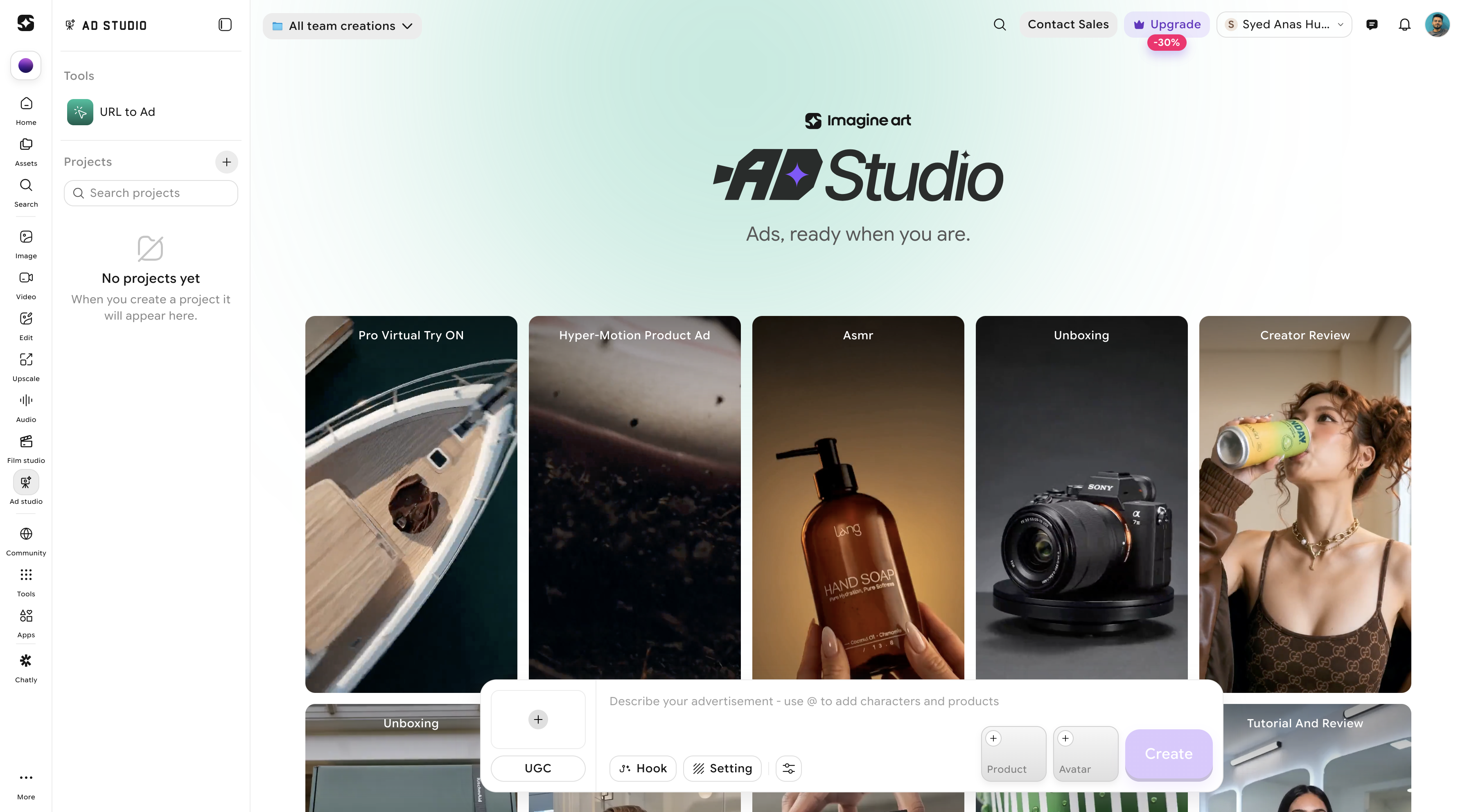
Adding a product in ImagineArt AI Ad Studio Paste a product URL from any Shopify, WooCommerce, Amazon, or DTC store and the studio pulls in your visuals automatically. No website yet? Upload your product images directly. Either way, you're ready to start generating in seconds.
Step 2 — Select a template and customise.
Pick the ad format that fits your campaign: UGC, Unboxing, Virtual Try-On, Hyper Motion, Review, or ASMR. Then set your creative direction — choose an avatar, write a hook, adjust the script, and pick a background. Full creative control, zero production overhead.
Step 3 — Generate and export.
Reviewing ad creative outputs in ImagineArt AI Ad Studio ImagineArt renders a complete, platform-ready video ad in minutes. Export directly to Meta, TikTok, YouTube, and Google — correctly sized and formatted, no post-processing needed. Run one session and walk away with 20–50 variants ready to test. The outcome: an all-in-one creative studio that takes you from product to published ad in minutes — without a shoot, a designer, or a production delay.
How to Choose the Right In-House Setup
| Your Situation | What You Need | ImagineArt Fit |
|---|---|---|
| Solo marketer, tight budget | Speed and iteration over polish | Generate volume without agency costs |
| Growing paid media programme | Consistency across formats at scale | Brief once, produce across every spec |
| High-volume, multi-channel campaigns | Fast refresh cycles, brand-consistent output | Ad Studio generates 20–50 platform-ready variants per session |
```
The question is not whether you need better ad creatives — every SaaS team does. The question is whether your current process produces them fast enough to test, learn, and improve. If it cannot, that is the problem ImagineArt solves.
Can You Build Better Ad Creatives Starting Today?
In this article, I covered what an ad creative actually is, how it differs from ad copy, what makes one perform, how to spot fatigue before it kills your budget, how to measure what is working, and how to build a proper in-house system using AI — without the agency overhead.
You do not need a retainer to produce great creatives at volume. You need the right workflow. Build it once, and it runs every campaign after that.
Frequently Asked Questions
An ad creative is every visual and written element a person sees when your ad appears — the image or video, the headline, the body copy, and the CTA button. All of it together is the creative. The creative is your ad. Everything else — targeting, bidding, placements — is infrastructure.
Ad creative is the full visual and written package — everything the viewer sees. Ad copy refers specifically to the text elements: headline, body text, and CTA wording. The creative stops the scroll. The copy closes the deal. Both work together but serve different functions.
The five main types are static image ads, video ads, carousel ads, native ads, and interactive or animated ads. Each format suits different campaign goals — static for direct-response, video for storytelling and demos, carousels for multi-message campaigns, native for engagement, and interactive for time-on-ad performance.
You build ad creatives in-house using an AI creative workflow. Tools like ImagineArt Workflows and AI Ads Studio let you generate multiple creative variations from a single brief or simply by uploading your product manually or through URL, resize for every platform automatically, and run a repeatable production pipeline — without a design team or agency retainer.
Syed Anas Hussain
Syed Anas Hussain is a computer scientist blending technical knowledge with marketing expertise and a growing passion for AI innovation. Curious by nature, he dives into new AI sciences and emerging trends to produce thoughtful, research-led content. At ImagineArt, he helps audiences make sense of AI and unlock its value through clear, practical storytelling.