
Tooba Siddiqui
July 30, 2026 • Updated July 30, 2026
21 mins Read
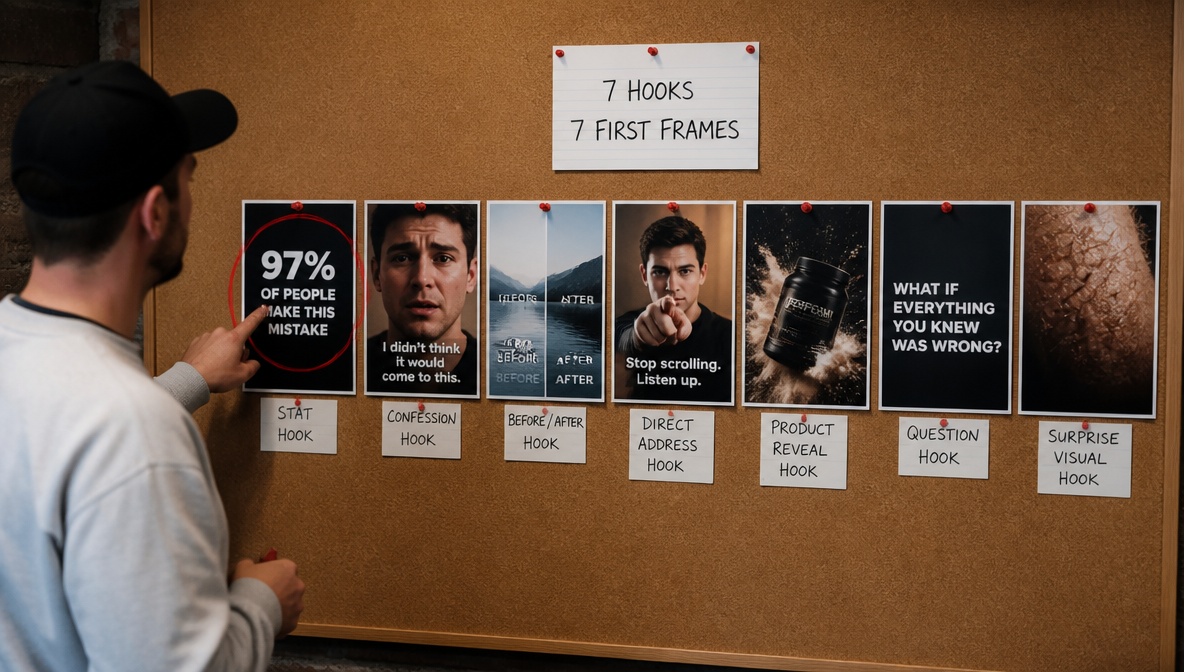
TikTok ad hooks are the first 1–3 seconds of a video ad — the moment that determines whether a viewer stops scrolling or keeps going. On TikTok, that decision happens faster than on any other platform. Meta's own research shows 71% of TikTok users decide whether to skip an ad within the first three seconds. No other social platform compresses the judgment window that tight.
This guide covers the eight best TikTok ad hook types, 30+ examples organized by type and vertical, a testing framework built for ecommerce brands, and how to brief creators so the hook actually lands.
What You Need to Know About TikTok Before Writing a Hook
TikTok is structurally different from every other platform where ads run. The feed is algorithmic rather than social. A viewer did not opt into your content the way a follower might. They are mid-scroll, already consuming content from creators they chose, and your ad enters that stream uninvited. The hook is not just the opening line of your ad. It is the entire reason the viewer does not leave.
The 3-Second Rule: Why TikTok Enforces It Harder Than Any Other Platform
Meta's own data shows 71% of TikTok users decide whether to scroll past an ad within the first three seconds — a higher threshold than Facebook (where most users give content 5–8 seconds) or YouTube (where the 5-second skip buffer still applies). The mechanism is different too. On YouTube, the skip button is a deliberate action. On TikTok, the scroll is reflexive. A viewer does not have to decide to leave. They have to decide to stay.
What this means: the first frame of your video is not a warm-up. It is the ad. If the hook lands in second two or three, a significant portion of your potential audience has already gone.
Sound-On Majority: How TikTok Changes the Hook Equation
Instagram and Facebook ads are built around a sound-off default. Facebook's own research found 85% of videos are watched without audio, which is why text overlays became standard practice. TikTok inverts that dynamic. TikTok's own creative team found 93% of TikTok videos are watched with sound on.
This changes how you write hooks. On Instagram, the text overlay carries most of the communication load. On TikTok, the spoken word matters. A strong hook needs to land both verbally and visually. The spoken line and the on-screen text should work together rather than one compensating for the other.
Why Native-Looking Ads Outperform Polished Ones on TikTok
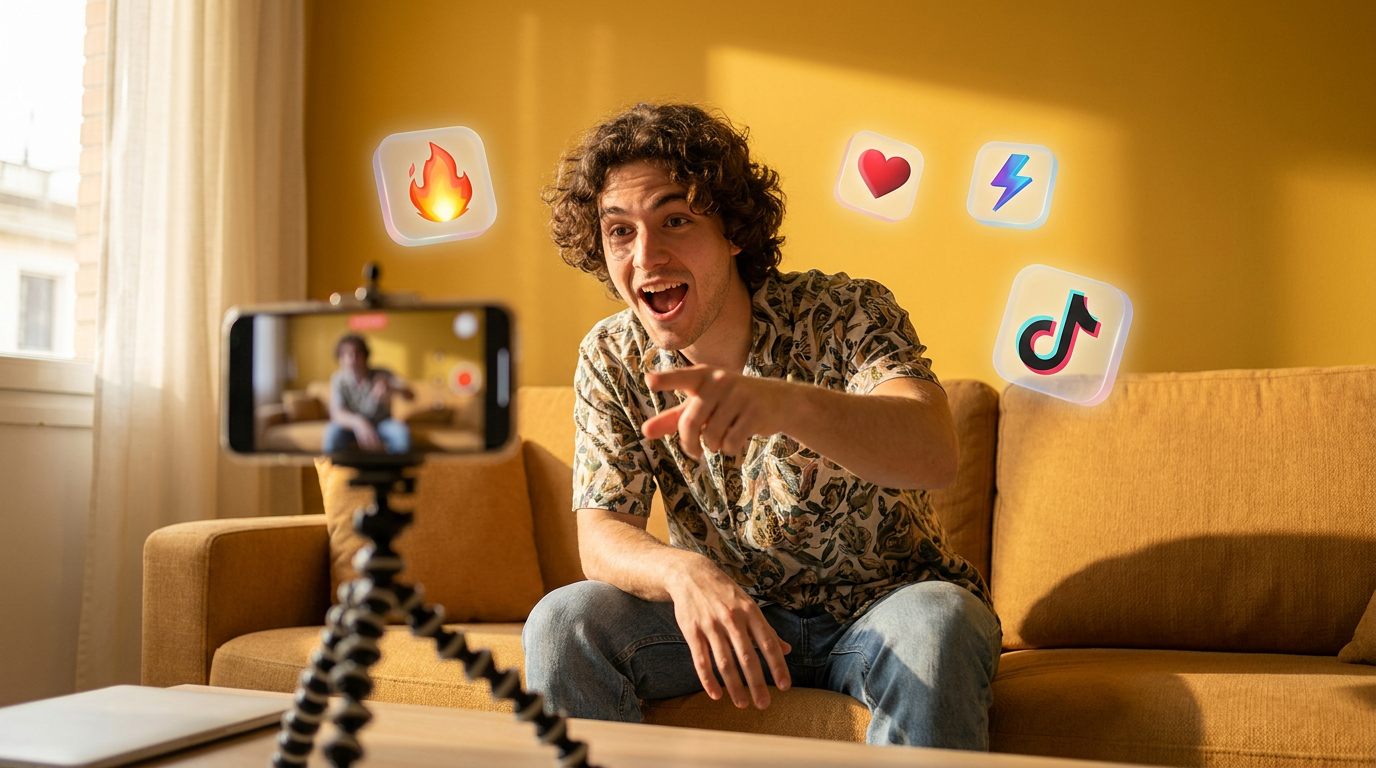
TikTok's internal creative effectiveness research found that ads matching the look and feel of organic TikTok content outperform polished, broadcast-style creative by a significant margin. The platform calls this "TikTok-first" creative. In practice: handheld camera movement, direct address, informal language, and visible creator context (a real environment, not a studio) all read as trustworthy to the TikTok audience.
The implication for hooks: a line that sounds scripted will lose before the first second ends. TikTok users have a fast-acting filter for ad language. Hooks that sound like a person talking to another person consistently outperform hooks that sound like copy. For AI tools purpose-built to produce TikTok-first creative, What Is the Best AI Video Generator for TikTok? covers the top options for 2026.
The 8 Best TikTok Ad Hook Types
Quick reference:
- Question Hook
- Problem-First Hook
- POV Hook
- Social Proof / UGC Hook
- Curiosity and Reveal Hook
- Demo-First Hook
- Bold Claim Hook
- Creator Recommendation Hook
For ready-made templates across all eight types — including AI video hook templates for visual execution — see Ad Hook Templates You Can Use Today.
1. Question Hook
A question hook opens by posing a direct question the viewer would answer yes to, or one that creates immediate self-identification. The goal is to make the viewer the subject of the ad before you have said anything about the product.
Why it works: Questions create an open loop. Research from behavioral economist Daniel Kahneman shows that an unanswered question holds more cognitive attention than a statement, which translates directly into scroll resistance.
Examples:
- "Are you still spending three hours editing one TikTok video?"
- "Why does everyone's skincare routine look exactly the same?"
- "What if your gym bag actually fit everything you need?"
- "Have you ever bought something because TikTok told you to?"
Template: "Are you still [the specific thing your product solves]?"
2. Problem-First Hook
The problem-first hook names the viewer's specific frustration before introducing anything about the product. It does not open with the solution. It opens with the pain point, stated plainly, in the language the customer would use to describe it themselves.
Why it works: The viewer recognizes themselves in the problem. Recognition creates attention. The more specific the problem, the stronger the hook. Generic pain points ("you're busy") land flat. Specific ones ("your foundation oxidizes by 2pm every day") land hard.
Examples:
- "My desk looked clean for exactly four minutes after organizing it."
- "Every meal prep container I've bought has leaked. Every single one."
- "Nobody told me my email list could be this expensive to maintain."
- "I was spending $400 a month on content creation and had nothing to show for it."
Template: "[Specific problem your customer experiences], stated as a first-person experience."
3. POV Hook
POV hooks place the viewer inside a scenario from the first frame, using "POV:" or a direct scene-setting opener. The format originated in organic TikTok storytelling and crossed into paid creative because it drops the formal distance between brand and viewer immediately.
Why it works: The viewer is not observing the ad. They are inside it. POV framing activates identification before the product has been shown, and it signals native content rather than branded advertising.
Examples:
- "POV: you found the one supplement that actually does what it says"
- "POV: your client asks where you got your content strategy"
- "POV: you finally stop rewatching tutorials and just start editing"
- "POV: the tool your competitor is using and not talking about"
Template: "POV: [the moment your product creates for the customer]"
4. Social Proof / UGC Hook
Social proof hooks open with validation from someone other than the brand — customer language, review references, or creator-led testimonials. The hook borrows credibility before the viewer has formed any opinion about the product.
Why it works: A 2023 Nielsen study found 88% of consumers trust peer recommendations over branded content. On TikTok, that preference is even more pronounced because the platform's identity is built around authentic creator content, not advertising.
Examples:
- "TikTok made me buy this. For once, it was worth it."
- "I saw this in 47 TikToks before I finally ordered it. Here's what happened."
- "My entire comment section asked me what I was using. It's this."
- "The number one selling product in its category and almost nobody knows why."
Template: "[Third-party signal] + [result or curiosity gap]"
For a full breakdown of AI-generated ad format options — product demos, unboxing, testimonial styles, and more — AI Ad Formats: UGC, Product Demos, Unboxing & More covers each format with platform-specific guidance.
5. Curiosity and Reveal Hook
The curiosity hook withholds information to create an open loop that holds the viewer through the first several seconds. It does not deliver the punchline in the hook. It creates the reason to watch for it.
Why it works: BJ Fogg's behavior model identifies curiosity as one of the most reliable motivators for continued action. On TikTok, where the scroll is the default, the curiosity hook gives the viewer a specific reason to override that default. The reveal must pay off — a weak payoff trains viewers to skip curiosity hooks from your brand going forward.
Examples:
- "I almost didn't post this because I was worried people would copy it."
- "There's a reason no one talks about this skincare step. I'm going to."
- "The editing trick I've been keeping to myself for two years."
- "This product fixed a problem I didn't know I had."
Template: "[Information withheld] + [implied reason to stay]"
6. Demo-First Hook
The demo-first hook skips the setup and opens directly with the product in action. No introduction, no context, no verbal setup. The first frame is the result, the transformation, or the product doing the thing it does.
Why it works: TikTok's own creative effectiveness research found that ads leading with the product outcome within the first two seconds outperform setup-led ads consistently. Demo-first hooks eliminate the lag between ad start and proof. The viewer sees the value before they have consciously registered they are watching an ad.
Examples:
- Opens with a 10-second time-lapse of a room going from messy to organized
- Opens with a skin texture close-up before and after
- Opens mid-edit showing a 3-hour video compressed to a 30-second clip
- Opens with the final plated meal, then cuts back to the raw ingredients
Template: Open on the result. Cut back to the process after the first 2 seconds.
ImagineArt's AI video generator can produce demo-first hook variations at scale without a full production shoot — useful when you need to test multiple product outcome framings before committing to one.
7. Bold Claim Hook
The bold claim hook opens with a direct, specific, verifiable statement about the product. It does not hedge. It does not qualify. It makes one claim and stakes the ad's credibility on it.
Why it works: Specificity signals confidence. A vague claim ("this product is amazing") reads as advertising. A specific claim ("this cut my editing time by 40%") reads as a real result. The more specific the number or outcome, the more the hook functions as a credibility signal rather than a marketing promise.
Examples:
- "This moisturizer reduced my pore size by 60% in two weeks. I have the before and after."
- "I switched to this tool and cut my video production time in half."
- "Three ingredients. One bowl. Fourteen grams of protein per serving."
- "This one ad format is generating 4x the ROAS of everything else I'm running."
Template: "[Specific measurable outcome] + [credibility anchor]"
8. Creator Recommendation Hook
The creator recommendation hook positions the ad as a personal endorsement from the person on camera, not a brand selling a product. The framing is "let me show you what I found" rather than "here is an advertisement."
Why it works: TikTok's 2023 marketing science study found creator-based ads generated 26% more brand recall than polished brand ads. The hook signals that the person speaking has personal stake in the recommendation, not a transactional one.
Examples:
- "I've been doing UGC content for two years and this is the only tool I keep coming back to."
- "My editor asked me to stop recommending this because now everyone uses it."
- "I test a lot of products. This one genuinely surprised me."
- "I need to talk about this before everyone else does."
Template: "[Creator personal framing] + [implied value or exclusivity]"
How to Write TikTok Ad Hooks That Convert
Knowing the eight hook types covers the structure. Writing a hook that actually converts — that holds attention long enough for the rest of the ad to close the sale — requires decisions about what goes inside that structure. The type sets the frame. Specificity, objective alignment, and channel awareness determine whether the hook lands.
Why Specificity Outperforms Cleverness
The most common mistake in TikTok ad hooks is prioritizing wit over specificity. A clever hook that could describe any product in your category has zero filtering function. It catches every viewer and pre-qualifies none of them.
The test: could this hook appear on an ad for a different product in the same category? If yes, it is not specific enough. "Tired of wasting time in the morning?" could sell 50 different products. "Tired of spending 20 minutes on a foundation that oxidizes before lunch?" sells one.
Specificity also works as a credibility signal on TikTok because the feed is full of vague, generalized ad language. A hook that uses the exact language your customer uses to describe their own problem reads as trustworthy before the viewer has consciously assessed why.
Matching Hook Type to TikTok Ad Objective
| Ad Objective | Best Hook Types |
|---|---|
| Awareness | Bold Claim, Curiosity, Demo-First |
| Consideration | Question, Problem-First, Creator Recommendation |
| Conversion / Purchase | Social Proof, Problem-First, Bold Claim |
| App Install | POV, Curiosity, Demo-First |
| Lead Generation | Question, Problem-First |
A hook written for awareness and served to a retargeting audience will underperform, not because the hook is weak, but because the hook type does not match what that viewer needs at that stage.
Writing for Sound-On and Sound-Off at the Same Time
Because TikTok skews sound-on (93%), it might seem safe to rely entirely on the spoken hook and skip the text overlay. That is a mistake for two reasons.
First, captions have trained TikTok users to read text overlays as a second layer of information, not a fallback for silent viewing. A video that uses text overlay effectively gets two communication channels in the same three seconds — spoken and written — working simultaneously.
Second, accessibility: viewers with hearing impairments, non-native speakers, and viewers who have lowered the volume all rely on overlays. Removing the overlay closes the ad to those viewers entirely.
The rule: the spoken line and the text overlay should not be identical. The spoken line delivers the hook. The overlay emphasizes one word, adds a data point, or creates visual contrast. Both channels working together outperform either one alone.
The First Frame Rule: What the Visual Must Do Before the Hook Lands
The first frame of your TikTok ad is not neutral. Every element in it — the person on camera, the background, the lighting, the motion — communicates before the hook line is heard or read. Viewers process visual context before spoken language.
What the first frame must do: signal relevance. A skincare ad that opens on a well-lit close-up of skin immediately communicates its category. A home organization ad that opens on a messy countertop sets the problem before the hook names it. The first frame and the hook should be doing the same job from two directions.
What breaks it: a clean, neutral, aesthetically pleasing first frame that communicates nothing specific. These frames look good in the editor preview. They underperform in the feed because they give the viewer no reason to hold before the hook begins.
You can generate on-brand first frame visuals for your TikTok ad hooks using ImagineArt's AI Ad Studio and for static first frame concepts, try ImagineArt AI image generator to test multiple visual treatments alongside hook variations.
TikTok Ad Hooks by Vertical
The eight hook types apply across every category. The language, specificity, and proof points change significantly by vertical. A bold claim hook for a skincare product sounds nothing like a bold claim hook for a SaaS tool.
Ecommerce and Product Brands
Ecommerce hooks on TikTok live or die on product proof. TikTok's own commerce data found 67% of users say the platform inspired them to make a purchase they had not planned. Hooks that show the product working, not just promise that it works, consistently outperform benefit-led copy.
Best hook types: Demo-First, Social Proof, Problem-First
- "This is why everyone is switching from [generic category] to this."
- "I ordered this skeptically. Here is what actually happened."
- "My packaging was falling apart until I found this."
- "TikTok Shop sent me this and I've used it every day since."
If your workflow starts at the product page rather than a creative brief, ImagineArt's guide on how to turn a product URL into a video ad covers the full AI-assisted production process from product link to TikTok-ready hook.
Beauty and Skincare
Beauty hooks on TikTok are dominated by transformation and specificity. Generic beauty claims have no stopping power. Hooks that name a specific skin concern, a specific product the viewer has already tried and failed with, or a specific visible result consistently outperform.
Best hook types: Demo-First, Problem-First, Bold Claim
- "My skin was doing this [shows close-up texture] until I changed one thing."
- "I've tried 14 vitamin C serums. This is the only one that didn't oxidize."
- "Your SPF is the reason your foundation is pilling. Here's the fix."
- "This fragrance-free moisturizer cleared my closed comedones in 11 days."
Before/after hook visuals for skincare can be prepared and refined using ImagineArt's AI image editor before they go into the video production pipeline
Fashion
Fashion hooks on TikTok succeed when they create social context — not just "this is a nice piece" but where it was worn, what it communicates, and why the viewer does not have it yet. The TikTok fashion audience responds to styling authority and to discovery framing.
Best hook types: Creator Recommendation, POV, Curiosity
- "I found the one pair of wide-leg trousers that actually fits a short torso."
- "POV: you finally crack the formula for looking put-together without trying"
- "This brand is about to be everywhere and almost nobody knows it yet."
- "Three ways I'm styling this that the brand's own page hasn't shown."
SaaS and Apps
SaaS hooks on TikTok need to make abstract value concrete in the first two seconds. "This tool will save you time" does not convert. "This tool cut my client reporting from four hours to 20 minutes" does. The hook must translate the software's output into a visible, relatable outcome.
Best hook types: Bold Claim, POV, Demo-First
- "I run a six-figure agency and this is the only tool I couldn't remove from my stack."
- "POV: you stop doing manually what your software should be doing for you"
- "This took me from 3 hours of video editing to 25 minutes. I'm going to show you."
- "The AI tool my clients keep asking about. I'll explain exactly what it does."
Service Businesses
Service business hooks must establish credibility and result before the viewer has any reason to trust the person on screen. Unlike product brands, there is nothing to demo in the first frame. The hook carries the entire weight of interest by leading with a specific, tangible outcome.
Best hook types: Bold Claim, Question, Creator Recommendation
- "My client went from 400 to 22,000 followers in 90 days. Here is exactly what changed."
- "Are you still charging per hour? Let me show you what that's costing you."
- "I run paid ads for ecommerce brands. This is the one change that moved ROAS the most."
- "The discovery call script that closed 80% of my leads last quarter."
How to Brief a UGC Creator on Hook Execution
Most TikTok ad hook failures at the UGC level are briefing failures, not creative failures. The creator does not write a weak hook because they lack the skill. They write a weak hook because the brief told them what the product does and asked them to be authentic, without specifying what the first three seconds must accomplish.
A hook brief for a UGC creator needs three things:
- The hook type. Tell the creator which of the eight types you are running. Do not leave this as a creative decision. "Open with a problem-first hook using this specific language: [line]" is a direction. "Be authentic and show us what you love about the product" is not.
- The exact line or a tight set of approved variations. Provide either the scripted hook line or two to three approved options. Creators have latitude in delivery, pacing, and environment. The hook line is not one of the variables. Give the creator room to make the delivery feel natural. Do not give them room to rewrite a different hook.
- The first frame description. Specify what should be visible in the first frame before the creator starts speaking. If the hook is problem-first, the first frame should visually establish the problem. If the hook is demo-first, the first frame should be the product in use. Without this instruction, creators default to facing the camera in a neutral environment.
One additional note: brief the hook separately from the body of the ad. Most UGC briefs cover the entire video in one document. Creators read it once, try to hold everything in mind, and under-execute on the hook because it is listed alongside seven other requirements. A one-paragraph hook brief, delivered as a separate document, produces stronger hooks than the same information buried in a full creative brief.
For a complete scripting and production system — including content pillars, script frameworks, avatar strategy, and the full testing loop — the AI UGC Content Creation Playbook covers the full pipeline from brief to scaled campaign.
How to Test TikTok Ad Hooks the Right Way
Most ad accounts test hooks by writing several variations of the same line — version A versus version B of the same hook type with slightly different wording. This is the least efficient testing structure available. Wording variation within the same hook type tells you which line performed better in one week of data. It does not tell you which structural approach resonates with your audience.
Why Hook Type Variation Outperforms Line Variation
Testing a question hook against a problem-first hook against a social proof hook in the same campaign gives you directional data on what your audience responds to structurally. That data scales. Once you know your audience converts from problem-first hooks more than from question hooks, every creative iteration built inside that type starts from a stronger foundation.
Testing "Are you still wasting time on X?" against "Are you still wasting money on X?" tells you one word worked better in one week. That finding does not transfer to the next creative cycle.
The practical framework: run three to four hook type variations in the first test cycle. After two weeks, identify the type with the best hook hold rate — the percentage of viewers who watch past the three-second mark. Build out that type with five to six line variations in cycle two.
A Practical Test Set for One Ecommerce Product
For a single ecommerce product, a clean first test cycle looks like this:
- Ad 1: Problem-first hook — states the customer's specific frustration in first-person
- Ad 2: Demo-first hook — opens on the product result in the first frame
- Ad 3: Social proof hook — opens with a customer line or review reference
- Ad 4: Bold claim hook — opens with one specific, measurable outcome
Same body copy, same CTA, same product. Only the hook varies. After 1,000 impressions per variant, hook hold rate and cost per click will show which structure your audience responds to.
For a broader view of hook testing across all video platforms — including a quick-reference framework by use case — Best Hooks for Video Ads in 2026 covers the full landscape with platform-specific guidance.
ImagineArt's AI video editor can cut multiple hook variations from the same creator footage — making it practical to run all four hook type tests without four separate shoots.
When to Retire a Hook
Hook fatigue on TikTok moves faster than on other platforms. The same users are served ads repeatedly within a short window, and a hook that performs well in week one will show declining metrics in weeks three to four.
The signal to watch is not CTR in isolation. It is the combination of declining hook hold rate and rising CPM. When the algorithm has to work harder to find new viewers who will respond to the hook (rising CPM) and those viewers are engaging less in the first three seconds (declining hold rate), the hook has reached its effective audience.
A two-week refresh cycle is a reasonable default for ecommerce brands running daily budgets above $500. For lower-spend accounts, four weeks is more appropriate. When you retire a hook, replace it with a new type variation, not a new line variation — that resets performance faster.
TikTok Ad Hooks vs Instagram Ad Hooks
The mechanics of a strong hook are the same on both platforms: specific language, a clear targeting signal, an open loop that holds attention. The execution differs in almost every practical respect.
| Factor | TikTok | |
|---|---|---|
| Audio default | Sound-on (93%) | Sound-off (85%) |
| Primary hook channel | Spoken line + text overlay | Text overlay leads |
| Creative style | Native, informal, creator-led | Visual-first, polish rewarded |
| Scroll speed | Faster — full-screen vertical feed | Slower — thumbnail competes |
| Hook window | 3 seconds | 3–5 seconds |
| What stops the scroll | Motion, face, spoken hook | Static visual, text contrast |
The most common mistake when adapting Instagram ad hooks to TikTok is treating the text overlay as the primary communication channel. On Instagram, the overlay often does most of the work because sound is off. Moving that creative to TikTok without rewriting the hook for spoken-word-first leaves the audio channel unused while competing against creators who are using it.
Adapting in the other direction — TikTok to Instagram — requires the opposite adjustment. A hook that works because of a creator's vocal delivery and direct camera address often loses its effect when the audio is removed and only the text overlay remains.
For a full breakdown of Instagram-specific hook strategy, including how the visual-hook relationship determines click-through rate and the primary metrics to track, see how to write Instagram ad hooks that drive clicks.
Frequently Asked Questions
What is a TikTok ad hook?
A TikTok ad hook is the opening 1–3 seconds of a video ad — the line, visual, or combination of both that determines whether a viewer stops scrolling or moves on. Because 71% of TikTok users decide within three seconds whether to keep watching, the hook is the single highest-leverage element of any TikTok ad.
How long should a TikTok ad hook be?
A TikTok ad hook should land within the first three seconds. The spoken hook line itself is typically one sentence — 8 to 12 words. Text overlays that accompany it should be shorter: three to seven words that reinforce the spoken line without repeating it.
What are the best TikTok hooks for ecommerce?
The highest-performing hook types for ecommerce brands are demo-first, problem-first, and social proof hooks. Demo-first hooks work because they show the product result before the viewer has formed any resistance. Problem-first hooks work because they open on the customer's frustration rather than the product's features. Social proof hooks work because TikTok's audience trusts peer recommendation significantly more than branded advertising.
How do I write a TikTok hook for a product?
Start with the specific problem your product solves, stated in the language your customer uses to describe it — not marketing language. Test that against a demo-first version that shows the product result in the first frame. The best TikTok product hooks make the viewer the subject of the first sentence, not the product.
How many TikTok ad hooks should I test at once?
Test three to four hook types in the first cycle — not three to four variations of the same type. Type variation (question vs. problem-first vs. social proof) generates more useful data than wording variation. After identifying the type with the best hook hold rate, expand to five to six line variations within that type in the second cycle.
What makes a TikTok hook feel native?
A native TikTok hook uses informal, conversational language, avoids ad-specific phrasing ("limited time," "click below," "introducing"), and opens as if a real person is starting a conversation rather than a brand beginning a pitch. TikTok's own research found creator-led, native-style creative generates 26% more brand recall than polished brand ads.
How often should I refresh TikTok ad hooks?
For ecommerce brands spending above $500 per day, a two-week hook refresh cycle is a practical default. Watch for declining hook hold rate combined with rising CPM — when both move in the wrong direction simultaneously, the hook has saturated its effective audience. Replace it with a new hook type rather than a new line variation.
Tooba Siddiqui
Tooba Siddiqui is a content marketer with a strong focus on AI trends and product innovation. She explores generative AI with a keen eye. At ImagineArt, she develops marketing content that translates cutting-edge innovation into engaging, search-driven narratives for the right audience.