
Syed Anas Hussain
April 20, 2026 • Updated June 10, 2026
9 mins Read
Ad fatigue is not a creative failure. It is a predictable outcome of running performance marketing at scale. Every ad will fatigue eventually. The question is not whether yours will. It is whether you have fresh creative ready when it does — or whether you are scrambling to catch up after performance has already collapsed.
How to Handle Ad Fatigue and Refresh Ad Creative
You handle ad fatigue by spotting the early warning signals before performance drops, identifying which type of fatigue you are dealing with, and refreshing the right creative elements at the right cadence — without blowing up the campaign momentum you have already built.
That is the short answer. But if you really want to understand how to handle ad fatigue and refresh ad creative properly — what causes it, how to diagnose it, and how to build a system that stays ahead of it — this article covers all of it.
What Is Ad Fatigue — And Why It Is Getting Worse
Ad fatigue happens when your audience sees the same creative too many times. Engagement drops. The algorithm reads that as a signal that your ad is no longer relevant. It starts downranking your delivery. Your CPM rises. Your reach shrinks. Your CPA climbs — sometimes without you even noticing why.
It is not just a behavioral problem. It is a technical one. Every time someone scrolls past your ad without engaging, they are actively training the algorithm to show it to fewer people.
And in 2026, it is happening faster than it used to. Here is why:
- Advantage+ and broad targeting deliver ads to more people, more quickly — which means creatives burn through their audience faster than older targeting set-ups allowed
- Users see 5,000 to 10,000 ads per day — the bar to stop a scroll is higher than ever, and the tolerance for repetition is lower
- Meta's Andromeda algorithm punishes repeated same-creative exposure more aggressively than previous systems — creative diversity is now a ranking signal, not just a best practice
Fatigue used to creep in over months. Now it can hit in days on high-spend campaigns.
The 3 Types of Ad Fatigue
Most teams only address one type and wonder why performance does not fully recover. Here is how to tell them apart.
Creative fatigue
The same visual and copy has been seen too many times. The audience recognises it before it finishes loading. Fix: refresh the creative elements — hook, visual, or copy.
Audience fatigue
The same audience has been overexposed to your brand across multiple campaigns. Even with different creatives, the brand itself has become noise. Fix: expand your audience pool, introduce exclusions, or pause that segment and let it rest.
Offer fatigue
The value proposition has been repeated so often it no longer feels compelling. "50% off" stops triggering urgency when someone has seen it forty times. Fix: rotate the angle — not the design. Shift from discount-led to benefit-led, or from urgency to social proof.
Diagnose which type you are dealing with before you decide what to change. Swapping visuals will not fix offer fatigue. Rotating copy will not fix audience fatigue.
How to Spot Ad Fatigue Before Performance Collapses
The data almost always shows signs of fatigue before performance fully breaks. Watch these signals:
| Signal | What It Means | When to Act |
|---|---|---|
| CTR drops 20%+ below 7-day baseline | Hook or creative losing impact | Act immediately |
| CPA rises 15–20% without budget changes | Full creative fatigue setting in | Within 48 hours |
| Frequency crosses 3.0 to 4.0 | Audience overexposed | Plan refresh now |
| Hold rate drops 25%+ | Ad body losing viewers mid-watch | Refresh hook first |
| Negative comments increasing | Audience annoyance building | Act before algorithm throttles |
| CPM rising without spend changes | Algorithm deprioritising delivery | Refresh creative, not bids |
One important distinction: do not confuse learning phase volatility with fatigue. New campaigns fluctuate in the first 5 to 7 days — that is normal algorithm behavior, not a signal to refresh. Fatigue shows up as a sustained pattern across multiple days, not a single bad session.
How to Refresh Ad Creative Without Blowing Up Your Campaign
Here is where most teams get it wrong. When they see fatigue signals, they kill everything and start over. That resets the learning phase, loses the performance history the algorithm has built, and often makes results worse before they get better.
The right approach is to evolve, not replace.
Refresh the Hook First
Hooks fatigue faster than any other creative element. They carry the full weight of the first impression, and users see them on every single impression. Swapping just the first 3 seconds of a video — or the opening line of a static ad — is often enough to reset attention without touching anything else.
Change the hook. Keep the body and CTA that are already working.
Rotate the Angle, Not Just the Design
Changing colors and layouts only delays the problem. What actually resets how your ad registers in a viewer's mind is changing the reason they should care.
Test different angles around the same product:
- Benefit-first: "Get 3 hours back every day"
- Problem-first: "Still spending hours on manual reports?"
- Social proof: "Over 50,000 teams already switched"
- Urgency: "Offer ends Friday"
Same product. Completely different frame. The audience experiences it as a different ad.
Build Modular Creative
Stop building ads as fixed, finished pieces. Build them as components.
Break every ad into three layers:
- Hook — the first 3 seconds or opening line
- Body — the proof, story, or demonstration
- CTA — the action prompt
Create 3 to 5 versions of each layer. Mix and match. Three hooks, four visuals, and three CTAs gives you 36 unique combinations from just nine core assets. Structured variation extends creative lifespan without requiring full production every refresh cycle.
Follow a Spend-Based Refresh Cadence
There is no universal refresh schedule. But spend level is the best proxy for how fast your creative will fatigue.
| Daily Spend | Refresh Cadence |
|---|---|
| Under $1,000/day | Every 7 to 10 days |
| $1,000 to $5,000/day | Every 5 to 7 days |
| Above $5,000/day | Every 3 to 5 days |
Do not wait for performance to drop before you refresh. Have the next batch ready before the current one fatigues. That is what keeps campaigns running without gaps.
How to Use ImagineArt AI Ad Studio to Refresh Ad Creative at Speed
The biggest problem with creative refresh is not strategy. It is production speed. If your ad fatigues in 4 days but takes 5 days to produce a replacement, you are always behind. You are reacting to crashes instead of preventing them.
ImagineArt AI Ad Studio solves this. Your product URL is already in the studio, your templates are already chosen — a refresh is one session, not a production cycle. Fresh variations are ready before you need them, not after performance has already dropped.
Here is how to use it in three steps:
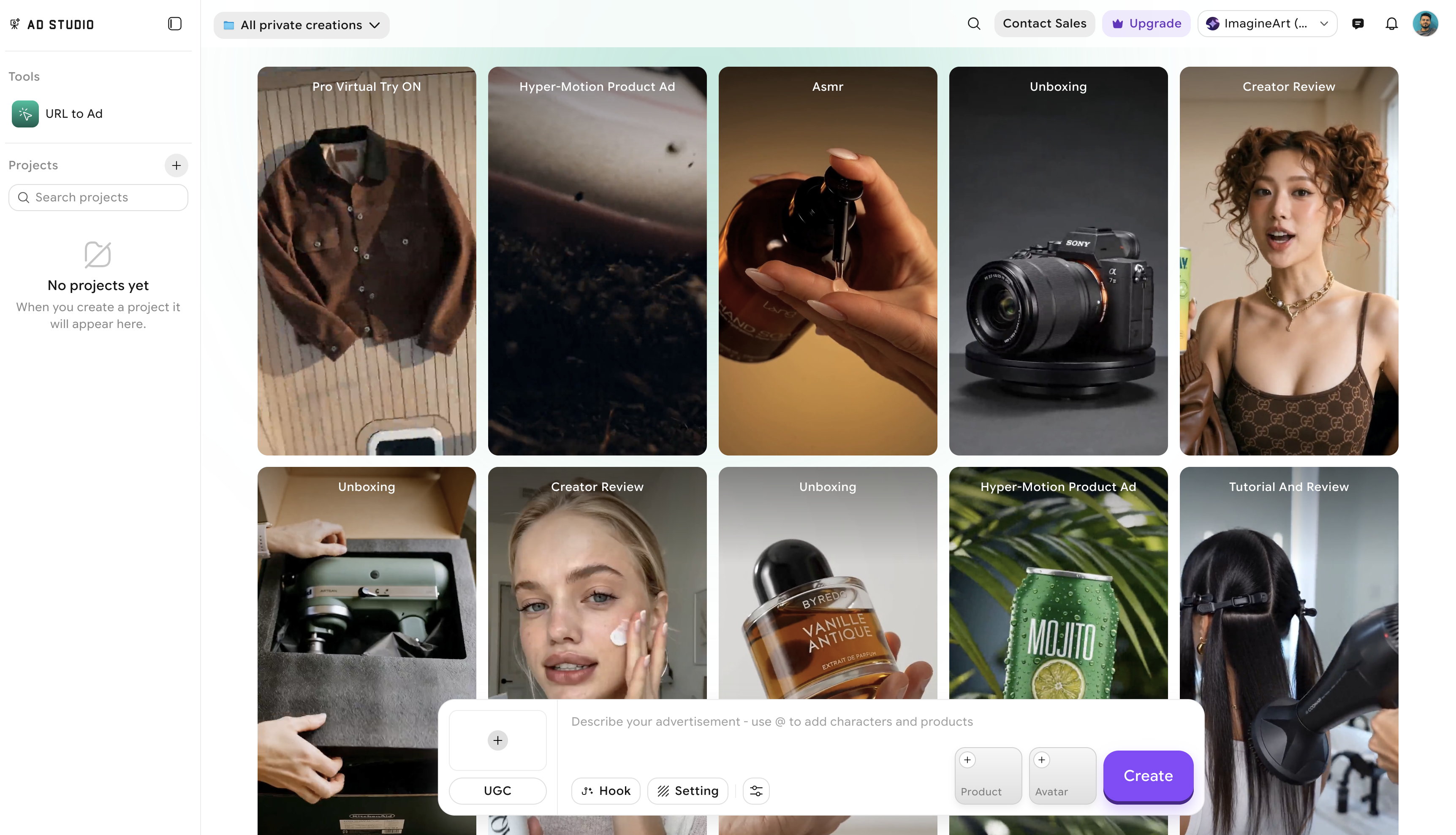
Step 1 — Open your product in Ad Studio and target the fatigued element. Your fatigue diagnosis tells you exactly what to regenerate. Hook rate dropped? You are rewriting the opening, nothing else. The angle wore out? You are changing the script direction. A format is dying on one platform? You are switching templates. Go into Ad Studio knowing which single layer you are refreshing — the product, body, and proven structure stay untouched.
Step 2 — Generate the replacement variants in one session. Set the new hook, swap the avatar, or adjust the script in the customization step, then generate. A single session produces 20–50 variants across hooks, avatars, and formats — enough to refresh the fatigued ad and stock several backups in the same sitting. Every export comes platform-ready for Meta, TikTok, and YouTube, so there is no resizing delay between generation and launch.
Step 3 — Build a reserve bank before fatigue hits. Do not wait for the crash. Run a refresh session on your spend-based cadence and keep pre-generated replacements ready. When the fatigue signals appear, you toggle off the tired creative and toggle on the replacement that is already sitting in your account. No scramble. No learning phase reset. No gap in delivery.
Recommended read: How to Do Ad Creative Analysis in 2026
What Not to Do When Ad Fatigue Hits
Knowing what to avoid is as important as knowing what to do.
Do not kill the whole campaign.
Fatigue is almost never a reason to pause everything. Identify the fatigued creative and swap it out. Keep the campaign structure, the audience data, and the algorithm momentum intact.
Do not over-refresh.
Constantly swapping creatives creates instability. The algorithm cannot optimise what keeps changing. Introduce new variants in small batches — not all at once.
Do not only change the visual.
Copy wears out faster than most teams realise. The hook line — the first words a user reads — fatigues before the image does. If you are only changing images and performance is not recovering, the copy is the problem.
Do not confuse every performance dip with fatigue.
Check audience size, frequency caps, and targeting before assuming the creative is causing the drop. A small audience with heavy spend will show fatigue signals even with excellent creative. Sometimes the fix is audience expansion, not a new ad.
Do not refresh based on a calendar.
Refresh when signals appear — not because two weeks have passed. Some creatives run for six weeks without issue. Others fatigue in four days. Let your data decide the timing, not a schedule.
Can You Handle Ad Fatigue Now?
Ad fatigue stops being a crisis the moment you stop treating it as one. Build the refresh pipeline. Set your cadence. Let the data tell you when to act. The teams winning on paid media right now are not the ones with the best single ad. They are the ones whose next ad is already waiting.
Recommended read: What Is the Best Place for Scalable Ad Creative in 2026?
Frequently Asked Questions
Ad fatigue happens when your audience has seen the same creative too many times. Engagement drops, the algorithm interprets this as poor performance, and your CPM rises while reach shrinks. In 2026, fatigue happens faster than ever due to broad targeting systems and users seeing thousands of ads per day.
Watch for CTR dropping 20% or more below your 7-day baseline, CPA rising 15–20% without budget changes, frequency crossing 3.0 to 4.0, hold rate dropping 25% or more, or negative sentiment increasing in comments. These signals usually appear before performance fully collapses — act on them early.
Evolve the creative, do not replace it entirely. Start by swapping just the hook — the first 3 seconds of video or the opening line of a static ad. Keep the body and CTA that are already working. Killing the whole campaign resets algorithm learning and usually makes performance worse before it gets better.
Refresh cadence depends on daily spend. Under $1,000/day: every 7 to 10 days. $1,000 to $5,000/day: every 5 to 7 days. Above $5,000/day: every 3 to 5 days. Do not wait for performance to drop — have the next batch ready before the current creative fatigues.
Syed Anas Hussain
Syed Anas Hussain is a computer scientist blending technical knowledge with marketing expertise and a growing passion for AI innovation. Curious by nature, he dives into new AI sciences and emerging trends to produce thoughtful, research-led content. At ImagineArt, he helps audiences make sense of AI and unlock its value through clear, practical storytelling.