
Syed Anas Hussain
June 16, 2026 • Updated June 16, 2026
13 mins Read
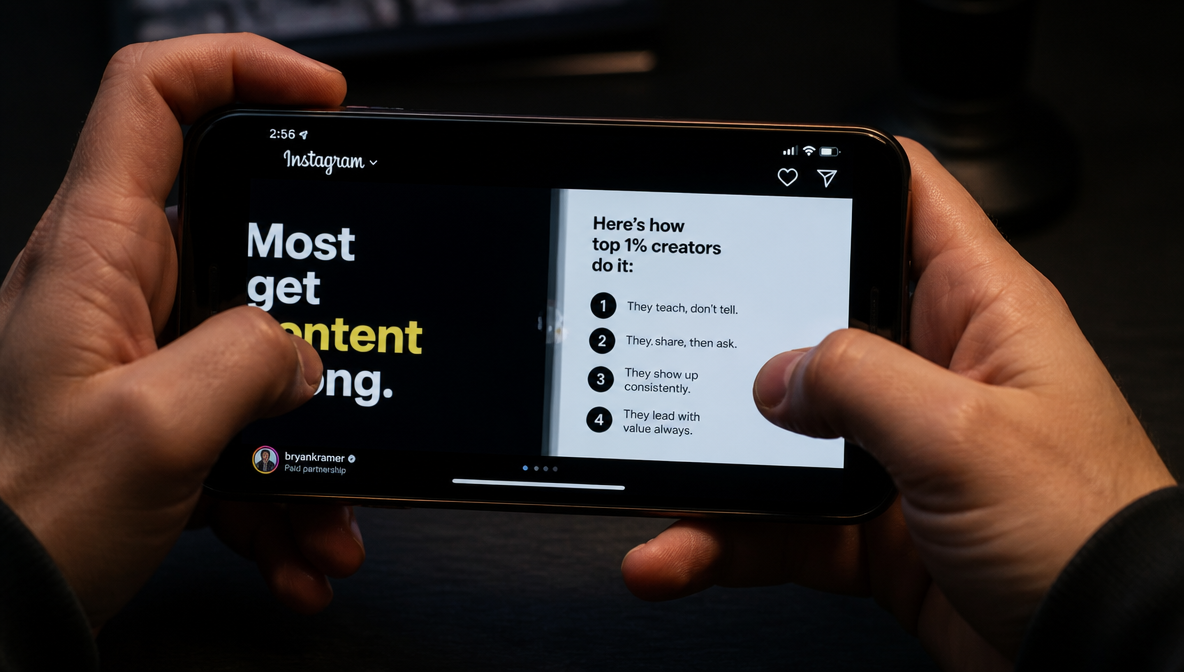
Instagram carousel posts get 1.9× more reach than single-image posts. LinkedIn carousels average a 21.77% median engagement rate — the highest of any format on the platform. The format works. What doesn’t work is the hook. Most carousels die on slide one because the opening line gives viewers no reason to swipe. These 15 carousel hooks change that — each one built on a specific psychological trigger, with ready-to-use copy templates and visual tips for making slide one impossible to scroll past.
Why Your First Slide Is Killing Your Carousel
A carousel hook is the headline copy and visual on slide one of a social media carousel post that compels viewers to swipe to the next slide. It works by opening a psychological gap — a question, a fear, a promised outcome — that the viewer needs to resolve. The swipe is the resolution.
The first slide carries approximately 80% of a carousel’s total performance weight. If slide one doesn’t earn the swipe, the rest of the content is irrelevant.
What the data says in 2026:
- Carousels with a strong hook on slide one get 3× more swipe-throughs than those without
- Engagement drops after slide 3 but recovers strongly at slide 8+, meaning the hook must set up momentum for the middle slides
- Optimal carousel length: 8–10 slides — enough to deliver value, tight enough to retain attention
The hook isn’t just copywriting. The visual — contrast, text size, color, and image — contributes to the scroll-stop before anyone reads a single word. If you're unsure how to measure whether your hook is actually working, Hook Rate vs Hold Rate explains the difference and which metric matters most at each stage of your ad.
The 6 Psychological Triggers Behind Every Great Carousel Hook
Every best carousel hook activates one of six psychological states. To write a carousel hook that keeps people swiping, match the emotional trigger to your content type first — then apply the corresponding formula.
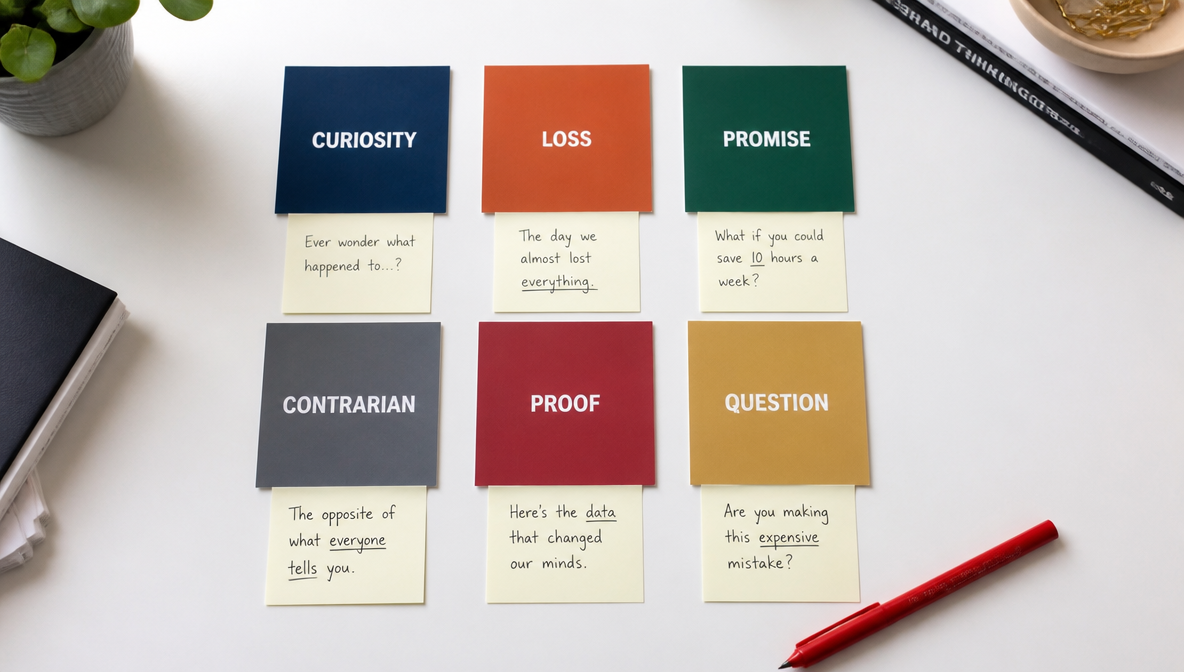
| Trigger | The Feeling It Creates | Best For |
|---|---|---|
| Curiosity Gap | I need to know how this ends | Tips, frameworks, numbered lists |
| Mistake/Loss | I might be doing this wrong | How-to guides, common error posts |
| Specific Promise | This will help me achieve X | Productivity, business, growth |
| Contrarian Take | Wait — I’ve been wrong about this | Thought leadership, education |
| Social Proof | If it worked for them, it can work for me | Case studies, results posts |
| Open Question | I want to know the answer | Opinion, debate, interactive content |
Each of the 15 hooks below maps to one trigger. When you know the emotional state you want to create, the hook writes itself. To see these triggers applied to real ads across formats, 20 Advertising Hook Examples That Actually Convert breaks down what each one looks like in production.
15 Best Carousel Hooks That Keep People Swiping
Curiosity Gap Hooks
Hook 1: The Numbered Tease
“5 things top creators do differently — #3 will change how you post forever.”
The list promises specific value. Calling out one item forces the swipe. Keep the callout specific and earned — don’t promise “life-changing” without the content to back it up.
Hook 2: The Cliffhanger Opener
“I lost 40% of my audience doing this. Here’s what I changed.”
Opens a story mid-consequence. The reader doesn’t know what “this” is, which creates immediate tension. Performs consistently on Instagram, LinkedIn, and TikTok.
Hook 3: The Partial Reveal
“The carousel formula that grew my account 0 → 50K. Slide 2 starts with the most important step.”
Signals that the best content is one swipe away. Specificity (0 → 50K) builds credibility before the reader has seen anything else.
Mistake / Loss Hooks
Hook 4: The Direct Callout
“Most creators are writing their first slide completely wrong.”
“Most creators” creates both relatability and mild threat. The viewer wonders if they’re in the majority being criticized. Works because it’s direct — no softening, no preamble.
Hook 5: The Costly Mistake
“Stop using this carousel format. It’s actively killing your reach.”
“Stop” is one of the most effective scroll-stopping words in social copy. The consequence is concrete enough to feel urgent.
Hook 6: The Metric Warning
“If your swipe rate is under 30%, you have a slide 1 problem. Here’s how to fix it.”
Anchors to a measurable benchmark. If the reader doesn’t know their swipe rate, they’ll keep reading to learn what it should be. If they do and it’s below 30%, they’ll swipe for the fix.
Specific Promise Hooks
Hook 7: The Outcome-First Statement
“How I went from 200 to 14,000 followers in 90 days — only using carousels.”
Lead with the destination, not the method. Time frames (90 days) make the promise concrete and testable.
Hook 8: The Time-Bound Win
“5 carousel tweaks that saved me 6 hours a week of content creation.”
Time is the most universally relatable productivity metric. “Saved me X hours” consistently outperforms “improved results by X%.”
Hook 9: The Specificity Hook
“The exact carousel structure that gets 3× the saves of a standard post.”
“Exact” and “3×” both signal precision. Vague hooks lose to specific ones — always.
Contrarian Hooks
Hook 10: The Myth Buster
“Forget the 1,500-word caption. The shortest posts in my account outperform them 4 to 1.”
Challenges a widely held belief. Works when the claim is counterintuitive AND backed up in the slides.
Hook 11: The Unpopular Opinion
“Hot take: consistency is overrated. Here’s what actually moves the needle.”
“Hot take” signals disagreement and invites engagement. Works especially well on LinkedIn where professional debate has cultural currency.
Social Proof Hooks
Hook 12: The Case Study Tease
“How a coffee shop in Austin used carousels to add $12K/month in revenue. No ads.”
Specific details ($12K/month, Austin, no ads) signal a real story, not generic advice. Case study hooks require authentic specificity.
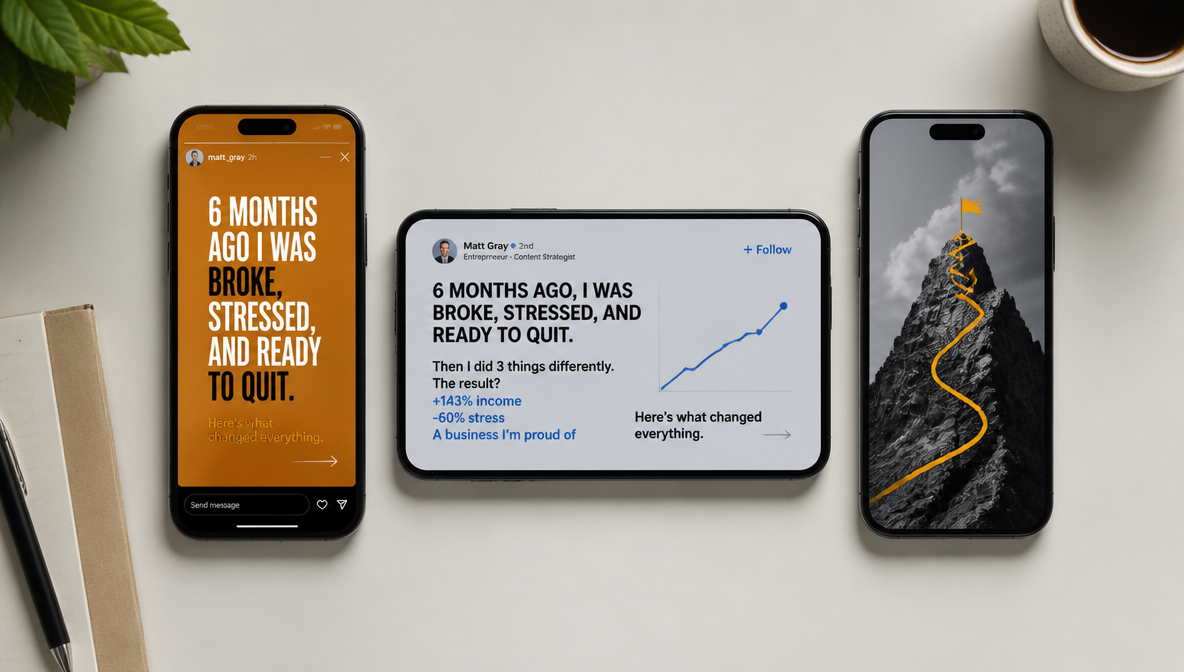
Hook 13: The Before/After Frame
“6 months ago, my carousels averaged 80 likes. Now they average 4,200. I changed one thing.”
Numbers + “one thing” = irresistible setup.
Open Question Hooks
Hook 14: The Direct Question
“What type of carousel content gets saved the most in 2026? The answer surprised us.”
Questions pull the reader into a dialogue. “The answer surprised us” adds a second curiosity layer.
Hook 15: The Challenge Hook
“Can you name the one element every viral carousel has in common? Most people can’t.”
Activates competitiveness. The reader doesn’t want to be in the “most people” group and will swipe to confirm or discover.
For hooks that work beyond the carousel format, the 50 Best Ad Hooks for Social Media Ads covers every major placement across Instagram, TikTok, and Facebook.
How to Create a Carousel Hook Slide That Stops the Scroll
Copy is half the equation. The visual on slide one determines whether someone pauses long enough to read it.
What makes a visual hook work:
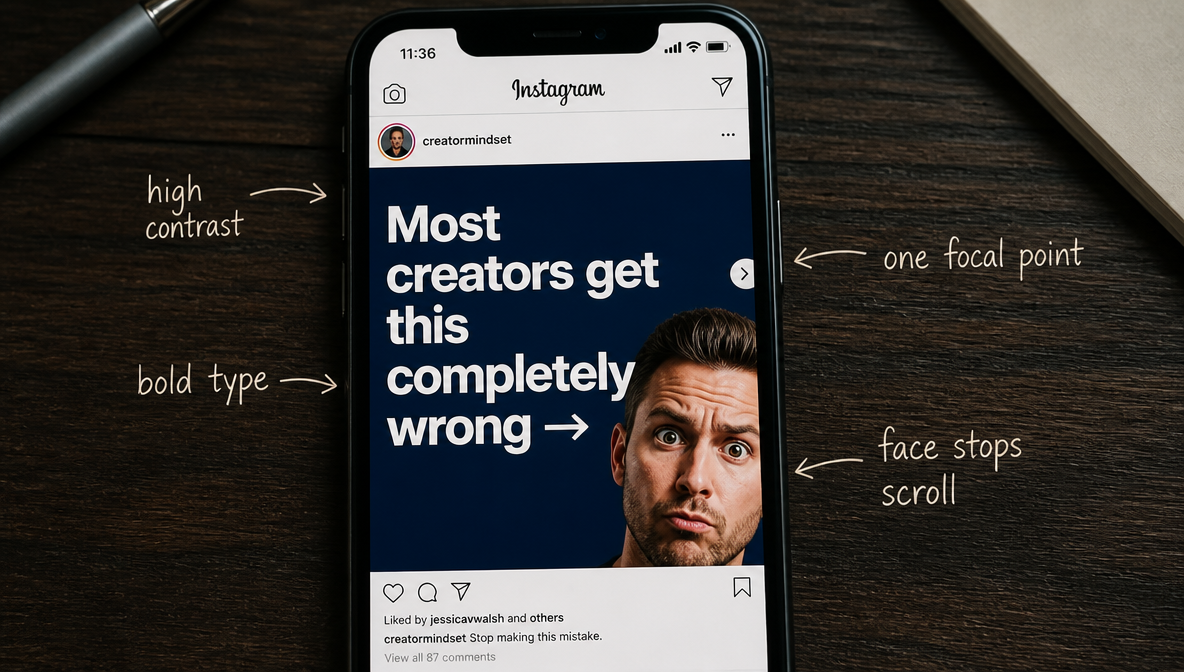
- High contrast: Stand out in a feed of muted, aesthetic content. Bright on dark, or dark on bright.
- One focal point: One image + one headline = maximum clarity. Don’t crowd the first slide.
- Expressive faces: Close-up faces attract more initial attention than landscapes or abstract graphics.
- Bold, legible typography: If the headline can’t be read at thumbnail size, resize or rewrite it.
ImagineArt’s AI image generator produces high-quality social media visuals in seconds — striking portraits, stylized product shots, or bold abstract backgrounds that make text pop. Generate hook slide images directly from a text prompt and export at carousel dimensions without manual resizing.
Quick win: Generate three visual variants of your first-slide concept in ImagineArt. Run the top two for 24 hours. The winner becomes your visual template for the next four carousels — building consistency while testing what actually hooks your audience.
For video ads running alongside your organic carousels, ImagineArt's AI Ad Studio ships with 20+ pre-built video hook templates built to stop the scroll in the first three seconds — see the full library in the section below.
Platform-Specific Carousel Hook Tips: Instagram vs LinkedIn vs TikTok
The best carousel hooks are adapted to the platform culture, not just copied across feeds.
Instagram: Personal stories, aesthetic visuals, and emotional resonance drive swipes. Curiosity gap and before/after hooks outperform here. First slide text: under 10 words, large typography, portrait format (1080×1350px).
LinkedIn: Professional audiences reward specific data points, counterintuitive insights, and industry-relevant mistake callouts. Contrarian and Mistake hooks earn the highest engagement. LinkedIn carousels average 21.77% median engagement rate in 2026 — the highest of any format on the platform.
TikTok: Fast-information formats, humor, and relatable observations work best. Keep slide one text minimal — the visual does most of the work.
Facebook Ads: For paid carousel formats, Specific Promise and Social Proof hooks convert best. A single stat or measurable outcome drives conversions better than curiosity hooks in paid contexts.
For a deeper look at what moves the needle specifically on Instagram, How to Write Instagram Ad Hooks That Drive Clicks covers copy, format, and creative structure in full.
AI Ad Studio Hooks: Pre-Built Video Hook Templates That Convert
Carousel hooks cover your organic content. When you're running paid video ads, the first three seconds are everything — and most brands waste them on a logo or a talking head. ImagineArt's AI Ad Studio comes loaded with 20+ pre-built video hook templates, each engineered around a specific psychological mechanism. Here's every template in the library, grouped by type. If you're running paid video alongside your organic carousels, see the full breakdown in Best Hooks for Video Ads in 2026 — every hook type tested and ranked.
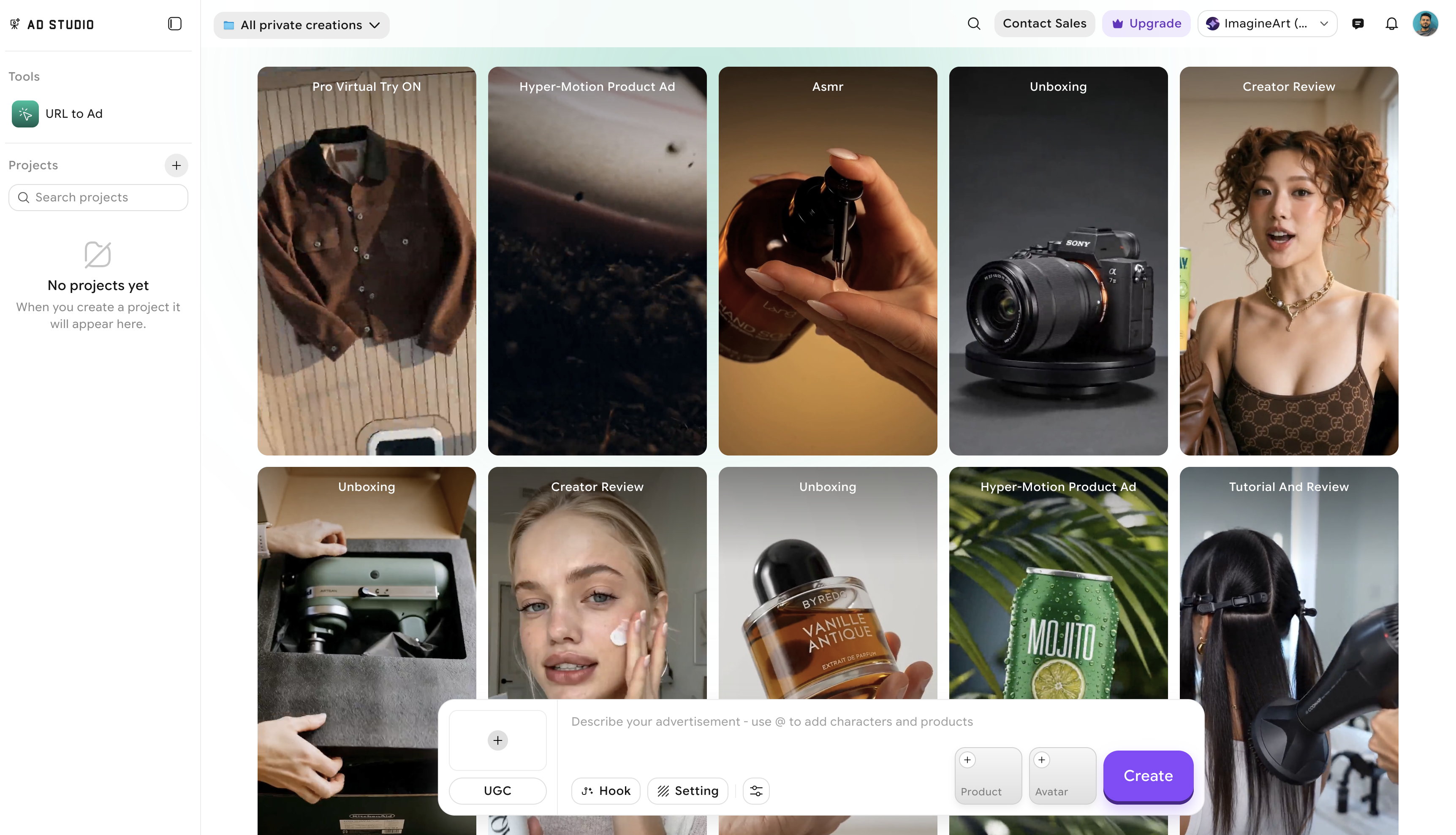
Physical Impact Hooks
Movement draws the eye before the brain registers it consciously. These hooks trigger the viewer's threat-detection instinct — something is happening to the person on screen — and attention locks in automatically.
- Product Hit — Object flies into frame, hits the subject. Brief reaction → pivot to product.
- Slap — Hand swings in and slaps the subject's cheek. Head jerks, snaps back to camera → hook line.
- Bird Hit — Avatar opens mouth to start talking — a bird flaps into frame and smacks their head. Quick flinch, "what the—" → avatar laughs, eases into casual product review.
- Product Bump — POV walk-in, camera taps avatar's forehead. Camera shakes. Brief "ow" + grin → product reveal.
Extreme Event Hooks
Scale the scenario to something impossible to look away from. These hooks create spectacle and resolve it with a product reveal.
- Buffalo Hit — A massive black bull charges from behind at full speed. At the last frame before impact, the avatar twists aside matador-style → hard cut to product review.
- Pendulum Swing — At a neon-lit carnival, a massive pendulum swings directly at the back of the avatar's head at terrifying speed. They don't flinch. It connects → hard cut to product review.
- Running Person — Static camera. Deep in the background, a runner sprints toward the lens at full speed, growing rapidly larger over 3 seconds. The reviewer stands still, eyes never leaving the camera. Just before collision → hard cut.
- Car Hit — Person walking on a road. A fast car approaches. Just before impact → hard cut to product review in a different setting.
- Ceiling Breaking — Static floor camera facing up. Without warning, the ceiling explodes and a female avatar crashes through holding the product. Dust settles. She reviews it casually.
Product Drama Hooks
The product becomes the protagonist. These hooks communicate durability, quality, or desirability through stress and spectacle.
- Blizzard — A cozy scene is suddenly hit by an impossible violent blizzard. Chaos fills the frame. When the storm clears, the product is still intact and working.
- Frozen Product — The product is frozen solid in a block of ice. Avatar uses an ice pick to break it free, removes the product, starts reviewing.
- Product Drop — Slow-mo product drop from above frame. Avatar dives in and catches it.
- Product Break — Avatar holds product up to camera, lowers it toward the surface — it cracks in slow motion on contact. Avatar recoils in dismay → hard speed-ramp into review.
- TNT Cracker — A lit firecracker is quietly tucked into the presenter's waistband. They stay completely calm reviewing the product for the entire video. The fuse fizzles out with no explosion. The unresolved tension is the hook.
Tension & Atmosphere Hooks
Something is wrong in the frame, and the presenter doesn't know it. The viewer is hooked on the unresolved threat.
- Scary Background Person — A clown slowly walks toward the main subject throughout the entire video. The presenter never notices.
- TV Glitch — Hundreds of TVs turn on simultaneously showing the model's face while she stands in the center holding the product.
Character & Dialogue Hooks
Natural, conversational entries that earn attention through relatability and surprise rather than shock.
- Random Object Mic — During a casual vlog, an absurd object is thrown at the presenter mid-sentence. They catch it, immediately use it as a microphone, and continue a completely serious product review without missing a beat.
- Interview — Avatar holds the product. An interviewer steps in, mic up — "got a sec?" → eyes drop to the product → "actually… what are you holding?" → avatar laughs, starts explaining.
Camera Technique Hooks
The shot itself is the hook — unconventional angles and reveals that feel raw and pull the viewer straight into the frame.
- Flip the Camera — Avatar walks holding the camera at high-angle overhead arm's length, pointing down at themselves — then flips to product reveal.
- Low Angle Shot — Video starts with the avatar's hand covering the camera. Low angle. Hand lifts to reveal.
- Camera Disruption — Avatar holds product at a high 3/4 angle, then reaches the other hand straight toward the lens and waves into the camera.
- Set Up Camera — Tight shot on avatar's torso as they place the camera down. The frame braces and drifts back as the avatar turns and steps away to reveal the full scene.
Put Your Hook in Front of the Right Audience
A great carousel hook earns the swipe. A great carousel hook paired with the right visual earns the save, the share, and the follow.
The gap between the two is usually the slide one image — and that's where most creators lose time they don't have. Searching stock libraries, briefing a designer, waiting on revisions. ImagineArt's AI Image Generator closes that gap: describe the visual you need for your hook slide, generate three or four variants in under a minute, pick the one that matches your hook's energy, and export at carousel dimensions. No designer, no stock search, no format-resizing after the fact.
For teams running paid carousels alongside organic, AI Ad Studio ships with 20+ pre-built video hook templates and handles static carousel creative production at the volume creative testing actually requires. The hooks in this guide are the strategy. ImagineArt is where they become production-ready assets.
Ready to Create Carousel Hooks?
Explore AI Ad Studio today and start generating carousel hooks that convert.
Frequently Asked Questions
A carousel hook is the copy and visual combination on slide one of a social media carousel that prompts viewers to swipe to the next slide. It works by opening a psychological gap — a curiosity, a fear, or a promised result — that only resolves when the viewer keeps scrolling. Without a strong hook, even excellent carousel content goes unseen.
The optimal carousel length is 8–10 slides in 2026. Engagement typically drops after slide 3 but recovers significantly at slide 8+, which means mid-carousel content needs to be strong enough to bridge the gap. Under 6 slides often feels thin; over 12 risks losing viewers before the CTA.
Contrarian and Mistake hooks perform best on LinkedIn because professional audiences respond strongly to counterintuitive claims and specific error callouts. Data-backed hooks — citing a specific percentage or benchmark — outperform emotional or curiosity hooks in professional contexts.
High contrast, one clear focal point, and large legible typography. Close-up faces outperform landscapes or abstract graphics. The visual should stop someone mid-scroll before they’ve read a single word. ImagineArt’s AI image generator makes it fast to create and test multiple visual variants for your hook slide.
The formula can transfer, but the tone and format should adapt. An Instagram hook can be emotional and personal; the same content on LinkedIn should be framed with data or professional stakes. Visual dimensions also differ — 1080×1350px for Instagram, 1:1 for LinkedIn, vertical for TikTok.
Build Carousels That People Can’t Stop Swiping
The 15 hooks above cover every major psychological trigger — curiosity, loss, promise, proof, contradiction, and question. Most creators use one or two instinctively. The creators whose carousels consistently outperform use all six deliberately, matching the hook type to the content goal before writing a word.
ImagineArt gives you the visual creation tools to match every formula. Generate scroll-stopping first-slide images, build carousels that keep your audience swiping across every platform — and when you're ready to scale with video ads, AI Ad Studio's hook templates are already built and waiting.
Syed Anas Hussain
Syed Anas Hussain is a computer scientist blending technical knowledge with marketing expertise and a growing passion for AI innovation. Curious by nature, he dives into new AI sciences and emerging trends to produce thoughtful, research-led content. At ImagineArt, he helps audiences make sense of AI and unlock its value through clear, practical storytelling.