
Syed Anas Hussain
June 17, 2026 • Updated June 17, 2026
12 mins Read
Most ads fail before the product appears on screen. Not because the offer is wrong or the copy is weak, because the first three seconds didn't earn the viewer's attention. Hook templates solve that. Today, we cover the full toolkit: seven proven copy-based hook formulas that work across every major platform, plus the complete library of AI-generated video hook templates from ImagineArt AI Ad Studio — the visual execution layer that turns a script into a scroll-stopping video ad.
If you want to go deeper on any specific platform or hook metric, these are the published blogs that cover each piece of the stack:
- Best Hooks for Video Ads in 2026 — hook types by platform, UGC hooks, what works on Meta vs TikTok vs YouTube vs LinkedIn
- Instagram Ad Hooks — platform-specific strategy for Reels and Feed placements, text overlay, muted-feed performance
- What Is Hook Rate? — how to measure hook performance, platform benchmarks, 3-second vs 2-second thresholds, YouTube View Rate
- Hook Rate vs Hold Rate — reading the downstream data once your hooks are live
- 20 Advertising Hook Examples That Actually Convert — real examples with performance data and psychological breakdowns
- 15 Best Carousel Hooks — the carousel-specific equivalent of this guide
What Makes a Hook Template Actually Work?
A hook template works when it opens a gap the viewer needs to close. That gap can be a question they want answered, a mistake they might be making, a result they want to achieve, or an event so unexpected their brain locks in before they decide to swipe.
The gap has to open in the first three seconds. In 2026, Meta's algorithm uses a 1.0-second early-retention signal to determine how much delivery your ad gets. TikTok's scroll velocity has roughly doubled since 2023. The hook isn't a creative preference — it's a performance variable with direct revenue implications.
What separates a template from a formula:
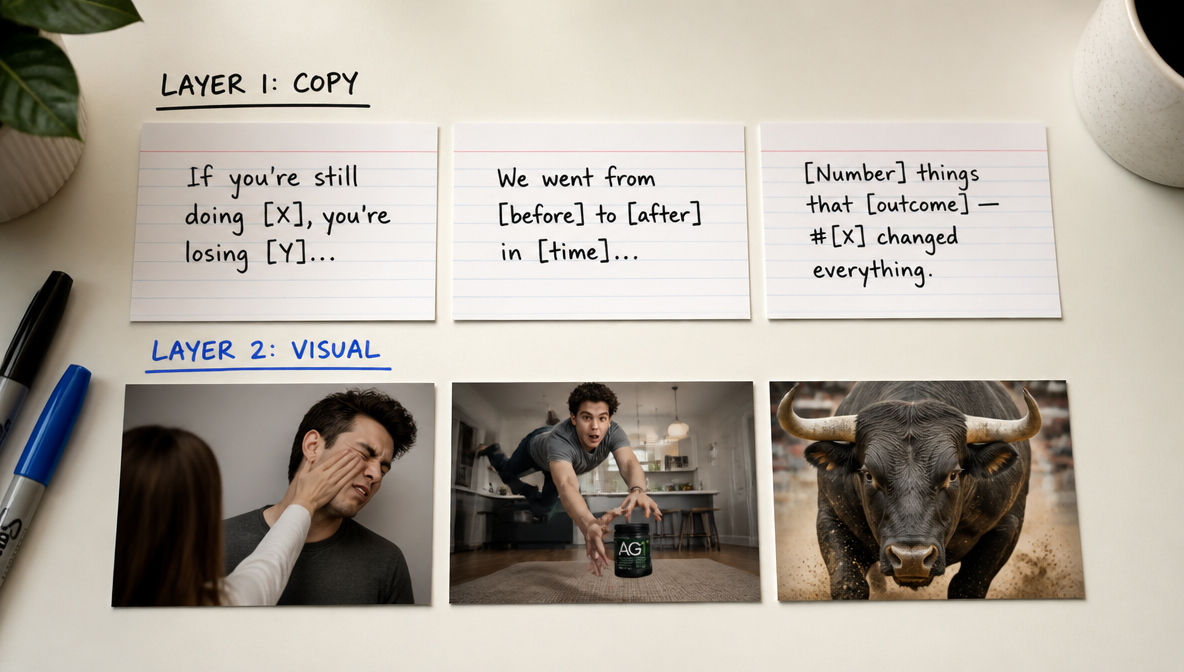
A formula is a category ("use curiosity"). A template is a ready-to-deploy structure with blanks to fill. The templates below are structured so you can adapt them to any product in under five minutes.
The two-layer hook system:
Most hook template guides cover Layer 1 — the copy. What to say in the first line. This guide covers both layers:
- Layer 1: Copy template — the verbal hook, what's spoken or written on screen
- Layer 2: Visual hook template — the physical scenario, camera angle, and action that happens before or alongside the words
Layer 2 is where most brands leave performance on the table.
7 Copy-Based Hook Templates for Any Platform
These seven templates cover every major psychological trigger — curiosity, loss, promise, proof, contradiction, and urgency. Each includes the base structure, a fill-in example, and the trigger it activates.
Template 1: The Mistake Callout
"If you're still doing [X], you're losing [result] every [time period]."
Example: "If you're still writing hooks manually, you're leaving 40% of your ad performance behind."
Trigger: Loss aversion. Works across TikTok, Reels, LinkedIn. Performs best when [X] is a specific, recognizable behavior — not vague.
Template 2: The Numbered Promise
"[Number] [thing] that [specific outcome] — #[X] changed everything."
Example: "7 hook templates that doubled our click-through rate — #4 was the one we never expected to work."
Trigger: Curiosity gap + specificity. The callout to a specific item forces engagement. Use odd numbers — they feel more credible than round ones.
Template 3: The Outcome-First
"We went from [before] to [after] in [time]. Here's exactly how."
Example: "We went from $2 CPMs to $0.40 in 11 days. Here's exactly how."
Trigger: Social proof + promise. Lead with the result, not the process. The more specific the before and after, the higher the hook rate.
Template 4: The Contrarian Open
"Everyone says [common advice]. Here's why that's [wrong / outdated / costing you]."
Example: "Everyone says post consistently. Here's why that's the wrong metric to optimize."
Trigger: Intellectual disruption. Works especially well on LinkedIn and YouTube Shorts where educational expectations are high. Must be backed by substance.
Template 5: The Direct Question
"Why does [specific audience] always [specific behavior] — even when [outcome]?"
Example: "Why do most DTC brands blow their entire ad budget in the first week — even when results look promising?"
Trigger: Self-identification. The viewer checks whether the question applies to them. If it does, they stay.
Template 6: The Bold Claim
"[Specific claim] — no [common excuse required]."
Example: "You can produce a 30-second ad in under an hour — no studio, no camera, no agency."
Trigger: Aspiration + objection removal. The "no [excuse]" structure pre-empts the skeptical thought the viewer would have had.
Template 7: The Open Loop
"[Context setup] — but what happened next was [unexpected result]."
Example: "We A/B tested 12 hook variants on the same ad. But what happened on day three was something our media buyer had never seen before."
Trigger: Narrative compulsion. The brain needs to close open loops. Works best for longer-form video ads where you need retention through the first 10 seconds.
AI Ad Studio Video Hook Templates: The Visual Execution Layer
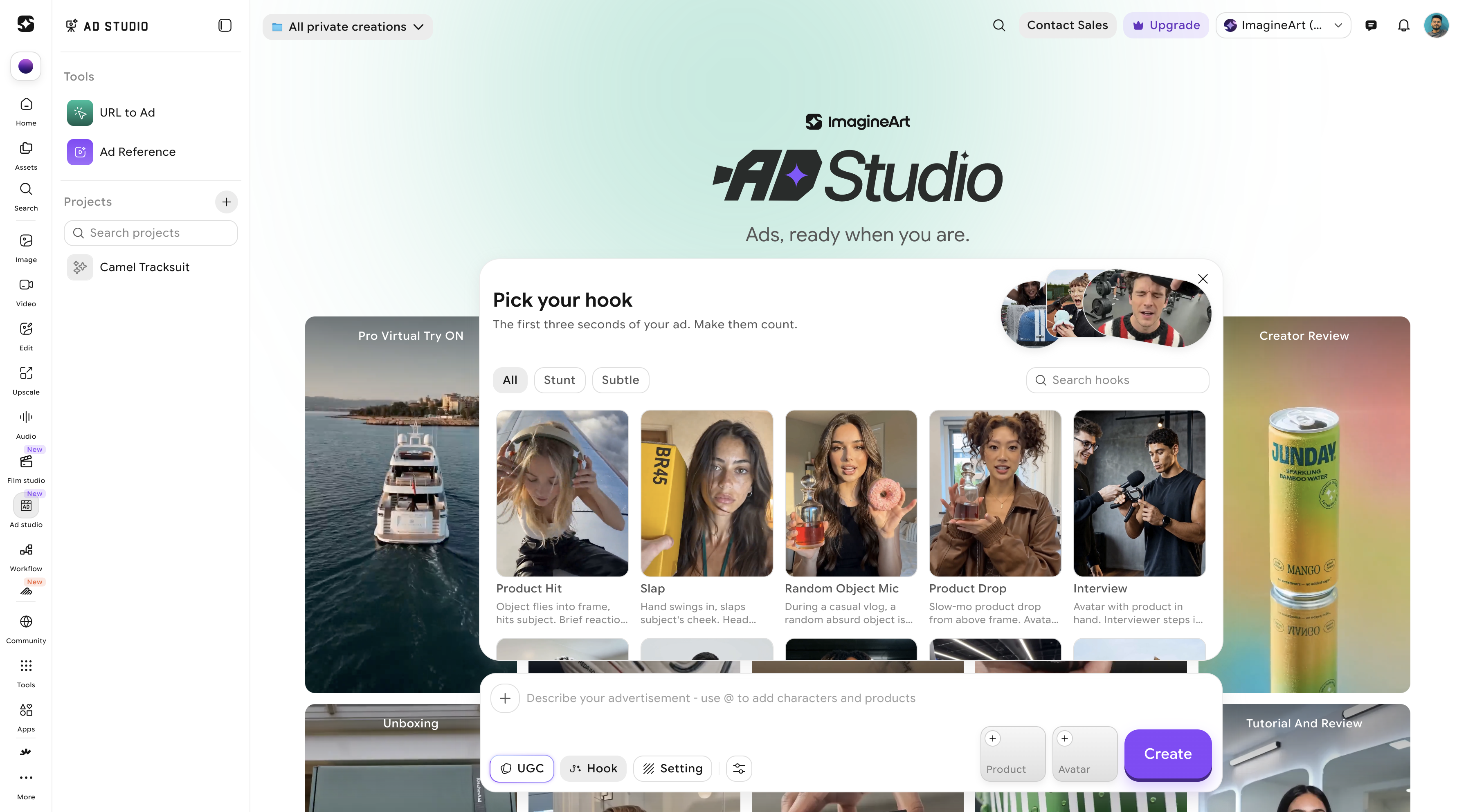
Copy templates tell you what to say. ImagineArt AI Ad Studio tells you how to visually deliver it. These are pre-built video hook scenarios — each one engineered around a specific psychological mechanism — that generate a complete video hook with your product and avatar. No filming, no set, no crew.
Here's the complete library, organized by hook mechanism.
Physical Impact Hooks
These hooks work because movement triggers threat-detection before conscious thought. The viewer's brain locks in before they've decided to watch.
- Product Hit — An object flies into frame and hits the subject. Brief reaction → pivot to product review.
- Slap — A hand swings in and slaps the subject's cheek. Head snaps back to camera → opening hook line.
- Bird Hit — Avatar begins speaking — a bird slams into frame and hits their shoulder. "What the—" → recovery → product review begins.
- Product Bump — POV walk-in. Camera taps avatar's forehead, camera shakes. "Ow" + grin → product reveal.
Extreme Event Hooks
Impossible scenarios that demand attention. The viewer has to see how they resolve.
- Buffalo Hit — A charging bull closes the gap from behind at full speed. Last-frame matador sidestep → hard cut to product review.
- Pendulum Swing — Neon-lit carnival. A massive pendulum arcs directly toward the avatar's head. They don't move. It connects → hard cut to product review.
- Running Person — A runner sprints toward camera from the background, growing from a speck to looming in 3 seconds. The presenter holds eye contact, completely still → hard cut.
- Car Hit — Person walking on a road. Car approaches at speed. Last frame before impact → scene cuts to product review.
- Ceiling Breaking — Floor-facing camera. The ceiling explodes. An avatar crashes through holding the product. Dust settles. Casual product review begins.
Product Drama Hooks
The product itself goes through an ordeal. These hooks communicate durability, quality, or desirability without a word spoken.
- Blizzard — A cozy setup is hit by a violent impossible blizzard. Chaos. Storm clears. Product: still working.
- Frozen Product — Product frozen solid in a block of ice. Avatar chips it out with a pick. Review begins.
- Product Drop — Slow-motion drop from above frame. Avatar dives in and catches it.
- Product Break — Avatar holds product up, lowers it to surface — it cracks in slow motion on contact. Avatar recoils → speed-ramp into review.
- TNT Cracker — A lit firecracker tucked into the presenter's waistband. They review the product calmly for the entire video. Fuse fizzles out. No explosion. The unresolved tension was the hook.
Tension & Atmosphere Hooks
Something is wrong in the frame. The presenter doesn't know it. The viewer can't look away.
- Scary Background Person — A clown walks slowly toward the presenter throughout the video. Never noticed.
- TV Glitch — Hundreds of screens blink on showing the avatar's face while they stand in the center, holding the product.
Character & Dialogue Hooks
Natural entries that earn attention through surprise and relatability rather than shock.
- Random Object Mic — A random absurd object is thrown at the presenter mid-vlog. They catch it without missing a beat and use it as a microphone for a completely straight product review.
- Interview — Avatar holds product. An interviewer walks in: "Got a sec?" Eyes fall to the product. "Wait — what are you holding?" Avatar laughs. Review begins.
Camera Technique Hooks
The shot itself is the hook — raw, unexpected angles that pull the viewer into the frame.
- Flip the Camera — Avatar walking, camera pointed down overhead → flips to product reveal.
- Low Angle Shot — Avatar's hand covers the lens. Lifts to reveal a low-angle upward shot.
- Camera Disruption — Avatar holds product, reaches toward the lens with the other hand, waves into camera.
- Set Up Camera — Tight shot of avatar placing the camera down. Frame braces, drifts. Avatar steps back to reveal the scene.
Hook Templates by Platform: TikTok, Reels, YouTube Shorts & LinkedIn
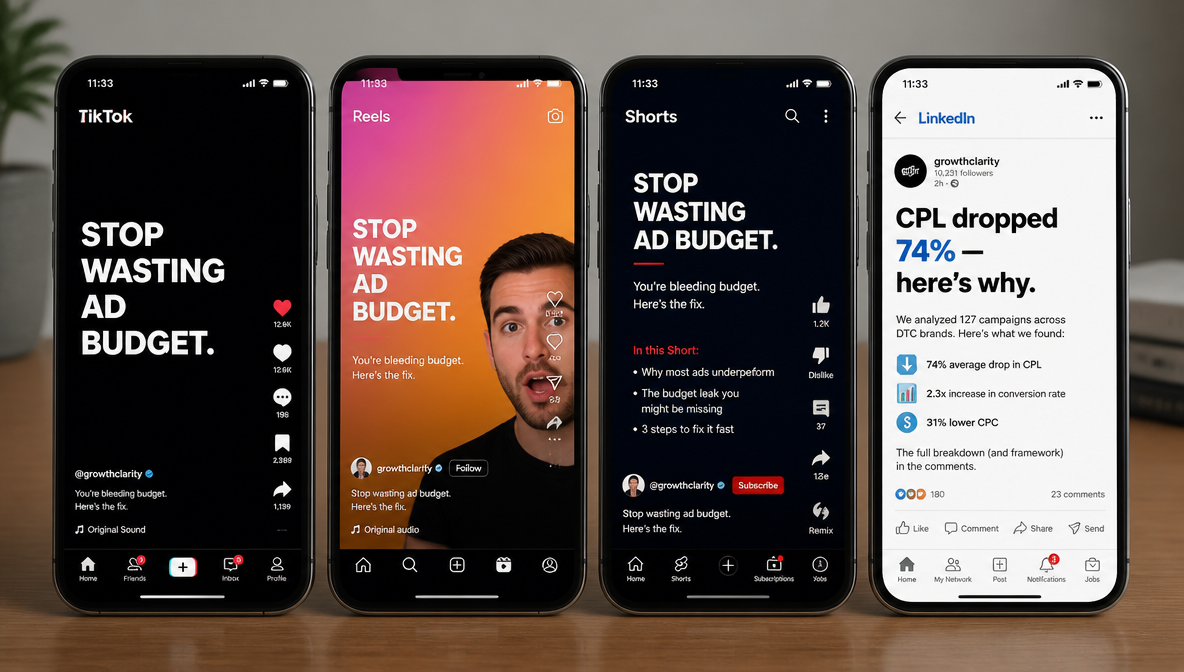
The same hook formula performs differently depending on where it runs. Platform culture, audience expectations, and algorithm signals all shape which template converts.
TikTok Hook Templates
TikTok rewards immediacy. The hook has to land within the first word — no windup, no setup. The platform's scroll velocity is the fastest of any social network.
What works: Physical impact hooks, bold claim templates, direct questions. Anything that creates a visual event or verbal disruption in the first half-second.
TikTok-specific copy adjustments:
- Open with the conflict, not the context: "You're losing money on every ad you run" beats "I've been running ads for three years and..."
- Under 12 words for the opening hook line
- Text overlay on screen reinforces the spoken hook — don't rely on audio alone
Best AI Ad Studio hooks for TikTok: Buffalo Hit, Running Person, Bird Hit, Slap — all create immediate visual disruption that stops the scroll before a word is spoken.
Instagram Reels Hook Templates
Reels skews slightly more curated than TikTok — the audience has marginally more patience, but the window is still under 2 seconds. Aesthetic quality matters here in a way it doesn't on TikTok.
What works: Before/after frames, outcome-first copy templates, contrarian claims. Visual polish on slide one matters.
Best AI Ad Studio hooks for Reels: Product Drop, Ceiling Breaking, TV Glitch — visually striking enough to stop a polished feed, unusual enough to create curiosity.
YouTube Shorts Hook Templates
YouTube Shorts audiences are conditioned for educational and informational content. Curiosity gap and authority-challenge templates outperform here.
What works: Numbered promise templates, open loop setups, direct question formats. Viewers on Shorts will tolerate a slightly longer setup than TikTok — use it.
Best AI Ad Studio hooks for YouTube Shorts: Interview, TNT Cracker, Pendulum Swing — slower-build tension that rewards the slightly longer attention span.
LinkedIn Hook Templates
LinkedIn carousel and video hooks play differently from entertainment platforms. The audience is professional, skeptical of hyperbole, and responsive to data and specificity.
What works: Contrarian opens, outcome-first with specific metrics, mistake callouts tied to professional consequences.
Copy adjustments for LinkedIn:
- Replace "you're leaving money on the table" with specific dollar amounts or percentages
- Name the professional consequence, not the emotional one
- First line carries more weight than first visual — text is the hook on LinkedIn
Use ImagineArt's AI social media tools to adapt the same hook video assets across TikTok, Reels, YouTube Shorts, and LinkedIn without rebuilding from scratch — platform resizing and formatting handled in the same workflow.
How to Test Ad Hook Templates and Know Which Ones Win
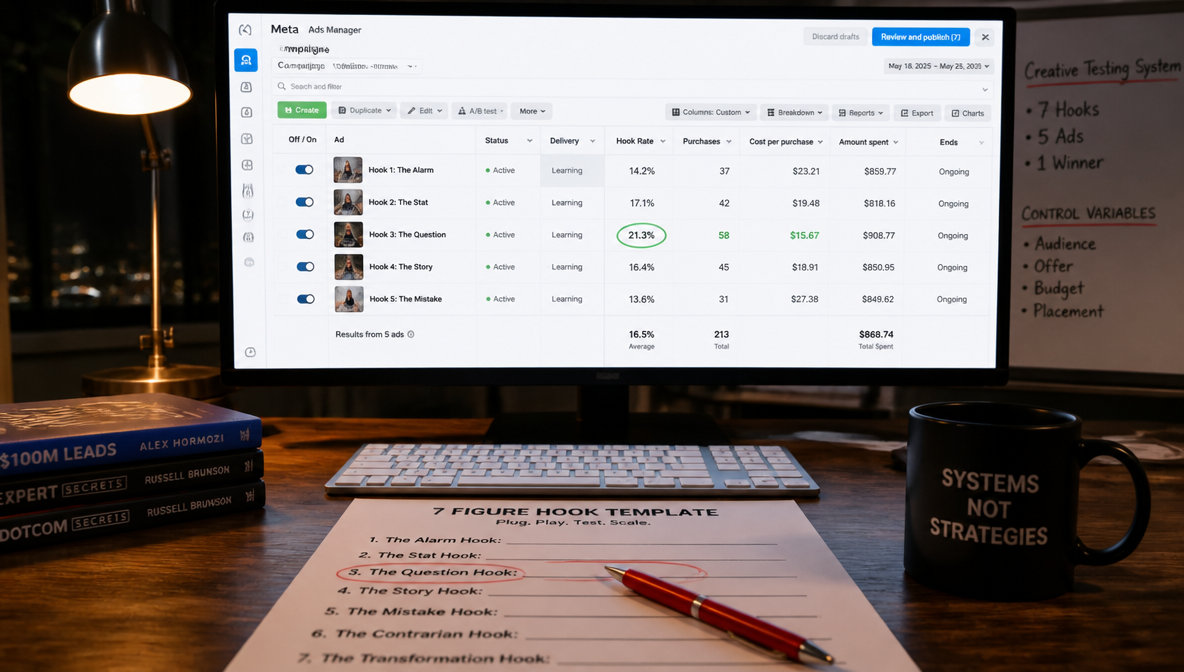
Running hook templates without a testing framework is guesswork. The goal is to find your audience's highest-converting hook archetype as fast as possible, then scale it.
The 4-6 variant test:
Ship 4–6 hook variants on the same body script. Keep the product reveal, offer, and CTA identical. Change only the hook — different template type, different visual hook scenario, different opening line.
What to measure:
- Hook rate: % of viewers who watch past 3 seconds. Below 25% is a failing hook.
- Hold rate: % who make it to 50% of the video. Low hook rate + high hold rate = good product, weak hook. Fix the hook.
- Thumb-stop ratio: Impressions that became views. Tells you if the first frame is doing its job.
Kill signals: Any hook variant under 25% hook rate after 48 hours of delivery. Don't iterate on it — replace the hook type entirely.
Scale signals: Hook rate above 40% consistently across 1,000+ impressions. That's your archetype for this audience. Build the next 3 ads around it.
Use ImagineArt AI image generator to create multiple static first-frame variants for testing before committing to full video production — faster to test at the thumbnail level first.
Frequently Asked Questions
A hook template is a ready-to-use structure for the opening line or scene of an ad, video, or social post designed to stop scrolling and compel viewers to keep watching. Hook templates come in two forms: copy templates (what to say in the first 3 seconds) and visual hook templates (the physical scenario or camera technique that creates the opening event). The best-performing ads use both.
A video hook should land within the first 3 seconds — ideally the first 1 second for TikTok. The hook is the specific moment of disruption, curiosity, or promise that earns the next 10 seconds of attention. After 3 seconds, you're in the body of the ad.
The Mistake Callout and Bold Claim templates consistently outperform on TikTok because they create immediate self-relevance — the viewer checks whether the hook applies to them. For visual hooks, physical impact and extreme event scenarios work best because they create a disruption before the viewer's decision to swipe has engaged.
Viral hooks share three traits: they create an open gap the viewer needs to close, they're specific enough to feel credible, and they deliver on the promise within the video. Templates built on curiosity gaps and unexpected contrarian claims outperform generic positivity hooks consistently.
Test 4–6 hook variants per campaign. Fewer than four gives insufficient data to identify a winning archetype. More than six spreads budget thin and slows down learning. Kill any variant under 25% hook rate at 48 hours and reinvest budget into the top performer.
The template structure can transfer, but execution should adapt. TikTok needs the hook to land in the first word. LinkedIn needs specificity and data in place of emotion. Reels benefits from visual polish. The script structure is portable — the delivery and tone are not.
The Hook Is the Ad
Every other element of an ad: the offer, the copy, the CTA, only matters if the hook earns the view. The templates above cover the full execution stack: copy formulas that open psychological gaps, and AI-generated video scenarios from AI Ad Studio that deliver those gaps visually before a word is spoken.
Pick a template. Build the hook. Test the variants. The creative that survives is the one that ran first. Explore ImagineArt's full creative features to see what else you can build alongside your ad hooks.
Syed Anas Hussain
Syed Anas Hussain is a computer scientist blending technical knowledge with marketing expertise and a growing passion for AI innovation. Curious by nature, he dives into new AI sciences and emerging trends to produce thoughtful, research-led content. At ImagineArt, he helps audiences make sense of AI and unlock its value through clear, practical storytelling.