
Kamran Arshad
November 3, 2026 • Updated November 6, 2026
23 mins Read
AI fashion stopped being a trend-report topic and became a budget line. Brands now use AI to forecast what will sell, draft what gets made, photograph what ships and answer what shoppers ask. The gap between the teams that do and the teams that do not grows every season.
This guide gives you the whole map in one read: what AI fashion means, where it is used, what real brands learned, which rules apply in 2026 and how to start without betting the business. It is built for brand owners, designers, merchandisers and e-commerce leads who want facts, not hype.
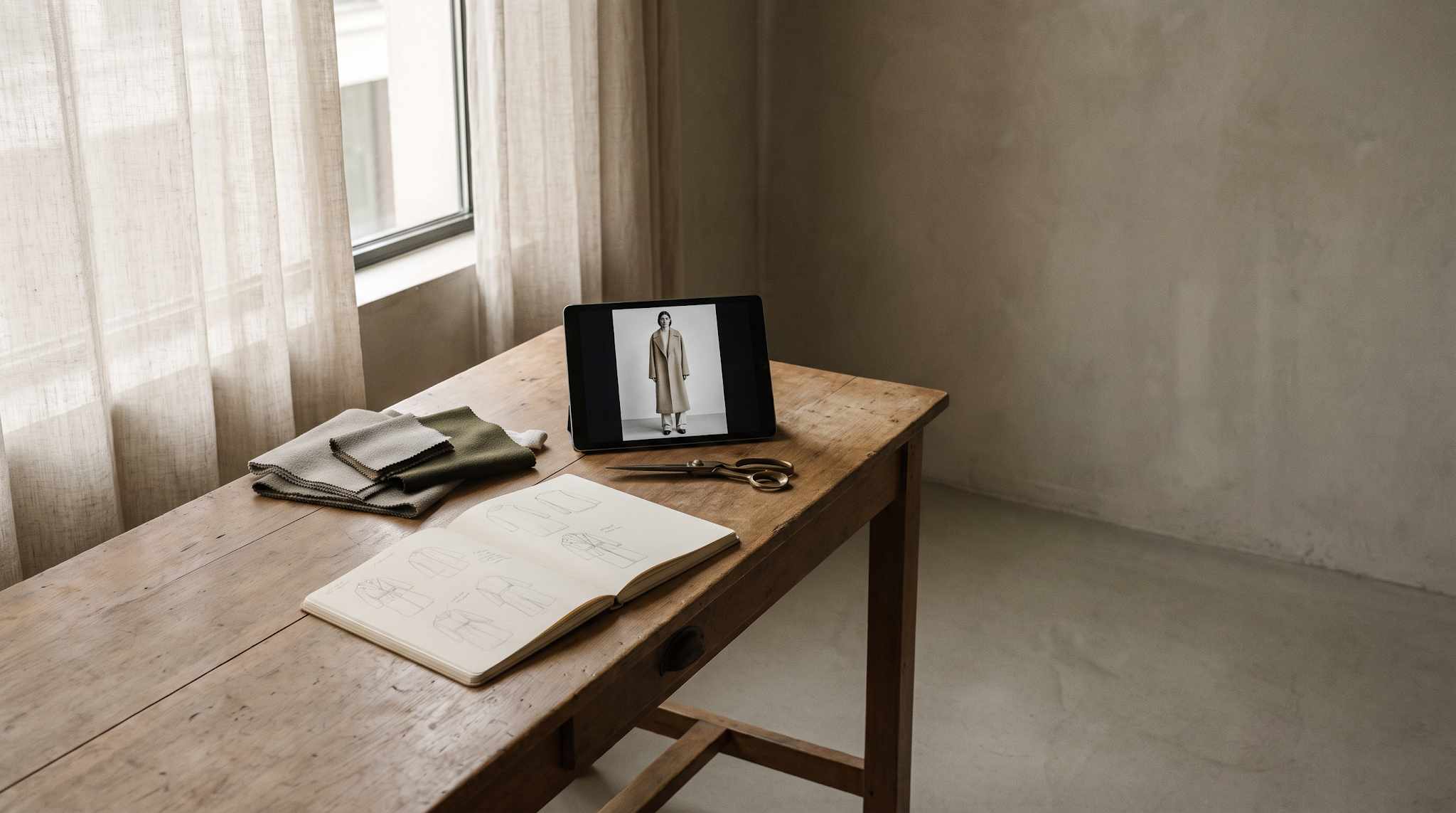 A designer's atelier worktable by a tall window with a sketchbook of garment sketches, fabric swatches, brass shears and a tablet showing a model in a long oat coat.
What Is AI Fashion?
AI fashion is the use of artificial intelligence to design, make, photograph, market and sell clothing. It covers forecasting demand, generating designs and patterns, creating model photos and campaign video, and helping shoppers find the right size. In 2026 its most visible use is imagery: brands turn a plain garment photo into worn photos and video without booking a shoot.
People use the phrase in three different ways, and mixing them up causes most of the confusion online. Each meaning has its own audience and its own risks.
AI in the fashion industry
This is the business meaning: AI used inside brands and retailers to run planning, design, content and retail. A demand forecast, an AI model photo and a size recommendation all belong here. Most of this guide is about this meaning.
AI-generated fashion
This is the creative meaning: designs, prints, images and virtual garments that AI produces. A concept sketch, a generated textile pattern and an AI-generated model photo all count. It raises questions about ownership and authenticity that we cover in the rules section.
AI-powered wearables
This is the hardware meaning: clothing and accessories with AI built in, such as smart eyewear. McKinsey projects smart eyewear with multimodal AI will exceed $30 billion by 2030, according to its State of Fashion 2026 report. We mention it for completeness and leave it aside from here.
Why AI Fashion Matters Right Now
Fashion is squeezed by volatile costs, slow growth and shoppers who change channels faster than brands change plans. AI answers two of those pressures at once: it cuts the cost of making content and it shortens the time to market. The numbers below show how quickly the industry is moving.
- Adoption is mainstream. More than 35% of fashion executives report using generative AI in areas such as customer service, image creation, copywriting and product discovery, per State of Fashion 2026. The same report describes AI shifting from a competitive edge to a business necessity.
- The profit pool is large. In 2023, McKinsey estimated that generative AI could add $150 billion to $275 billion to the operating profits of apparel, fashion and luxury within three to five years. Read the full analysis.
- Shoppers already use it. Coresight Research found that 58% of US consumers familiar with AI had used or planned to use it for shopping, as reported by Fashion United. About one in four consumers now uses AI tools to shop, according to McKinsey research reported by Modaes.
- Confusing pages cost sales. About 40% of US shoppers had abandoned an online apparel purchase because of confusing or missing product information, according to the same Coresight research.
Put those together and the message is plain. Your product images and product data are now read by machines as well as people, and the brands with clear, consistent, accurate content get recommended.
The Three Kinds of AI Behind AI Fashion
Under the label sit three different technologies. Knowing which one you are buying tells you what it can and cannot do.
1. Predictive AI
Predictive AI learns from past data to forecast the future. It estimates demand, suggests prices, ranks products and plans inventory. Retail has used it for years, and it is the most mature of the three. It rarely makes headlines, but it is usually the first AI a merchandising team adopts because the data it needs already sits in the point-of-sale and inventory systems.
2. Generative AI
Generative AI creates new content: images, video, text, patterns and 3D shapes. It is the wave behind AI model photos, concept sketches and campaign video, and it drives most of the current excitement. It is also the newest of the three, which is why terms of service, ownership rules and labeling laws are still catching up.
3. Embedded AI
Embedded AI sits inside the shopping experience: search, chat assistants, size recommendations and virtual try-on. Shoppers meet it without knowing a model is behind it. It tends to be judged on one thing only: whether it gets the shopper to a decision faster than scrolling would.
One brand can run all three at once. A retailer might forecast demand with predictive AI, create product photos with generative AI and recommend sizes with embedded AI.
How AI Is Used Across the Fashion Value Chain
AI touches every stage from first idea to the return desk. The stages below run in the order a garment moves, so you can see where a single change compounds into the next.
1. Trend forecasting and merchandising
Merchandisers used to rely on trend reports and last season's sales. AI now reads search behavior, social posts and reviews in near real time, and surfaces patterns a human team would miss. McKinsey describes this as a way for both mass-market and luxury brands to inform the next collection. The human still decides what to make. The machine widens what the human sees.
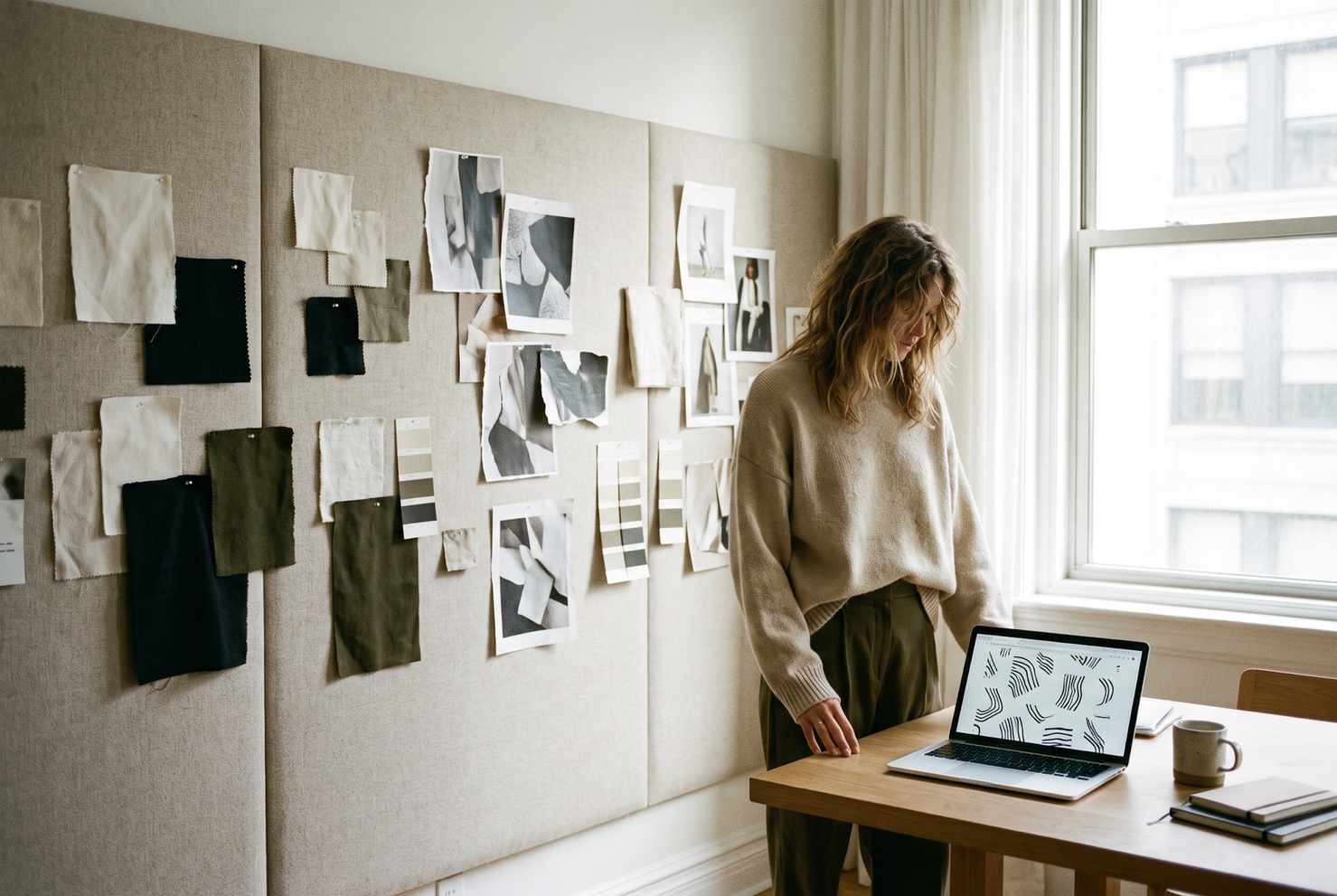 A pinboard covered with fabric swatches, color chips and printed street-style photographs, with a laptop in front showing abstract line shapes.
- Spot rising colors, silhouettes and fabrics earlier.
- Size buys closer to real demand, which cuts overstock.
- Time markdowns with fewer guesses.
Also read: 11 fashion marketing trends for 2026.
2. Design
Designers use AI to explore faster. A prompt produces dozens of concept sketches, prints or colorways in minutes, and the designer edits the strongest. 3D tools turn patterns into virtual garments, so a team can review fit and drape before cutting fabric. Taste still decides. AI shortens the distance between an idea and something a team can react to, and it is cheap enough to run a dozen directions before committing a sample budget to one.
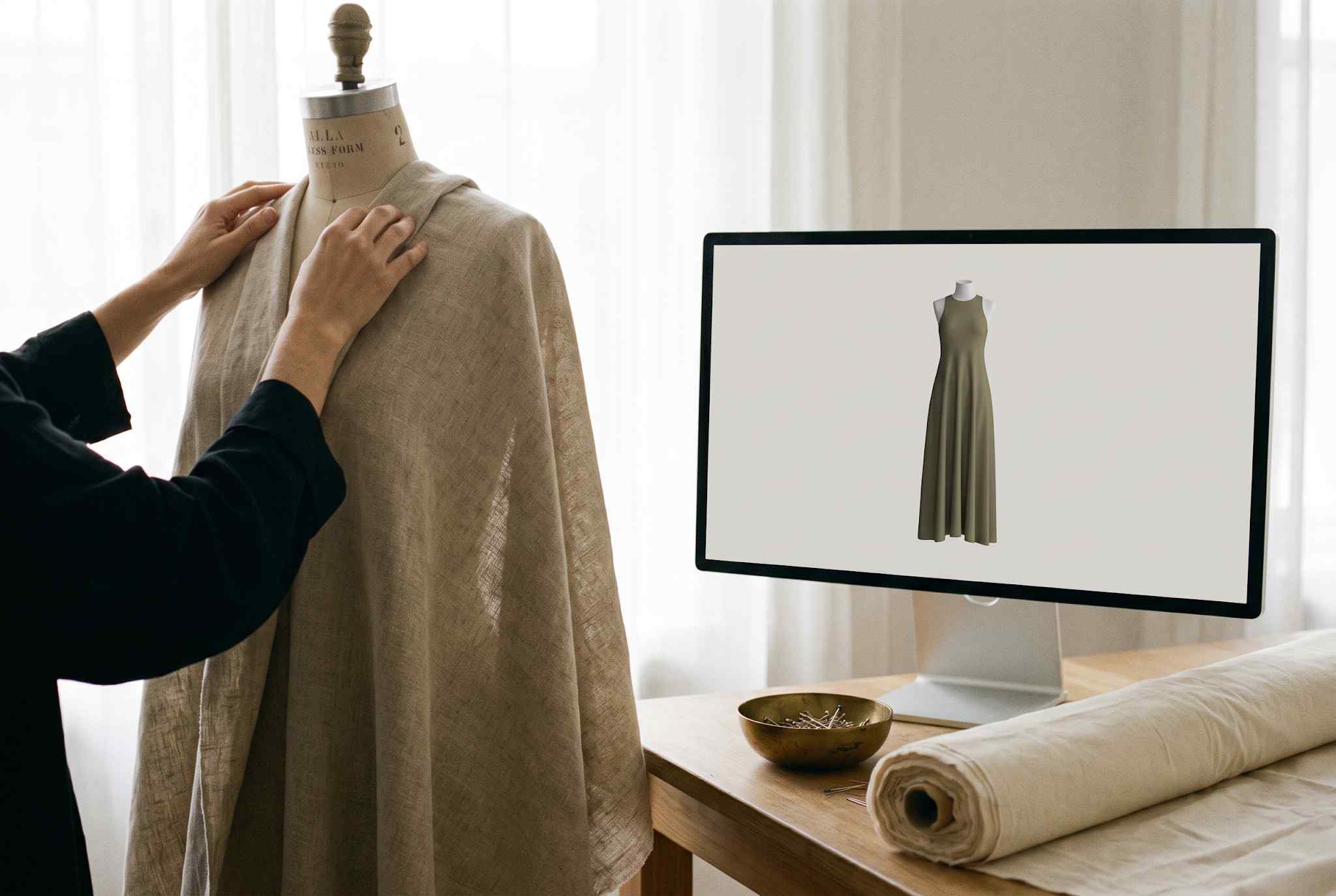 A designer's hands draping oat linen on a dress form beside a monitor showing a 3D render of the same dress.
3. Sampling, production and supply chain
Planning is where predictive AI earns its keep. Better forecasts mean better production runs, fewer stockouts and less unsold stock. Virtual samples reduce the number of physical samples a team has to cut and ship. This is less glamorous than image generation, and often worth more.
4. Product imagery
This is the most visible use of AI in fashion today. Brands generate on-model product photos, lookbooks, editorial campaigns and short video from their own garment photos, with consistent-looking AI models standing in for a casting, a studio and a crew on every drop. The next section covers it in depth.
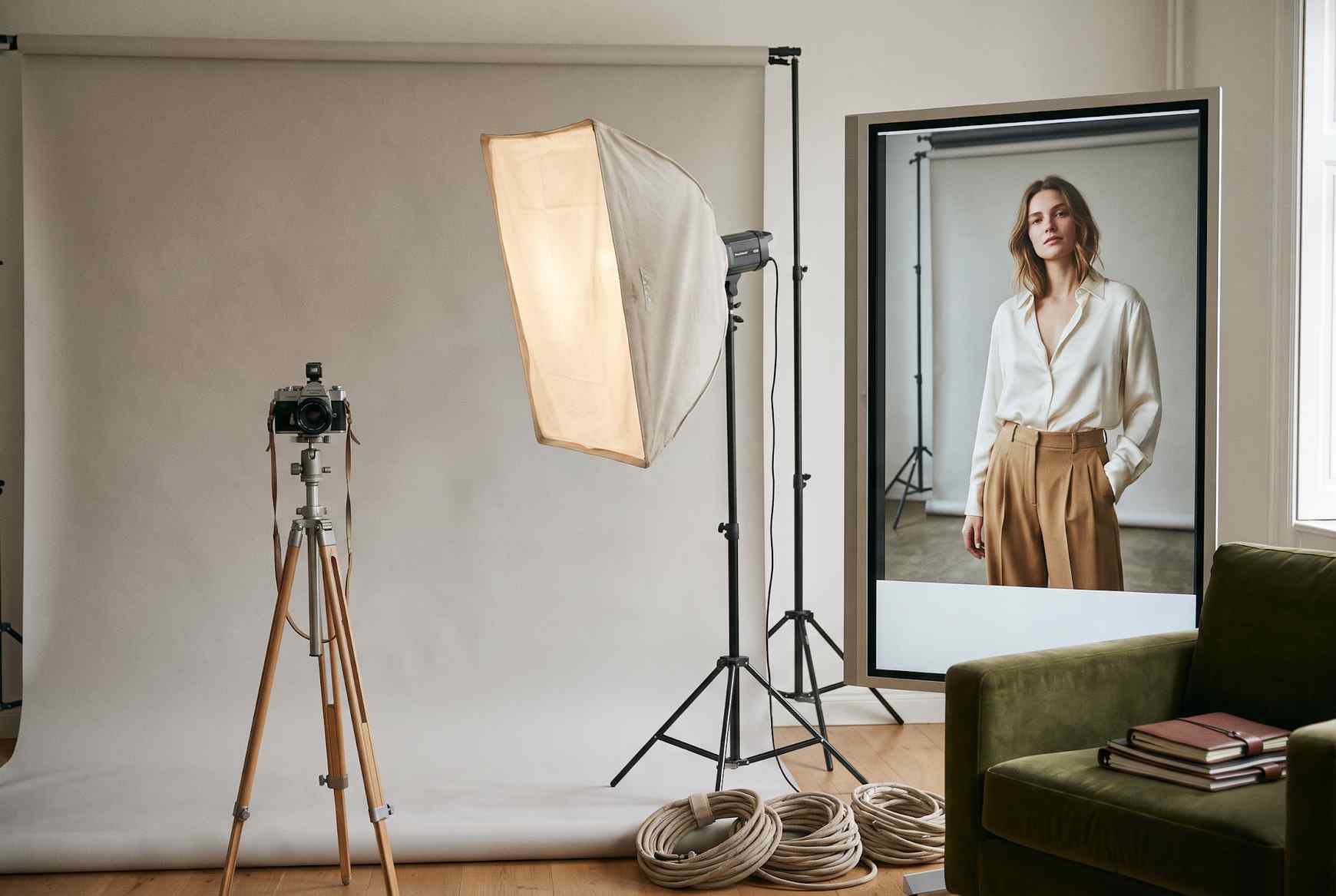 A photo studio with a camera on a tripod and a softbox facing an empty grey backdrop, beside a display showing a finished model photograph in an ivory shirt and camel trousers.
5. Marketing and content
Fashion teams use AI to localize a campaign for several markets and to test many versions of an ad. Creator-style video, such as a try-on or an unboxing, can come from the same model and look. Present it as brand content, never as a real customer review, and keep the disclosure rules in mind the same way you would for any paid placement.
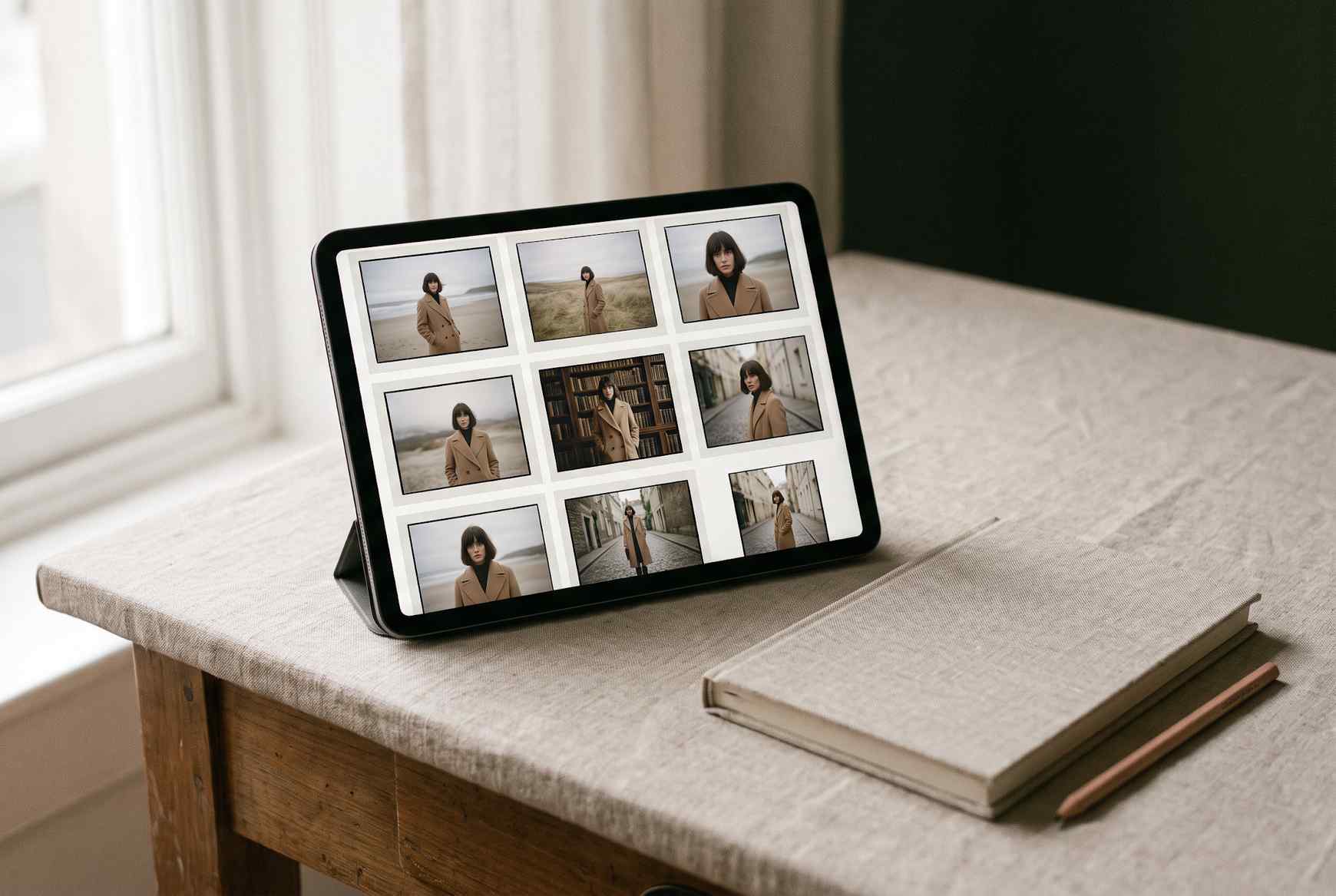 A tablet on a linen-covered desk showing a three-by-three grid of photographs of the same model in a camel coat in nine settings, beside a notebook and pencil.
6. The shopping experience
Embedded AI helps shoppers find products, choose sizes and see how clothes might look on them. Google's virtual try-on, launched in the US in July 2025, lets shoppers upload a full-length photo and see apparel on themselves across Search, Shopping and Images. It sits next to, not instead of, the brand-made model photos covered in this guide: one shows the shopper on the garment, the other shows the garment on a consistent model your team controls.
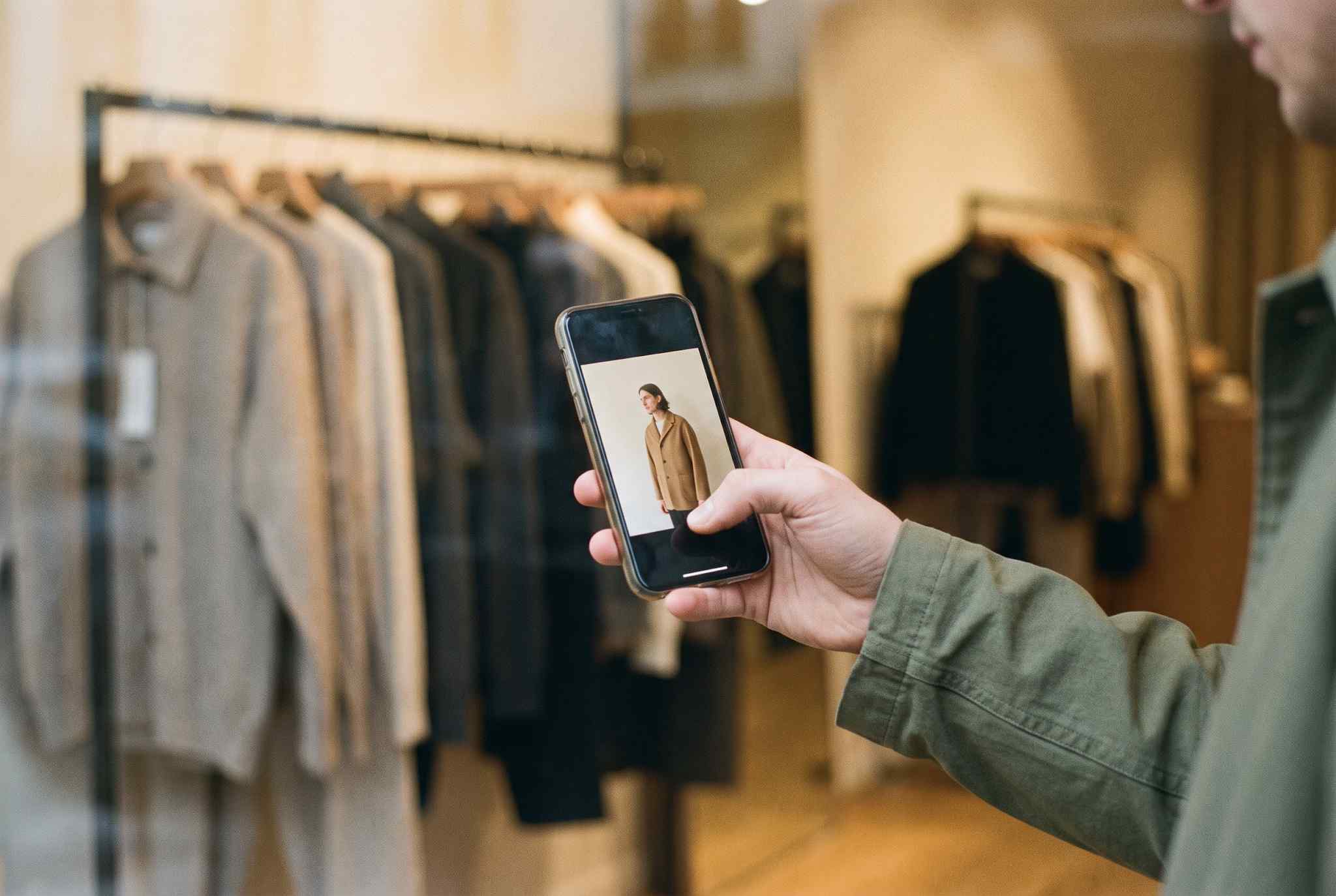 A shopper's hand holding a smartphone that shows a person in a camel wool jacket, in a boutique with racks of clothes behind.
7. Customer service and returns
Chat assistants answer routine questions around the clock. Fit and sizing tools aim at the biggest cause of returns. The size of the problem explains why brands invest here.
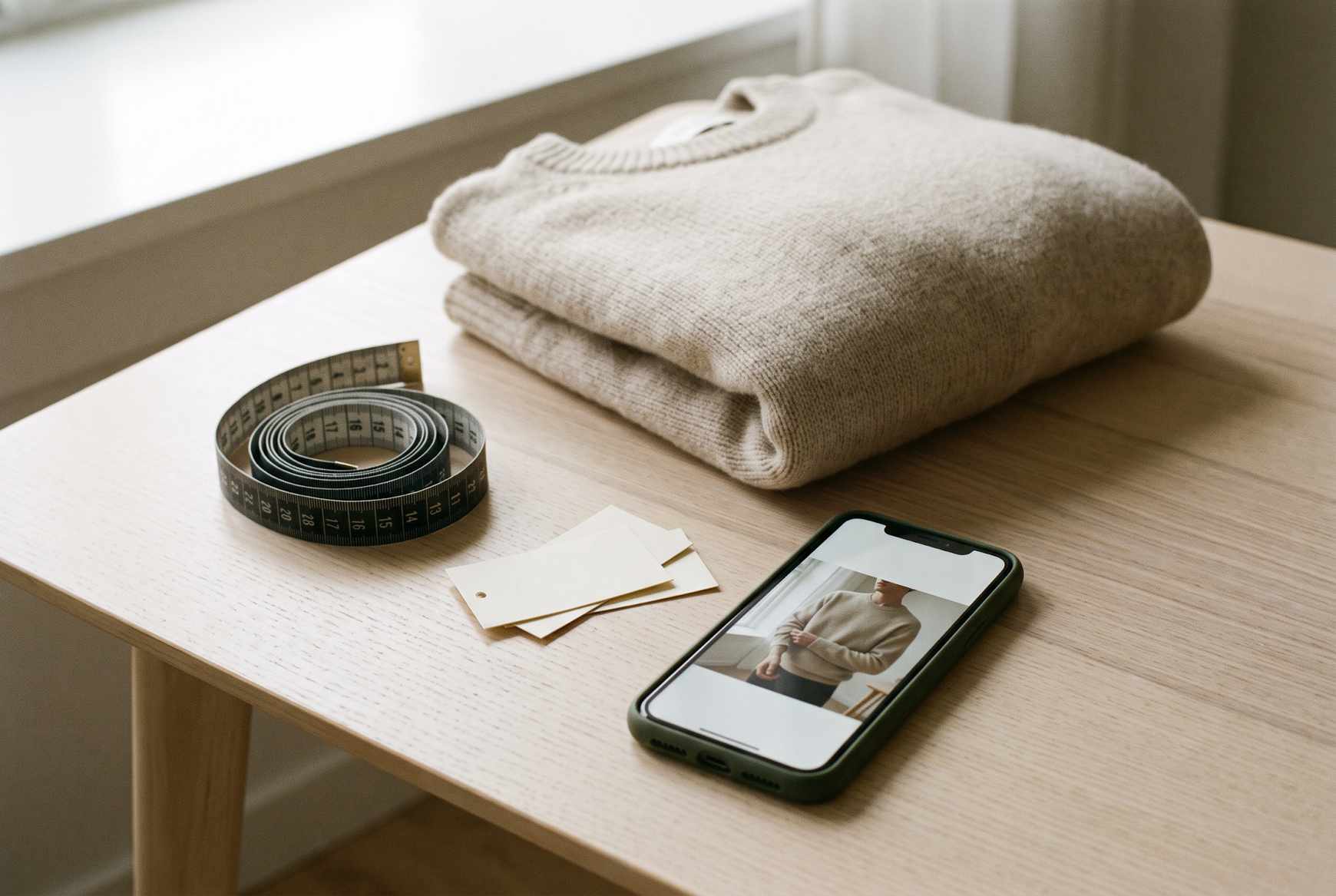 A fabric measuring tape, a folded oat knit sweater and blank size labels beside a phone showing the same sweater worn by a model.
- US retail returns reached about $849.9 billion in 2025, or about 15.8% of sales, with online returns near 19.3%, per NRF and Happy Returns data.
- The US online apparel return rate was about 23.4% in 2025, and about 70% of returning shoppers cited size or fit, per Coresight Research.
Returns are an information problem as much as an image problem. Honest worn images, model measurements and real garment measurements work together to solve it.
AI Fashion Photography: How It Actually Works
AI fashion photography turns a garment photo into a worn photo or a short video, without a physical shoot. It is the part of AI fashion most brands meet first, because every online seller needs product images and most feel the cost.
Brands from independent boutiques to enterprise retailers such as Khaadi already use ImagineArt to produce fashion and apparel campaigns without booking a studio, a model or a location. ImagineArt Fashion Studio is the part of the platform built specifically for this.
Here's how it works:
- Choose a model. Pick a preset, upload your own or generate one from a prompt.
- Dress the look. Select or upload a top and a bottom, and choose the fabric for each piece.
- Add footwear and accessories. Shoes, jewelry and accessories from presets or your uploads.
- Set the background. A catalog backdrop or an outdoor editorial scene.
- Direct the pose. A preset pose, a reference image or a description.
- Shoot or animate. Generate a still, or animate it into video in square, vertical or widescreen formats.
Common use cases of AI fashion
These are the jobs brands bring to ImagineArt's Fashion Studio most often.
-
Flat lay to worn photo
Brands with only flat photography create worn images. See how to turn a flat lay into an on-model photo with AI.
-
Skipping the ghost mannequin rig
Some brands generate a worn image directly instead of renting a ghost mannequin rig, which saves the equipment cost and the extra retouching pass that rig photography usually needs.
-
Lookbooks and campaigns
One model, many looks, many places. Learn what a lookbook is and how to make one.
-
One face across the range
A saved model keeps the brand recognizable. See how to keep the same AI model across your collection.
-
Ads and social
The same model becomes try-on, unboxing and styling clips for Meta, TikTok and YouTube.
On a product page, lead with a clean, unstyled on-model image and state the model's height and size so shoppers can judge fit. Pair it with a flat lay as a true-color reference, and check every detail against the real garment before it goes live.
What it costs
Cost is why most brands opt for AI fashion photography, especially retailers and boutique brands. The honest comparison is cost per approved image, which includes review time, clearly explained in what a product page image really costs.
| Route | Typical cost per image | What you pay for |
|---|---|---|
| Outsourced product-only shot (flat lay, mannequin) | About $15 to $75 | Shoot and basic editing |
| On-model product photography | About $150 to $400 | Model, styling, shoot and retouching |
| A full-day professional shoot, 50 to 100 images | About $20 to $160 | Photographer, studio, basic retouching |
| AI approved image, with review time (modeled) | About $1 to $4 | Generation plus a few minutes of review |
These are planning ranges, not quotes, and results vary by brand, baseline and location. The full-day row looks cheaper per image than à la carte on-model shots because the day rate is spread across 50 to 100 frames, and it usually excludes model and styling fees.
Global Adoption of AI Fashion
AI fashion photography and virtual fashion models are no longer experiments. The cases below are widely reported, and each one carries a lesson you can use before you spend a dollar.
| Brand | What was reported | The lesson |
|---|---|---|
| Levi's (2023) | Announced a partnership to add AI-generated models and drew criticism | If AI stands in for real diversity, expect pushback. Represent real people too |
| Mango (July 2024) | Ran a teen-collection campaign with AI-generated models | AI campaigns are viable. Shoppers question how accurately they show fit |
| Zalando (late 2024) | Reported about 70% of a quarter's editorial imagery as AI-generated, cutting production from six to eight weeks to three or four days and cost by about 90% | At scale, AI changes speed and cost. Treat the figures as the brand's own claims |
| H&M (2025) | Created digital twins of 30 consenting models, who keep control of use. First images were watermarked as AI | Consent, pay and labels make it defensible |
| Guess in Vogue (Aug 2025) | Ran a print ad with an AI-generated model. Vogue said it was a paid placement, and the ad drew strong backlash | Disclosure and beauty standards matter |
The pattern holds across all five. The brands that handled it well paid attention to consent, labels and honesty. The ones that stumbled treated AI as a trick to hide.
The Case for AI Fashion
When AI fashion works, it works on the metrics a CFO or finance manager cares about. These are the benefits teams report most often, and each is measurable in a pilot.
- Speed: Imagery moves from weeks to days, so products go live sooner.
- Cost: Casting, studio, travel and reshoot fees drop out of the bill.
- Consistency: One saved model and one backdrop across a range make a catalog look like a brand.
- Volume: More images per product, and more variants to test.
- Localization: A model for each storefront, from one garment photo.
- Flexibility: New seasons and colorways without rebooking people.
ImagineArt's Fashion Studio is purpose-built for fashion and apparel brands. Book a pilot with our forward-deployed creatives and see how much faster you can produce campaign-quality assets without expensive shoots.
AI Fashion Photography & Commercial Usage Rights
Four questions decide your legal position about commercial usage of AI-generated fashion images, and the answers changed in 2026. The table gives the short answers. Our full guide, Can you use AI-generated fashion images commercially?, has the sources, dates and a policy template.
| Question | Short answer, 2026 |
|---|---|
| Can I use AI images commercially? | Yes, if the tool's terms grant commercial rights |
| Do I own the copyright? | In the US, purely AI-generated images have no copyright owner. Human authorship is required |
| Do I need consent? | Not for a synthetic model who is not a real person. Yes, in writing, for an AI version of a real model |
| Must I label? | Often, yes. New York and the EU require disclosure of fully AI-generated people in ads, and Amazon asks sellers to tag AI-generated people in listings |
Dates worth knowing: India's synthetic-content rules took effect on 20 February 2026, the US Supreme Court declined to revisit AI authorship on 2 March, New York's synthetic performer law took effect on 9 June, Amazon began asking sellers to tag AI-generated people in late July, and the EU's transparency duties began on 2 August. Google Merchant Center also requires AI images to keep their metadata tag.
How to Start With AI Fashion: A Five-Step Playbook
You do not need a transformation program. You need one bottleneck, one pilot and one number to start with AI fashion. These five steps keep the risk small and the learning fast.
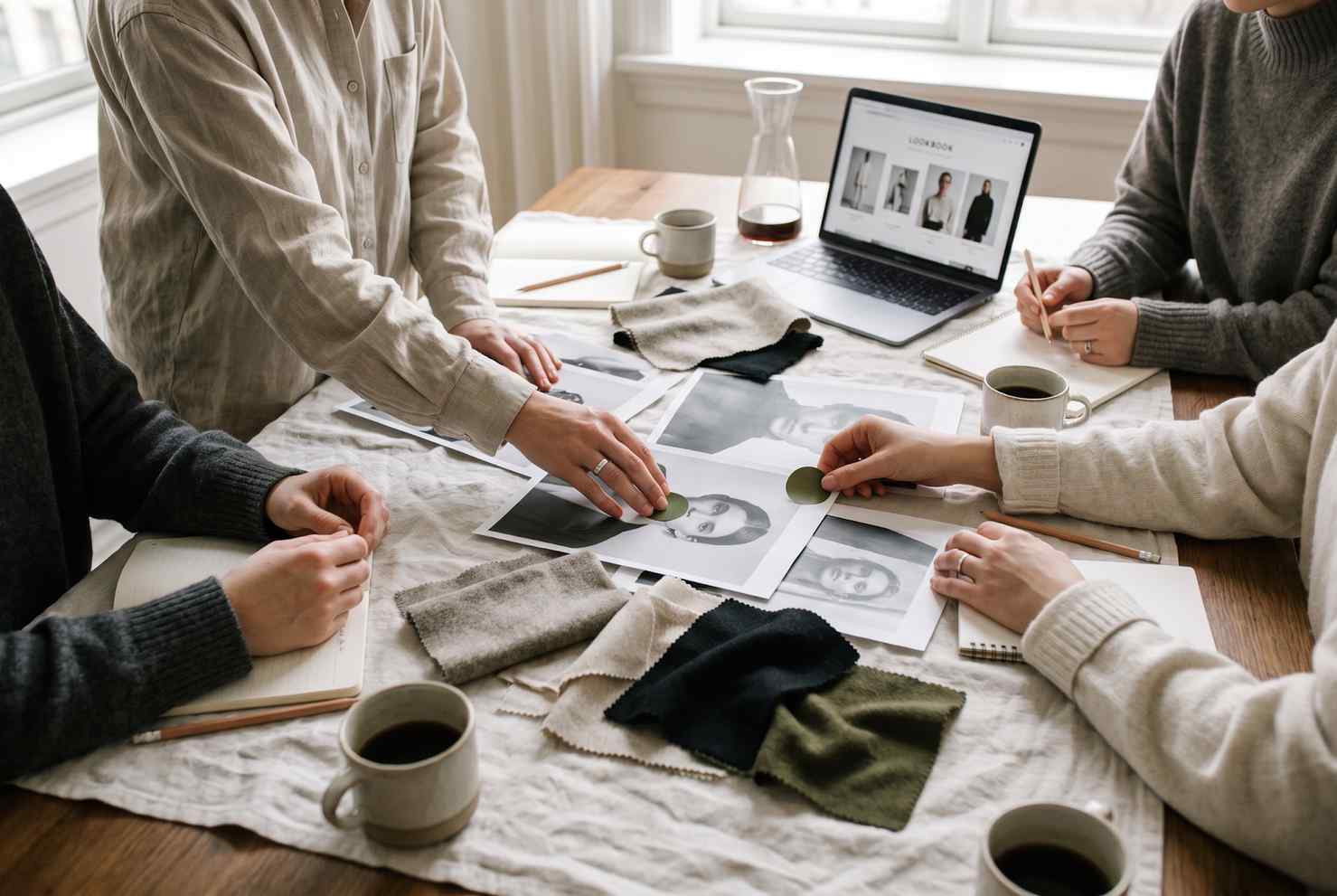 Four pairs of hands around a table reviewing printed model photographs, fabric swatches and a laptop showing a lookbook page, with one hand placing an olive sticker on a chosen photograph.
- Pick one bottleneck. McKinsey's advice is to target use cases where AI removes a real constraint. For many brands that is product imagery.
- Run a 20-style pilot. Include your hardest garments, one model and one backdrop. Keep the pilot small enough that one person can own it end to end, with a short scorecard for pass or fail on each image.
- Measure cost per approved image. Add generation, review time and any garment photography, then divide by approved images.
- Write a one-page policy. Cover tools, models, review, labels, metadata and records.
- Scale in stages. Move to bulk once the pilot passes your accuracy review.
The steps stay the same for everyone, but where you start depends on the size of your business.
For small or independent labels
You have the most to gain, because a studio day is a large share of your budget. Start narrow and keep a real shoot for your hero pieces.
- Start with flat lay to worn photos for the product page.
- Save one model and use it everywhere.
- Keep a flat lay in every gallery.
For mid-market or direct-to-consumer brands
Your constraint is consistency and speed across several drops a year. Build one repeatable system your whole team can follow.
- Run catalog, lookbook and ad variants from one saved model.
- Apply labels and metadata for marketplaces.
- Track returns by reason, not only by rate.
For large retailers
Your constraint is the long tail of SKUs and the number of markets. Governance and delivery matter as much as creative quality.
- Use bulk generation for the long tail, and real shoots for campaigns.
- Localize models for each market.
- Get written consent for any digital twin of a real person.
Types of AI Fashion Tools and How to Choose
There are hundreds of AI fashion tools on the market, but most fall into six groups. Here is what each one does and the question to ask before you buy.
1. Forecasting and planning
These predict demand and plan inventory. Ask whether the tool connects to your sales data, and whether it can explain a forecast in plain terms your merchandising team can act on, not just a number.
2. Design and 3D
These generate concepts and virtual garments. Ask whether you can export into your design process, and whether the output format matches what your pattern makers and sample room already use.
3. Imagery and video
These create AI model photos, lookbooks and clips from garment photos. Ask whether the tool keeps garment details and the same model across a whole shoot, and whether it exports both stills and video from one setup so you are not paying for two separate subscriptions.
ImagineArt's Fashion Studio is purpose-built for this group. Set up a meeting with our forward-deployed creatives to see how you can scale campaign output without scaling costs.
4. Virtual try-on
These show clothes on a shopper's own photo. Ask whether it works on your product pages and on mobile, since most apparel browsing now happens on a phone.
5. Size and fit
These recommend sizes. Ask whether they reduce returns in your categories, and whether they learn from your own return data over time instead of using generic body-shape assumptions.
6. Assistants and search
These handle chat, discovery and agentic shopping. Ask whether your product data is ready for them: complete materials, measurements and imagery are what let an assistant recommend your product with confidence.
Whatever you choose, ask every vendor the same five questions before you sign. They save you from the expensive surprises.
- Do the terms grant commercial use, including advertising, on my plan?
- Are the models exclusive to me, or shared?
- What happens to my garment photos?
- Do exports carry provenance metadata?
- Who is liable for IP claims over outputs?
What People Get Wrong About AI Fashion
Most bad decisions about AI fashion start with a belief that sounded reasonable in a meeting. Five misconceptions come up again and again, and each one either wastes money or creates risk.
1. AI mostly makes the pictures, not the clothes
The popular picture is a machine dreaming up next season's collection. In practice, most AI spend in fashion goes to imagery, planning and customer service. The areas executives named in State of Fashion 2026 were customer service, image creation, copywriting and product discovery. Design uses AI too, but as a sketching partner. The designer still decides taste, fit and construction, and the sample room still decides whether it can be made.
AI models look fake when the inputs are weak
Bad AI fashion photos usually trace back to one of three causes: a blurry or wrinkled garment photo, a tool that was never built for apparel, or nobody checking the output at full zoom. Fix those and the results change. Start from a clean, well-lit garment photo, use top-tier models that keep fabric, fit and color true, and inspect hands, hems, logos and prints up close before anything goes live.
The fastest way to judge a tool is to run your hardest garment first. Try the sheer blouse or the busy print, not the plain black tee. If that passes, the rest of the range usually will.
Labeling is no longer optional
A year ago, labeling AI images was good manners. In 2026 it is a rule in several places. New York's synthetic performer law took effect on 9 June, the EU's transparency duties began on 2 August, and Amazon now asks sellers to tag AI-generated people in listings.
The reputational risk moves even faster than the law. When Guess ran an ad with an AI-generated model in Vogue in August 2025, much of the backlash was about disclosure and beauty standards rather than image quality. Label synthetic people in ads and keep the metadata your tool embeds, and you avoid both problems.
AI hasn't replaced the photoshoot
The brands furthest along still shoot. The common setup is hybrid: real photographers and models for hero campaigns, partnerships and press, and AI for the long tail of product pages, colorways and market-by-market variants.
H&M shows where the line is moving. It created digital twins of 30 models who consented to it and keep control over how their likeness is used. That is AI working alongside talent, not erasing it.
Small brands have the most to gain
It is easy to assume AI fashion is an enterprise game. The math says otherwise. A single studio day can swallow a large share of a small label's content budget, while a 20-style AI pilot can be run by one person in about two weeks. Large retailers save more in absolute dollars, but small brands feel the difference more, because the savings decide whether a new drop gets proper imagery at all.
AI Fashion Glossary
You will see these terms on vendor pages, in press coverage and on sales calls. Knowing them makes it much harder for anyone to oversell you.
| Term | What it means |
|---|---|
| Generative AI | AI that creates new images, video, text or patterns |
| Predictive AI | AI that forecasts outcomes, such as demand, from past data |
| Synthetic model | An AI-generated person who is not a real individual |
| Digital twin | An AI replica of a real person, used only with their written consent |
| On-model photo | A garment shown worn on a body |
| Flat lay | A garment laid flat and photographed from above |
| Ghost mannequin | A garment shown with its worn shape but no visible mannequin |
| Lookbook | A styled set of images that presents a collection |
| Virtual try-on | A tool that shows clothes on the shopper's own photo |
| Model consistency | The same face and body across every image in a range |
| Provenance metadata | Data inside an image file that records it was made or edited with AI |
| Cost per approved image | Total spend divided by the number of images that pass review |
The Next Shift: AI Assistants Will Shop Your Catalog
So far this guide has covered how fashion content gets made. The next change is about who reads it. Shoppers increasingly ask an AI assistant to find a linen shirt under $80 or a wedding-guest dress in their size, and the assistant answers by reading product pages. McKinsey's State of Fashion 2026 names this "AI shopper" as one of the ten themes shaping the year.
That changes what a good product page looks like. Remember the Coresight figure from earlier: about 40% of US shoppers have abandoned an apparel purchase because product information was missing or confusing. A human shopper might email you to ask. An assistant simply recommends someone else. Four habits keep your catalog in the running.
- Fill in every product field, including materials, measurements, sizes and the height and size the model is wearing.
- Shoot each range on one model and one backdrop, so images are easy to compare and clearly belong to one brand.
- Keep AI metadata intact and label synthetic people wherever the rules require it.
- Work from the assistants your team already uses. ImagineArt's Fashion Studio works inside ChatGPT through GPT for Fashion. Direct your next fashion campaign without leaving your favorite AI assistant.
Also read: 14 use cases of generative AI for the fashion industry.
How to Find Out If AI Fashion Works for Your Brand
You do not need a strategy deck to answer this question...
Pick 20 styles, including the three that are hardest to photograph. Run them through one AI workflow with one saved model and one backdrop. Review every image against the real garment, count how many you would actually publish, and divide your total cost, review time included, by that number. Then put the result next to the cost per image from your last shoot.
If the AI number wins and the images pass your accuracy check, you have a business case. If they do not, you have spent very little and learned exactly where the tool falls short.
You can run the pilot yourself in ImagineArt Fashion Studio: choose a model, dress the look and generate catalog, editorial and lookbook images from one setup. If you would rather have help, ImagineArt works with more than 350 companies, including Unilever's Knorr and Khaadi, and a forward-deployed creative can plan and run the pilot with your team. Talk to our team.
Frequently Asked Questions About AI Fashion
AI fashion is the use of artificial intelligence across the fashion business: forecasting demand, designing, creating product and campaign imagery, marketing and shopping experiences. It also covers fashion that AI generates, such as prints and virtual garments.
Brands use AI to forecast trends, explore designs, generate model photos and video, write copy, recommend sizes, answer customer questions and plan inventory. Product imagery is the most visible use in 2026.
It is the use of AI to turn a garment photo into worn photos or video without a physical shoot. You choose a model, dress the look, set the background and direct the pose.
For routine product imagery, brands increasingly use AI models. Most keep real models for hero campaigns and partnerships, and any real model whose likeness is used for an AI version must consent in writing.
Yes, if the tool's terms grant commercial rights and you follow labeling and accuracy rules. In the US, purely AI-generated images have no copyright owner. Our guide, Can you use AI-generated fashion images commercially, has the full details and sources.
Often, yes. New York and the EU require disclosure of fully AI-generated people in ads, and Amazon asks sellers to tag AI-generated people in listings. Check the rules in every market and marketplace you sell in.
In our model, about $1 to $4 per approved image, including review time. A traditional on-model shoot costs far more per finished image. Our guide, What a product page image really costs, walks through the math.
AI model photos are brand-made images on a synthetic person. Virtual try-on shows a garment on the shopper's own photo. Many brands use both.
It depends on the job. For model photos and campaign imagery, look for garment accuracy, a saved model, commercial rights and a workflow your team can document. ImagineArt Fashion Studio is built for that job.
Yes, and they often gain the most, because a studio day is a large share of a small budget. Start with a 20-style pilot and measure cost per approved image.
It can if images look cheap or misleading. Check every image against the real garment, label synthetic people where required and treat real talent fairly.
Save one model in your tool and generate every product from it, with the same backdrop and lighting. Check each batch with a short scorecard for face, body and garment accuracy.
It can reduce the number of physical samples and improve demand planning, which cuts unsold stock. Treat any specific saving as something to measure, not assume.
A pilot takes about two weeks at a few hours a day, including garment photos, generation, review and measurement.
Kamran Arshad
Kamran Arshad is a full-stack marketer and growth strategist for Gen AI and B2B SaaS companies.