
Zahida Misher
November 18, 2026 • Updated November 18, 2026
8 mins Read
In Mission: Impossible, Ethan Hunt sits in a Prague restaurant with the boss who suspects him, and for a while the frame is perfectly normal. Then Ethan senses something is wrong, and the whole world leans sideways. That lean is a Dutch angle: the camera rolls on its lens axis so the horizon slants and the scene stops feeling safe.
It's one entry in our guide to types of camera shots, and the easiest to overdo (more on Thor below). Covered here: what is a Dutch angle, where the name comes from, seven films and shows that use it well, when it backfires, and how to get one on a phone, a camera or an AI model.
What is a Dutch angle?
A Dutch angle is a shot where the camera is rotated around the lens axis, so the horizon is no longer parallel to the bottom of the frame. StudioBinder's shorthand: directors use it to signal that something is wrong. You'll also see it called a Dutch tilt, a canted angle or an oblique angle.
StudioBinder calls it a tilt on the camera's x-axis, which is where the naming gets confusing. Keep the axes straight:
- Roll: the camera turns sideways around the lens. This is the one.
- Tilt: the camera pivots up or down. A different move, despite the nickname.
- Height from above: a high angle shot looks down.
- Height from below: a low angle shot looks up. Either can be combined with a roll.
Why is it called Dutch?
"Dutch" is commonly traced to "Deutsch", meaning German, because the technique came to prominence in 1920s German Expressionism. StudioBinder says it was once called the German angle and has nothing to do with Holland. Wikipedia's Dutch angle history also records a second theory, where "Dutch" just meant something out of the ordinary.
Wikipedia's earliest recorded example is Edwin S. Porter's Dream of a Rarebit Fiend (1906). Dutch angles also turn up in film noir.
Dutch angle examples from 7 films and shows
Watch for two patterns below: a roll at the turn after level coverage (Mission: Impossible, Casino), or a roll tied to one character or world for the whole film (Caligari, Snatch, Batman). Montages are the exception: Wikipedia notes they often alternate the tilt direction shot to shot.
The Cabinet of Dr. Caligari
The 1920 German Expressionist film runs skewed frames and crooked sets through the whole asylum story, so a distorted, unreliable world feels physical (Sirui).
The Third Man
Carol Reed's 1949 film leans on the roll to stress the hero's alienation in a foreign city. No Film School on the Dutch angle says it was the first exposure to the technique for many American viewers. In a 1972 interview cited by Wikipedia, Reed said William Wyler sent him a spirit level after seeing it.
Mission: Impossible
The 1996 Prague restaurant scene is about timing. Ethan's team is dead; his boss Kittridge suspects him and has a second team waiting. Brian De Palma shoots the talk level and only rolls the camera once Ethan senses the trap.
StudioBinder's breakdown of the restaurant scene notes the tilted shots use a very shallow depth of field and a different camera height for each man. Sirui reads the heights: Ethan stays near eye level so we side with him, while Kittridge's very low angle marks him as the threat.
Casino
In the 1995 film, a hotel scene between Nicky Santoro and Ginger opens level on the hotel, then cuts to a tilted shot underlining the chaos the affair will cause.
Snatch
Boris the Bullet-Dodger is shot with a tilt in almost every scene of the 2000 film, according to No Film School, so his presence never feels quite right.
Inglourious Basterds
In the 2009 film the tilt switches as the perspective shifts between the Bear Jew and the Nazi officer. No Film School reads it as a warning that something terrible is coming.
Batman, the 1960s series
The TV show and the 1966 film gave each villain their own tilted angle, because they were crooked. The most literal Dutch angle shot on this list, and the most fun.
When does a Dutch angle stop working?
It stops working when it shows up so often that viewers adjust to a crooked world, and the warning sign turns into wallpaper.
Thor (2011) is the example both No Film School and Sirui reach for. No Film School's writer felt the film went Dutch every time it wanted a mood shift, which drained the tension and made some fights hard to follow. Battlefield Earth (2000) drew harsher criticism for constant tilts: Roger Ebert wrote, in effect, that its director had learned directors sometimes tilt the camera, but not why.
Two rules follow. Keep the shots before it level, since StudioBinder notes the roll lands harder after them. And commit: Sirui warns that a tiny tilt looks like a levelling mistake.
How to shoot a Dutch angle on a phone or camera
- Pick the beat where the story tips over, and storyboard the scene first so the level shots before it are planned too.
- Choose the roll. Sirui gives roughly 10 to 20 degrees as subtle and 30 to 45 as dramatic.
- On a phone, use the level in reverse. Turn on Apple's grid and level setting in Settings > Camera. Roll away from level on purpose, judge the angle against the grid, and hold it. Sirui notes a wide lens steepens the diagonals, so try the iPhone 17's 13 mm Ultra Wide.
- On a camera, check your head. Sirui's rigging notes say a ball head can roll the camera, most fluid video heads only pan and tilt, and many gimbals allow a roll offset. A telephoto quiets the lines.
- Mix it with height for meaning. Low angle plus tilt makes a figure loom and wobble; high angle plus tilt makes someone small and disoriented (Sirui).
- Fixing it later costs pixels. Rotating a level clip in the edit works, but Sirui notes this crops the edges and lowers usable resolution.
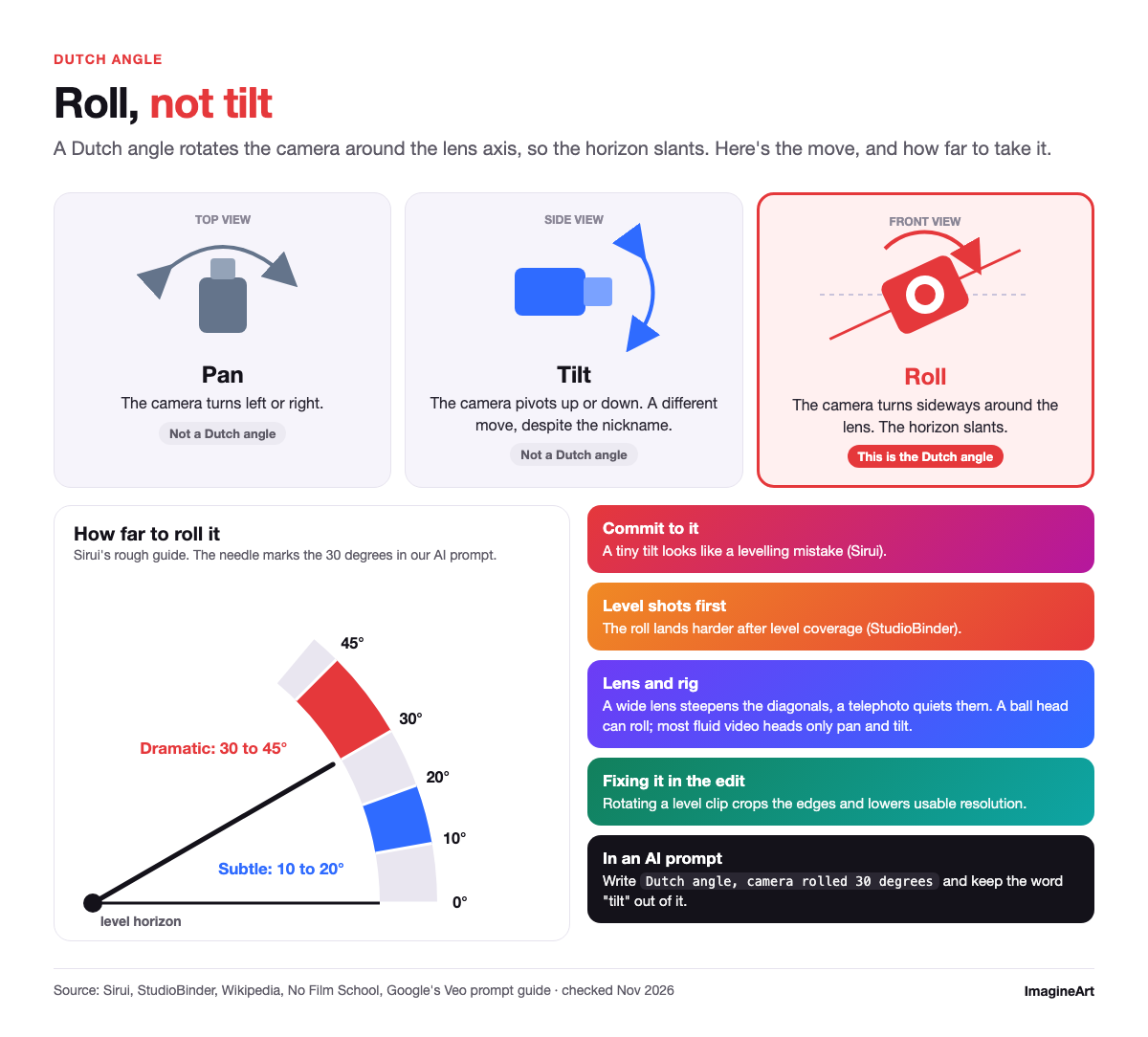 Roll, not tilt: how far to roll a Dutch angle
How to get the roll from an AI video model
Our starting wording: name the angle, give the roll a number, and keep the word "tilt" out of it. The three runs below let you check whether that holds. The reason is vocabulary: to a filmmaker a tilt is an up-and-down move, so "the camera tilts" can be read as the wrong instruction, while "canted frame" describes the roll itself.
Google's own Veo prompting guide lists the term, with a character running down a hallway as its example, and warns that some advanced angles aren't officially supported and results may vary.
In AI Film Studio the angle goes in your brief, not a button. Write it like a director (who's in frame, where, what mood), set the lens and focal length, choose the Noir genre, then animate the shot in Create Video.
Try this prompt in AI Film Studio with the Noir genre and the widest focal length on offer: "Dutch angle: the camera is rolled about 30 degrees clockwise, so the hallway walls and ceiling lights run diagonally across the frame. Static camera. Medium close-up of a detective in his fifties in a damp trench coat, standing in a narrow apartment hallway lit by one flickering bulb. He slowly turns his head toward a door at the end of the hall that has just creaked open. Cold blue shadows, warm sodium light from the stairwell, shallow depth of field. No text, no watermark."
For a control shot, rerun it with the first sentence swapped for "Eye-level shot with a perfectly level horizon." and compare the pair.
Then test the wording. Keep the scene and swap only the angle phrase. One way to run it: ImagineArt's AI video generator with Kling 4.0 at 16:9.
| Run | Angle phrase | What to look for |
|---|---|---|
| A | "Dutch angle, camera rolled 30 degrees" | A rolled frame from the start |
| B | "canted frame, the horizon slanted about 30 degrees" | The same roll, in plain words |
| C | "the camera tilts as he turns" | A vertical tilt instead of a roll |
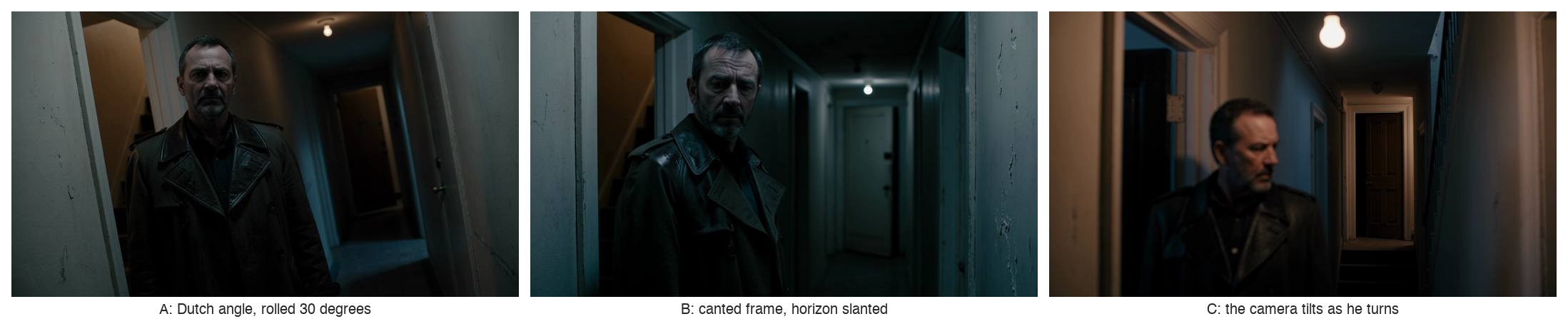 The three runs side by side: A, B and C
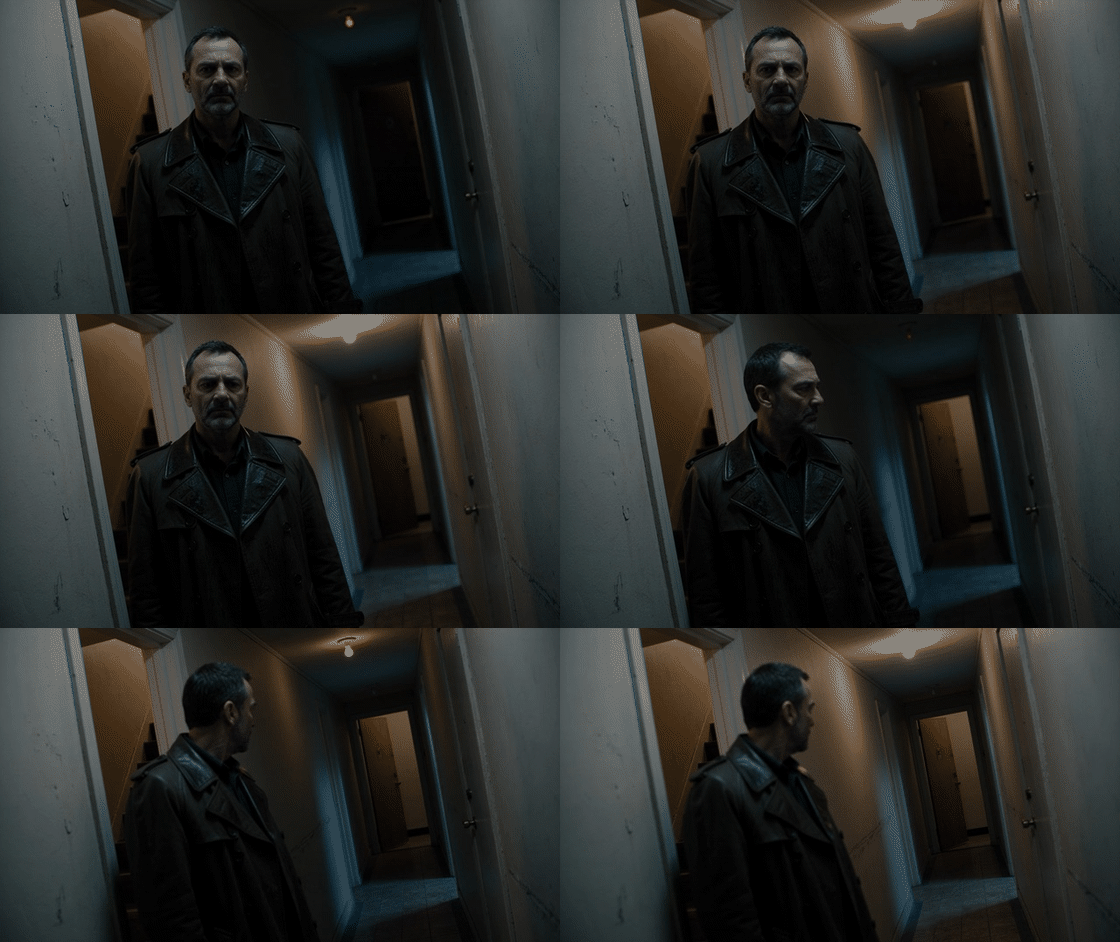 Run A: "Dutch angle, camera rolled 30 degrees"
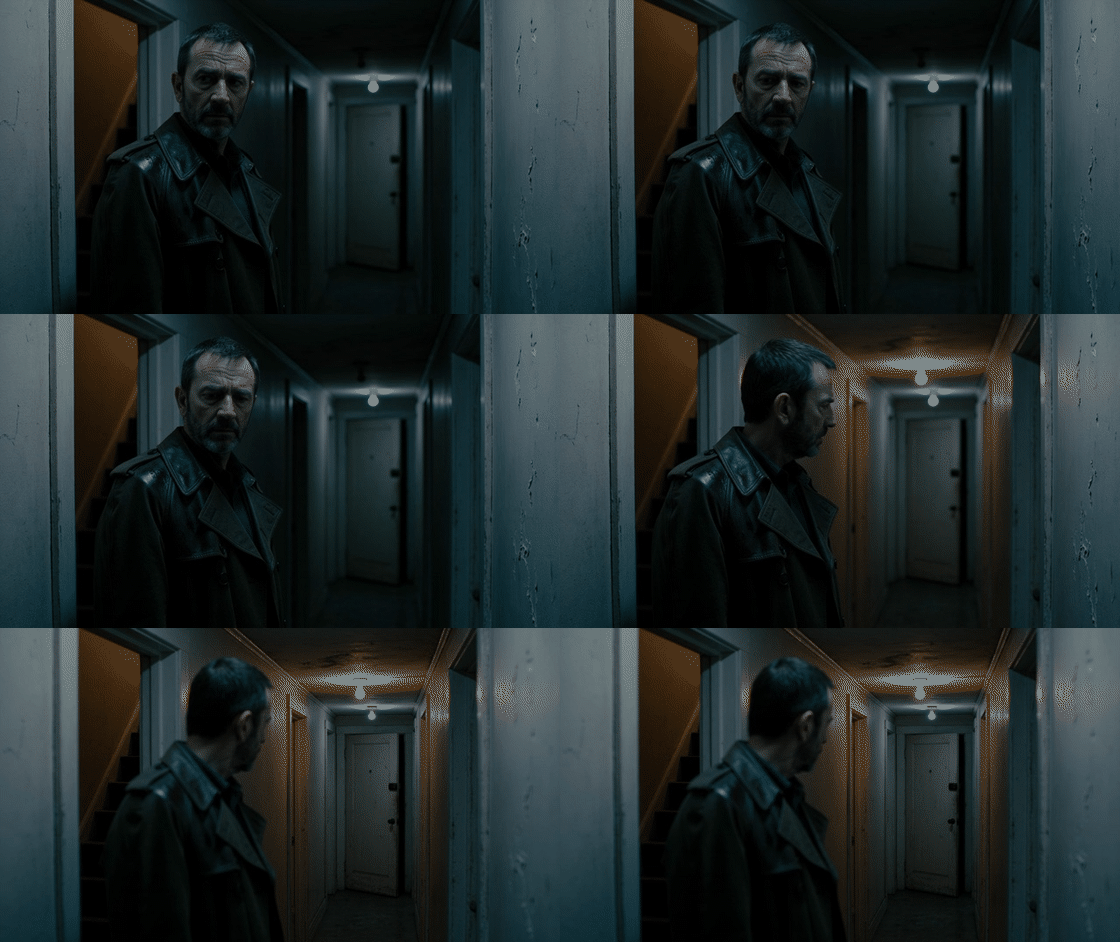 Run B: "canted frame, the horizon slanted about 30 degrees"
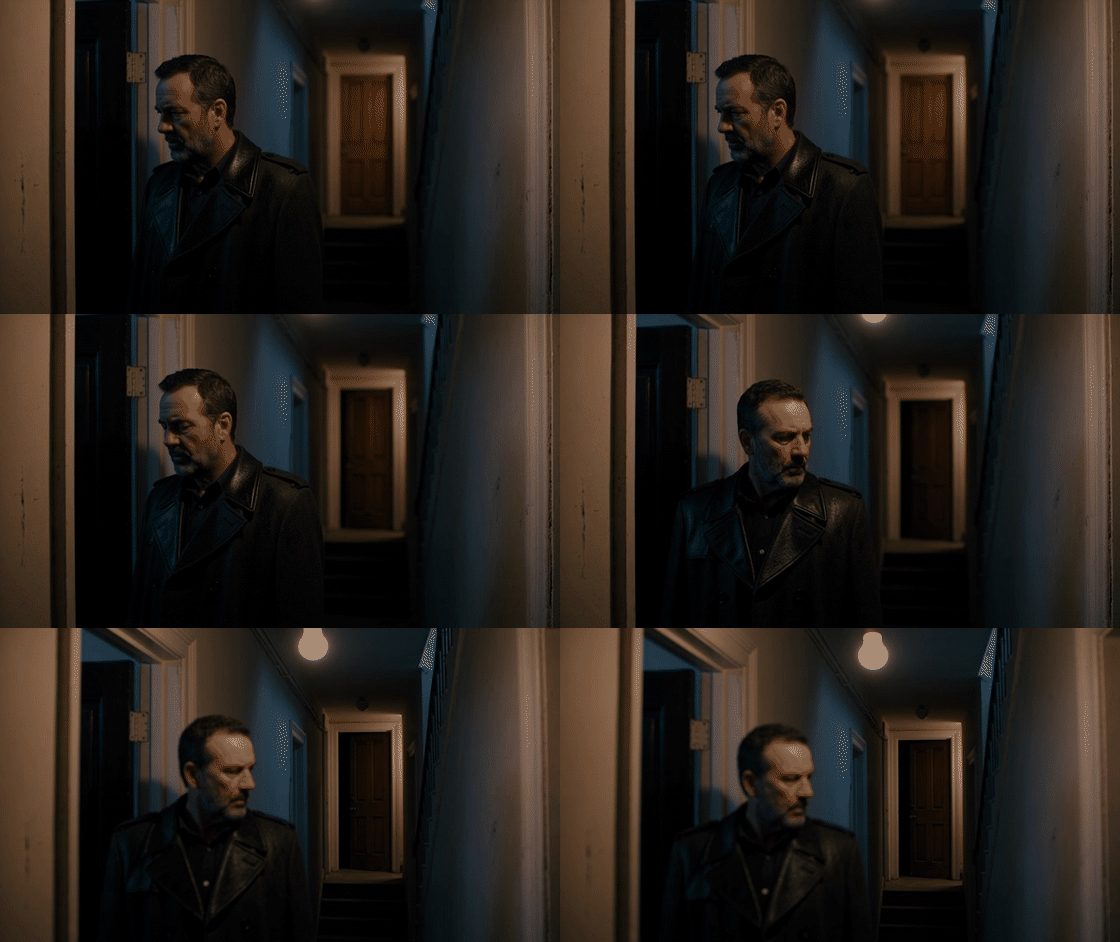 Run C: "the camera tilts as he turns"
In all three, watch for drift back to level. Our AI video prompts guide has more camera wording to test.
Frequently asked questions
It makes a scene feel unstable, as if something is wrong. Paired with height it also shifts power: from below a tilted figure looms, from above they look small and disoriented.
Thor (2011) rolls the frame for mood shifts, and does it so often that No Film School's writer felt it drained the tension and muddled some fights.
It's usually the cowboy shot: a frame from roughly mid-thigh up, named for Westerns that kept the gunslinger's holster in view. It's a size, not a tilt.
Yes. Rotate the clip in your editor, but expect a crop at the edges and some lost resolution.
Sirui suggests roughly 10 to 20 degrees for a subtle roll and 30 to 45 for a dramatic one. Go too small and it reads as a mistake.
Lean with a reason
It's a roll, not a tilt, and it works best as one well-timed shove after a run of level frames. The Third Man and Mission: Impossible show the payoff; Thor and Battlefield Earth show the cost of rolling every other shot.
With an AI model, start by naming the roll and giving it a number of degrees, then use the wording test above to see whether "tilt" throws it off. Then make the level version too, because a crooked frame only means something next to a straight one. Write your hallway brief in AI Film Studio and see how far 30 degrees goes.
Zahida Misher
Exploring how AI transforms marketing, I help businesses unlock growth and future-proof their presence.
View all articlesRecent posts

The Best AI Avatar Generators In 2027: 11 Tools Compared And Ranked
50 Types of Art Styles: Definitions, Examples and AI Prompts
How to Edit Images With Ideogram 4.6: 38 Edits, Prompts and Results