
Tooba Siddiqui
August 11, 2026 • Updated August 11, 2026
13 mins Read
Jewelry photography has always had two jobs: show the product, and make someone feel something about it. The best shoots do both at once — a ring on a marble pedestal tells you it exists; a ring breaking through dark water tells you what it means to wear it.
In 2026, the range of what a jewelry photoshoot can look like has expanded fast. The Chanel-tier architectural editorial and the Gen Z TikTok-coded color shoot are both legitimate and being done at high quality. The question is which one serves the story your brand is trying to tell — and in some cases, whether you need both in the same campaign.
15 Jewelry Photography Ideas to Try in 2026
Here are 15 jewelry photography ideas tested across AI tools and real visual references, from the most elite to the most scroll-stopping.
1. Architectural Pedestal Editorial
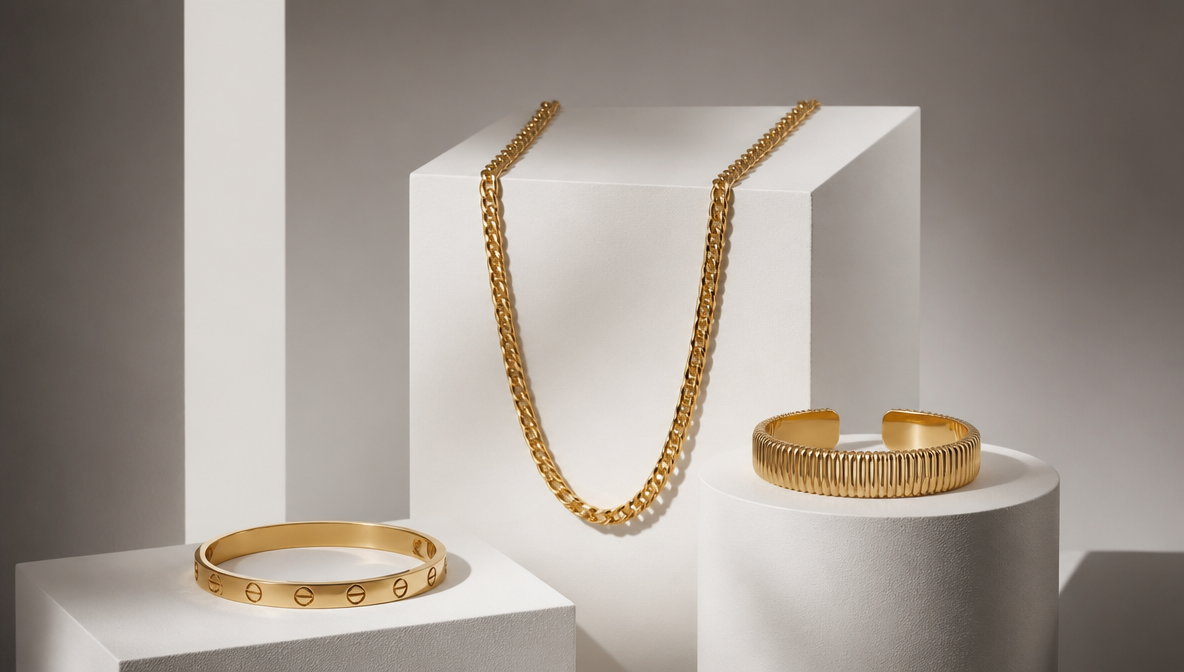 Pedestal jewelry photography -- generated by ImagineArt AI image generator
White geometric risers at varying heights, warm neutral background, gold jewelry distributed across the levels — some pieces higher, some draped across edges, a chain falling between blocks. The composition is spatial and intentional, like a sculpture installation rather than a product display.
What makes it work is the relationship between pieces rather than the pieces alone. The eye moves between the levels, making visual connections between the bangle, the cuff, and the chain. It reads as editorial even when the background is completely blank.
Prompt: "Luxury jewelry editorial, gold bangle bracelet, chain necklace, and cuff arranged on white geometric pedestals at varying heights, warm grey gradient background, architectural composition, soft studio lighting with gentle shadows, photorealistic"
Visual direction: Stick to warm neutrals — off-white, warm grey, cream. The gold needs a background that doesn't compete with it.
2. Dark Water Emergence
A hand or wrist rising from dark, still water — jewelry catching the only light in the frame. The water surface reflects the movement. The mood is dramatic, cinematic, aspirational. The darkness makes the metal and stones the brightest things in the image, which is exactly where attention should go.
This is the highest-drama idea on this list and the one closest to a classic luxury campaign. Chanel has done versions of this. Cartier has done versions of this. The reason it keeps coming back is that it works: dark water and precious metal is a combination with no bad camera angles.
Prompt: "Luxury jewelry campaign, elegant hand emerging from dark still water, diamond ring and diamond watch on wrist, dramatic rim lighting illuminating the jewelry, dark moody background, water droplets on skin, cinematic photography, photorealistic"
Visual direction: Rim light from one direction only. No fill light. Let the rest go dark.
3. Concentric Light Rings on Dark Reflective Surface
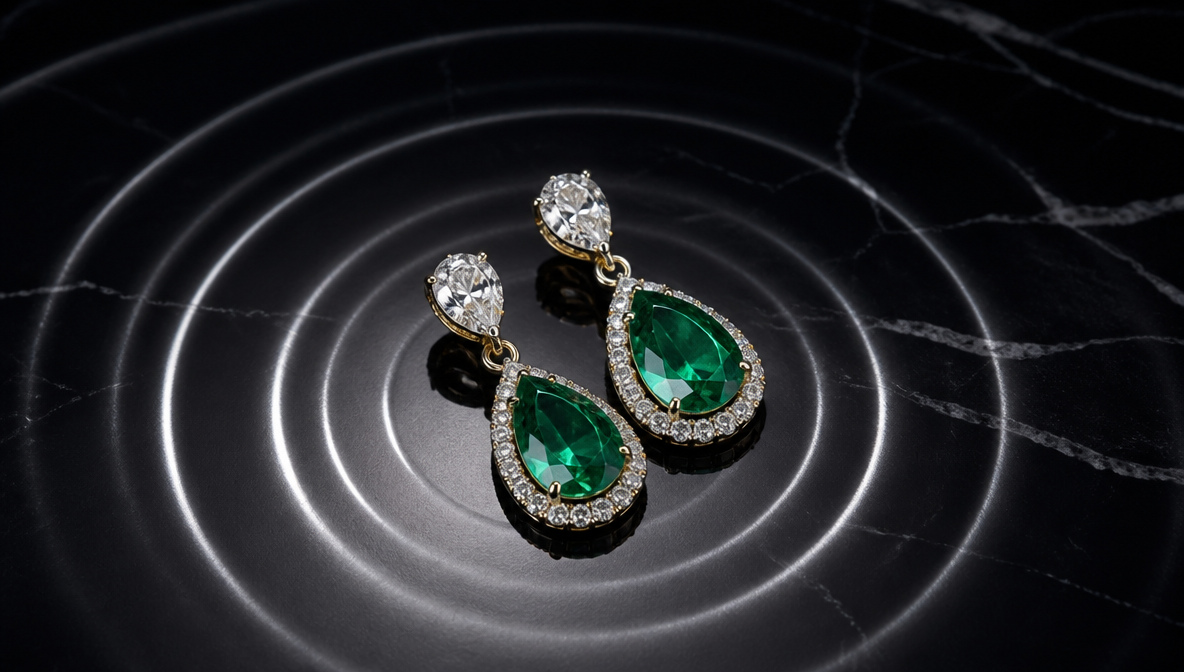 Jewelry photography on dark reflective surface -- generated by ImagineArt AI image generator
Jewelry flat on a dark reflective surface — black marble, wet glass, dark acrylic — with circular light rings radiating outward from behind or around the piece. The concentric rings make the dark background active rather than empty, and the gemstones read with extraordinary clarity against it.
The light ring effect works particularly well for colored stones because it creates a visual halo that emphasizes gem color saturation. Green emeralds, blue sapphires, and burgundy or deep red rubies all photograph at their most vivid against a very dark background with this kind of ambient ring lighting.
Prompt: "Fine jewelry flat lay, emerald drop earrings on a dark reflective black marble surface, concentric circular light rings radiating outward from behind the jewelry, dark moody background, high clarity on gemstone facets, luxury editorial, photorealistic"
Visual direction: The rings should be subtle — glowing, not harsh. Think boudoir light, not stadium.
4. Poolside Aqua Editorial
Jewelry placed on white stone or marble beside turquoise pool water — the blue-green reflection of the water bouncing onto the metal, the surface of the pool visible in the background out of focus. Summer, but expensive. The aqua reflection gives white metal a cool blue cast that reads as simultaneously tropical and luxurious.
This shoot idea has a specific color story — gold warms up in pool light in a way white gold and platinum don't. Know which metal you're shooting before deciding on this one.
Prompt: "Diamond ring on white limestone surface beside a turquoise swimming pool, aqua water reflection casting blue-green light on the jewelry, soft natural daylight, pool water visible and slightly defocused in background, luxury summer editorial, photorealistic"
Visual direction: Shoot mid-morning or late afternoon when the sun angle keeps the pool from blowing out.
5. Raw Stone and Earth Stacking
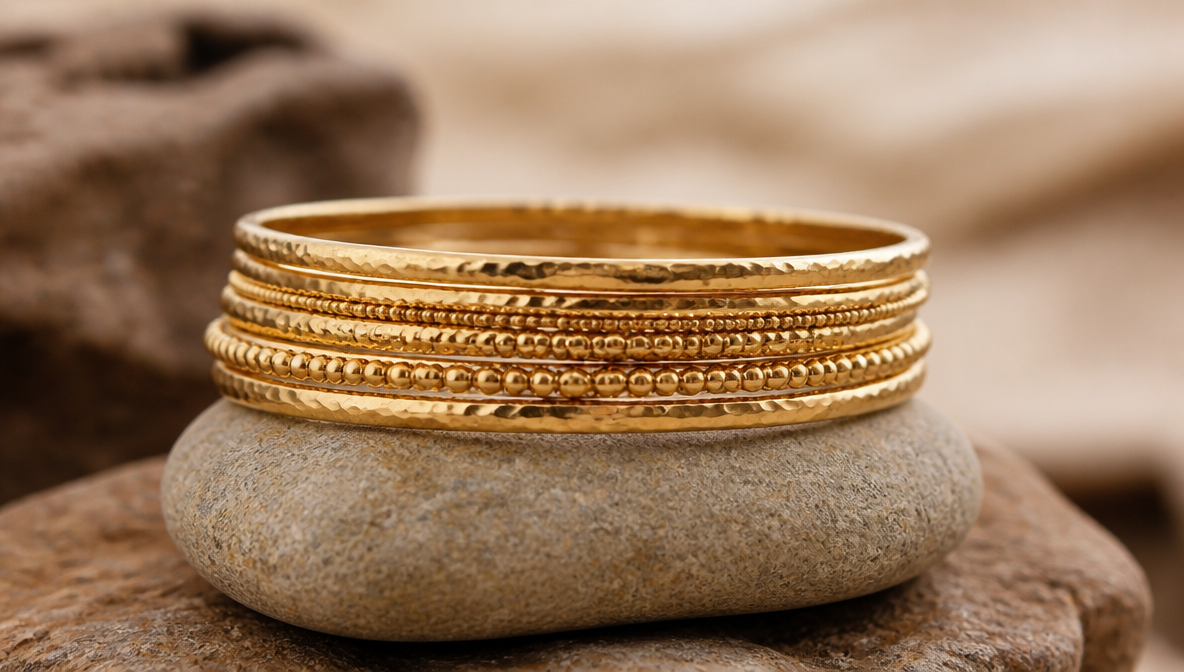 Earth stacking jewelry photography -- generated by ImagineArt AI image generator
Bangles, rings, and cuffs stacked directly on smooth river stones, rough granite, or natural rock formations. The contrast between the refined finish of the metal and the raw, unpolished texture of the stone creates a visual tension that reads as grounded and organic — luxury that doesn't need a velvet tray to announce itself.
The naturalness of the surface makes the gold look less like a product and more like something found.
Prompt: "Gold bangle bracelets stacked on smooth river stones and raw natural rock, warm neutral background, soft diffused natural lighting, organic and editorial feel, jewelry presented without a studio prop, photorealistic"
Visual direction: Vary the stone textures — smooth pebbles against rough granite gives the composition more visual interest than uniform stones.
6. Color Theory Shoot — If You See Red, You Want Jewelry
Gen Z coded, TikTok-born, and genuinely effective. A single bold color saturates the entire frame — deep red, cobalt blue, chartreuse, burnt orange — and the jewelry is the only metallic element, making it pop against the chromatic field. The color isn't background; it's the whole world of the image. The jewelry is the interruption.
This is the "if you see red, you need jewelry" idea in visual form: the color triggers a feeling and the jewelry anchors it. Red reads as desire, gold reads as reward. Blue reads as calm, silver reads as clarity. The color choice is a strategic decision, not just an aesthetic one.
Prompt: "Jewelry editorial on a deep saturated red background, gold chain necklace and ring as the only metallic elements in the frame, bold monochromatic color story, studio lighting, high contrast between warm gold and deep red, Gen Z editorial aesthetic, photorealistic"
Visual direction: One color, total commitment. No neutrals, no props in a different color family. The jewelry has to be the only thing breaking the palette.
7. Jewelry in Ice
A ring, pendant, or earrings suspended inside a clear block of ice — visible through the frozen surface, slightly distorted by refraction, real enough to reach for but just out of reach. Ice acts as its own backlight, which gives the jewelry a clarity that no other prop achieves.
This one performs consistently well on social media because it reads as both a product shot and a concept piece. The visual discomfort of jewelry being frozen is intentionally provocative.
Prompt: "Diamond ring suspended inside a clear block of ice, jewelry visible through the frozen surface with slight light refraction, clean white or pale blue background, macro detail on ice texture and ring clarity, editorial jewelry photography, photorealistic"
Visual direction: Backlight the ice block. The light travels through and illuminates the piece from within — no other lighting setup achieves this.
8. Clean Girl Tray Flat Lay
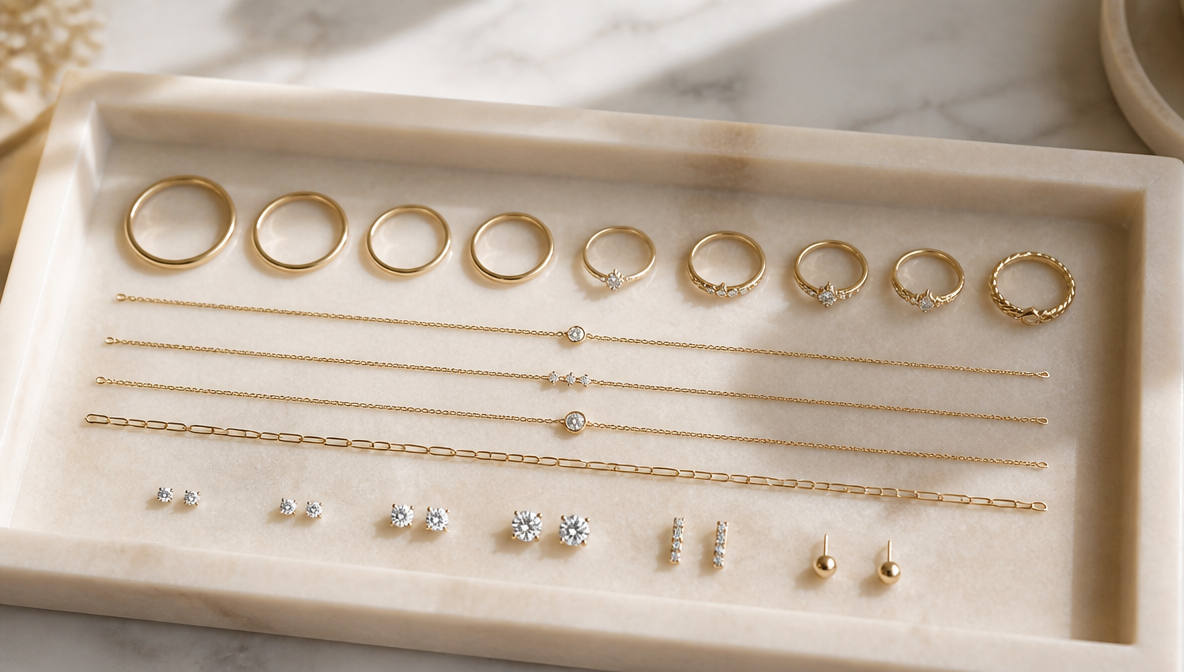 Minimalist flat lay jewelry photography -- generated by ImagineArt AI image generator
A perfectly organized velvet or marble tray — rings in a row by size, chains laid flat without tangling, studs in pairs — with natural side light and a minimal background. The aesthetic is organized, personal, aspirational in a low-key way. It looks like someone's actual jewelry collection if that person had perfect taste and unlimited storage.
This is the highest-performing format for jewelry on Pinterest and still drives significant organic reach on Instagram — the same principles that make it work for flat lays apply to product photography broadly. It suggests a lifestyle as much as it shows a product.
Prompt: "Jewelry collection flat lay on a cream marble tray, gold rings arranged in a row by size, delicate chains laid flat, diamond studs in pairs, soft natural side lighting, clean minimal background, Pinterest-style jewelry editorial, photorealistic"
Visual direction: Every item needs its own space. Crowding kills the clean-girl aesthetic.
9. Skin Texture Close-Up
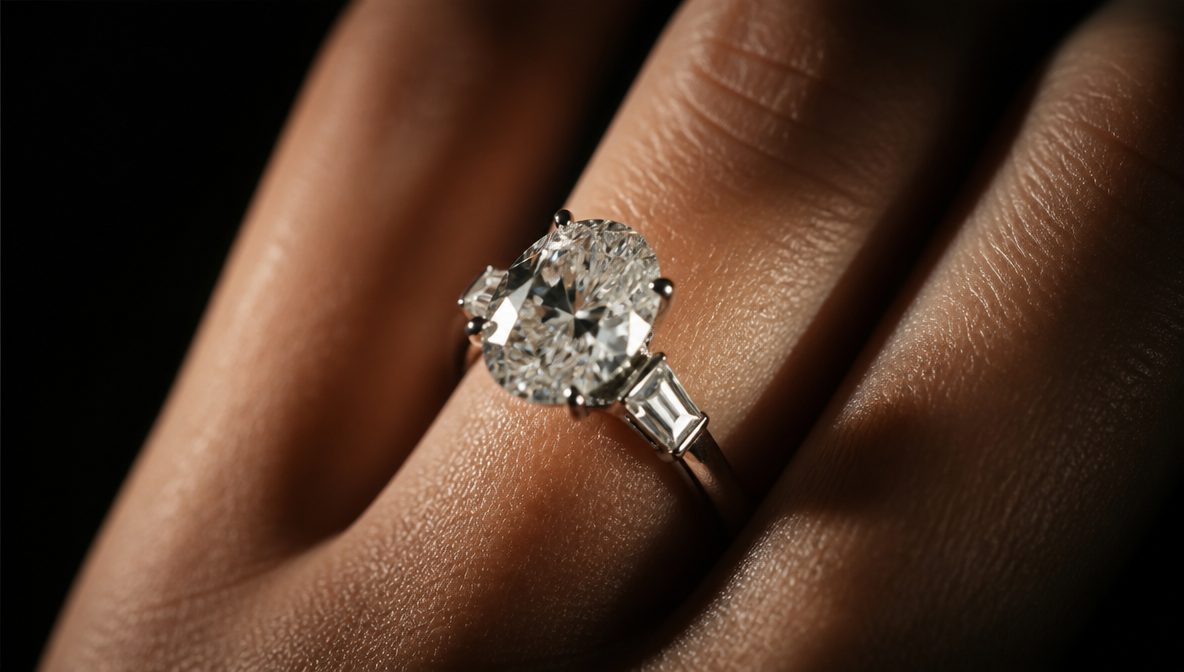 Jewelry photography with close-up skin texture -- generated by ImagineArt AI image generator
A macro shot of jewelry on skin — a ring on a finger, a pendant at the collarbone, a cuff at the wrist — with dramatic raking light that shows every texture of both the metal and the skin simultaneously. The closeness of the shot makes both the piece and the body feel equally precious.
Skin is part of the product story for jewelry. You're not photographing a ring on a hand; you're photographing what a ring looks like when it belongs to someone. The skin texture under raking light adds warmth and humanity that no pedestal can replicate.
Prompt: "Macro jewelry close-up, diamond ring on a woman's finger, dramatic raking side light emphasizing both the ring's facets and the skin texture, shallow depth of field, warm skin tone, dark background, intimate and luxurious, photorealistic"
Visual direction: Skin should be moisturized and natural. The warmth of skin tone is what makes gold jewelry glow.
10. Unexpected Surface Editorial
Jewelry placed on backgrounds and surfaces nobody expects — sliced citrus, fresh flower petals, wet glass, rough ceramic, sand, crumpled silk, the pages of an old book. The contrast between the precision of fine jewelry and the texture of an organic surface creates a compositional tension that makes both elements more interesting.
The juxtaposition is the point: a diamond ring on an orange slice is visually strange in a way that makes you look twice. Looking twice is the whole job of an editorial image.
Prompt: "Gold pendant necklace resting on a sliced orange, macro editorial jewelry photography, citrus texture visible in detail against the gold metal, warm natural lighting, clean shallow depth of field, editorial product photography, photorealistic"
Visual direction: The surface should be fresh — wilted flowers and dry fruit undermine the sense of luxury. Everything in the frame needs to feel alive.
11. Maximum Stack
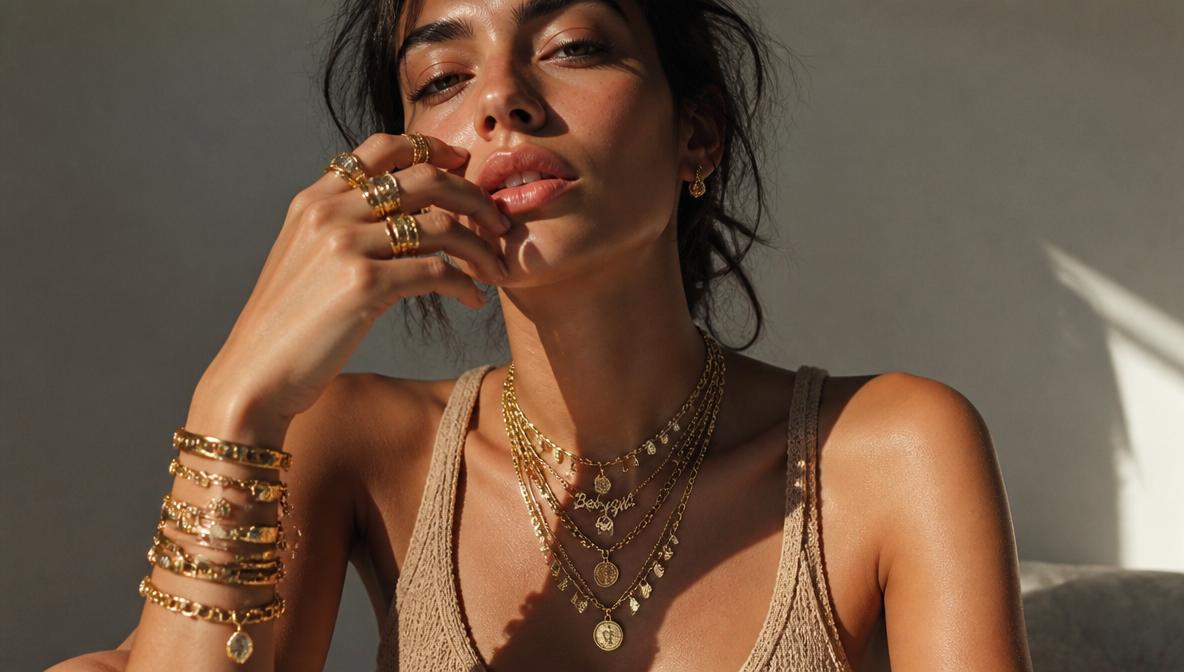 Jewelry photography with maximum stack -- generated by ImagineArt AI image generator
Maximalist stacking taken to its logical extreme — eight rings on one hand, five chains at different lengths, bangles up a forearm. This isn't about any single piece; it's about the collective visual weight of jewelry worn without restraint. The mood is confident, Gen Z, intentionally too much.
Stacking content is one of the highest-engagement jewelry formats across TikTok and Instagram because it inspires both aspiration and imitation.. Viewers want to know where each piece is from. The jewelry photography idea is also the content strategy.
Prompt: "Maximalist jewelry stack editorial, multiple gold rings on every finger of one hand, layered gold chain necklaces at different lengths, gold bangles stacked high on a wrist, confident editorial styling, natural light, Gen Z aesthetic, photorealistic"
Visual direction: Let the stacking look intentional but not rigid. Rings pushed to different positions on the finger, chains with slightly different fall lines — the perfect imperfect of how someone actually wears this much jewelry.
12. Flash Night Editorial
Hard flash photography against a dark background — the jewelry caught in the bright flat light of a direct flash, everything else falling into darkness. This is the night-out, party-era, disposable-camera aesthetic that's driven enormous engagement for Gen Z jewelry brands. The flash makes metal reflective in a completely different way from studio soft boxes.
The visual is democratic on purpose: it looks like a photo taken at a party rather than a studio, which is exactly what makes it feel authentic and desirable rather than aspirational and distant.
Prompt: "Jewelry flash photography editorial, gold layered necklaces on a model at a party, hard direct flash lighting creating high contrast, dark background, party atmosphere, slightly raw and real aesthetic, Gen Z night editorial, photorealistic"
Visual direction: Overexpose slightly and let the metal burn out a little. The slightly blown highlights on metal in flash photography are part of the aesthetic, not a mistake.
13. Mirror and Double Reflection
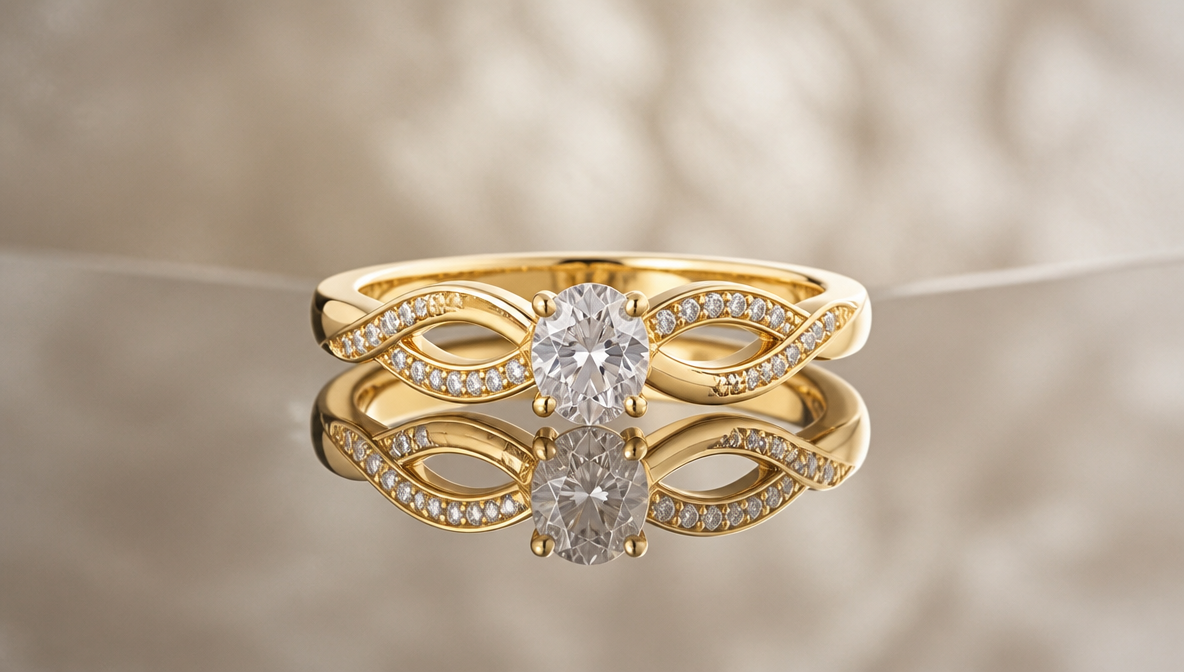 Double reflection jewelry photography -- generated by ImagineArt AI image generator
Jewelry photographed on, near, or reflected in mirrors — creating doubled imagery, infinite reflections, or compositions where the real piece and its reflection are both visible and roughly equal in the frame. The conceptual dimension is about repetition and perception: which is the real ring, which is the reflection?
This works particularly well for high-concept jewelry brands and independent designers because it suggests depth and meaning beyond the product.
Prompt: "Fine jewelry editorial, gold ring resting on a mirror surface with perfect reflection below, both the ring and its reflection equally visible and sharp, soft neutral background, elegant minimal composition, luxury jewelry photography, photorealistic"
Visual direction: Keep the mirror surface clean and dry. A single fingerprint ruins the perfect reflection.
14. Cinematic Motion Campaign
Jewelry in movement — a hand mid-gesture with rings catching the light, chains swinging with the motion of a turned head, a bracelet blurred by a raised wrist. The jewelry is sharp; everything around it is in motion. This implies a life being lived, not a piece being displayed.
The motion doesn't need to be extreme. A slight gesture photographed at the right shutter speed captures enough movement to make a static image feel alive.
Prompt: "Jewelry campaign, woman's hand mid-gesture with diamond rings catching light, background and surrounding elements in slight motion blur, rings sharp and clear, warm natural light, cinematic movement, luxury editorial photography, photorealistic"
Visual direction: Freeze the jewelry, blur the context. Motion blur on the piece itself looks like a mistake.
15. Negative Space Minimalist
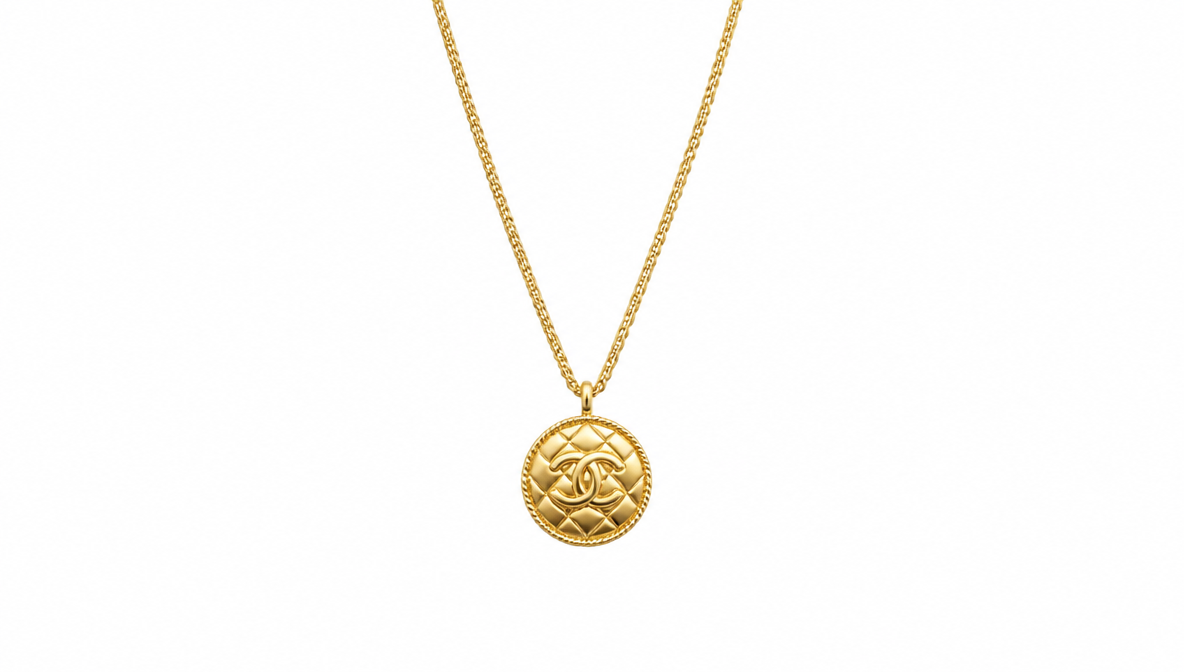 Jewelry photography with white space-- generated by ImagineArt AI image generator
A single piece of jewelry — one ring, one pendant, one earring — centered in an ocean of white or cream space. Nothing else. No props, no surface texture, no environmental context. Just the piece and the space around it. This is the Chanel approach: restraint as confidence, emptiness as luxury.
The image communicates that this piece doesn't need a supporting cast. The negative space isn't emptiness — it's editorial authority.
Prompt: "Single gold pendant necklace centered in a large expanse of pure white space, soft diffused even lighting with no shadows or surface texture, pure minimalist jewelry editorial, one piece with nothing else in the frame, Chanel aesthetic, photorealistic"
Visual direction: Center or very slightly off-center. Dead center reads as product catalog; slightly off reads as editorial. Know which you're making.
How to Do Jewelry Photography with ImagineArt
- Generate your scene with ImagineArt AI image generator. Use the AI product photography app and drop in your product image or describe the piece via prompt. Pick your concept — pedestal editorial, poolside, dark surface — and generate a batch of 8 variations at once to find the strongest composition before committing to a direction.
- Refine with ImagineArt AI image editor. Once you have a strong base image, use ImagineArt AI image editor to correct the detail work: sharpen individual facets on a gemstone, fix any text or hallmark rendering on the metal, adjust lighting per surface so the gold behaves differently from the stone setting, and clean up any background inconsistencies. This is the step that takes a good AI generation to something that reads as professionally retouched.
- Generate model and lifestyle versions via the Fashion Studio. If the jewelry needs to be shown on skin — a ring on a hand, a pendant at the collarbone — take your approved product image into the Fashion Studio and place it on an AI model without a physical shoot. Skin tone, hand position, lighting direction, and setting are all controllable from the same interface.
- Build out the full campaign asset set with Workflows. Once the hero image is approved, use ImagineArt AI Workflows to generate platform-specific crops and format variations automatically — 1:1 for Instagram feed, 9:16 for Reels and Stories, 16:9 for YouTube and display ads — without manually reworking each one. Swap the product for a new SKU and the entire asset set regenerates in minutes.
Start Shooting
The fifteen ideas above cover the full range from quiet architectural restraint to maximum Gen Z visual noise — and the AI prompts work across ImagineArt 2.0, Seedream 5, and Nano Banana Pro depending on how much post-production polish the output needs.
The only rule: pick the idea that matches the story your piece is trying to tell, not just the one that looks impressive in isolation.
Tooba Siddiqui
Tooba Siddiqui is a content marketer with a strong focus on AI trends and product innovation. She explores generative AI with a keen eye. At ImagineArt, she develops marketing content that translates cutting-edge innovation into engaging, search-driven narratives for the right audience.