Arooj Ishtiaq
August 5, 2026 • Updated August 5, 2026
10 mins Read
Editorial photography is a type of photography built to tell a story or portray a concept rather than to sell a product directly. Understanding the distinction matters for any fashion brand deciding what kind of imagery to commission, because editorial and commercial photography solve genuinely different problems, even when they end up sitting on the same brand's product page or social feed. This guide covers what actually makes a shoot editorial rather than commercial, with real examples.
What Is Editorial Photography?
Editorial photography is photography intended to inform, engage, or tell a story, commonly found in magazines, newspapers, editorial features, and journalism. It's historically distinguished from commercial photography by one core distinction: editorial images aim to express or engage, not to sell.
A useful way to separate the two comes down to intent and context rather than visual style alone. A photograph of a rock climber ascending a mountain, used to accompany a magazine article about rock climbing, is an editorial photograph. The same image, used in an advertisement for climbing gear, becomes a commercial photograph. The image itself might look identical. What changes is the purpose it's serving.
Editorial vs. Commercial Photography
The distinction between editorial and commercial photography isn't just a matter of visual style—it dictates every decision made before, during, and after a shoot. While a commercial photograph is built to eliminate hesitation and drive a transaction, an editorial photograph is engineered to evoke a feeling, spark narrative curiosity, or document a moment in time.
| Dimension | Editorial Photography | Commercial Photography |
|---|---|---|
| Primary Objective | Tell a story, communicate a concept, or express a creative vision. Artistic impact and emotional engagement matter more than direct sales. | Promote and sell a product, service, or brand. Success is measured through conversions, engagement, and marketing performance. |
| Garment & Product Framing | Clothing supports the visual narrative. Fabrics, textures, or details may be partially hidden, blurred, or creatively lit to reinforce the mood. | The garment is the main subject. Color, texture, stitching, fit, and construction must remain accurate, clearly visible, and consistent across every image. |
| Creative Direction | Photographers, art directors, and fashion editors have significant creative freedom to experiment with composition, styling, and storytelling. | Creative decisions follow brand guidelines, campaign objectives, and client requirements to maintain a consistent visual identity. |
| Retouching & Editing | Editing is generally restrained, especially in journalism and documentary contexts, where altering or removing visual elements is ethically discouraged. | Extensive retouching is common, including skin cleanup, background replacement, object removal, color correction, and product enhancement. |
| Licensing & Legal Requirements | Editorial use may not require model or property releases when published for journalism, commentary, education, or news reporting, depending on local laws. | Commercial use typically requires signed model and property releases for any recognizable people, locations, or private property used in advertising and marketing. |
What This Means Practically for Releases and Usage Rights
The usage-rights distinction above isn't a technicality. It has real consequences for how a brand can actually use a shoot afterward.
If a shoot is genuinely editorial- magazine placement, press coverage, cultural commentary- it generally doesn't need a model release, since editorial use is treated as journalism rather than advertising. The moment that same image gets repurposed into a paid ad or a product page, it typically needs a model release and, if a recognizable location or property appears, a property release too.
Brands producing "editorial-style" campaign content intended for commercial use should secure releases upfront, at the time of the shoot, rather than assuming that editorial-style visuals carry editorial-level legal protection. The style of an image and its legal usage category are two separate things, and conflating them is a common, avoidable mistake.
How Editorial Photography Applies to Fashion
Fashion photography occupies a distinctive position in this framework. It's frequently editorial in style even when a brand ultimately uses it for commercial purposes. A fashion magazine feature showcasing a season's trends through styled, narrative imagery is editorial in the traditional sense, telling a story without the need for accompanying text.
A brand's own campaign photography often borrows heavily from editorial visual language, mood, styling, narrative composition, even when its ultimate purpose is closer to commercial than pure journalism.
This is why the fashion industry treats "editorial" more as a visual and creative style than a strict legal or usage category. A brand producing what it calls an "editorial shoot" is usually describing atmosphere and creative approach: styled locations, expressive poses, mood-driven lighting, rather than making a formal claim about the image's eventual commercial usage rights.
The Anatomy of an Editorial Shoot: From Mood Board to Pull Letters
Unlike catalog photography—where the goal is standardized lighting across 50 garments—an editorial shoot functions like a short film. Executing an editorial shoot requires a distinct pre-production pipeline:
- The Narrative Concept & Mood Board: Every editorial starts with a central theme (e.g., "70s Cinematic Nostalgia" or "Cyberpunk Utility"). The mood board dictates lighting temperature, grain, location texture, and talent expressions.
- Fashion Styling & Pull Letters: In traditional magazine editorial, stylists use a "pull letter" (a formal request backed by a publisher) to borrow sample garments from fashion houses. The outfit choice serves the story first and commercial availability second.
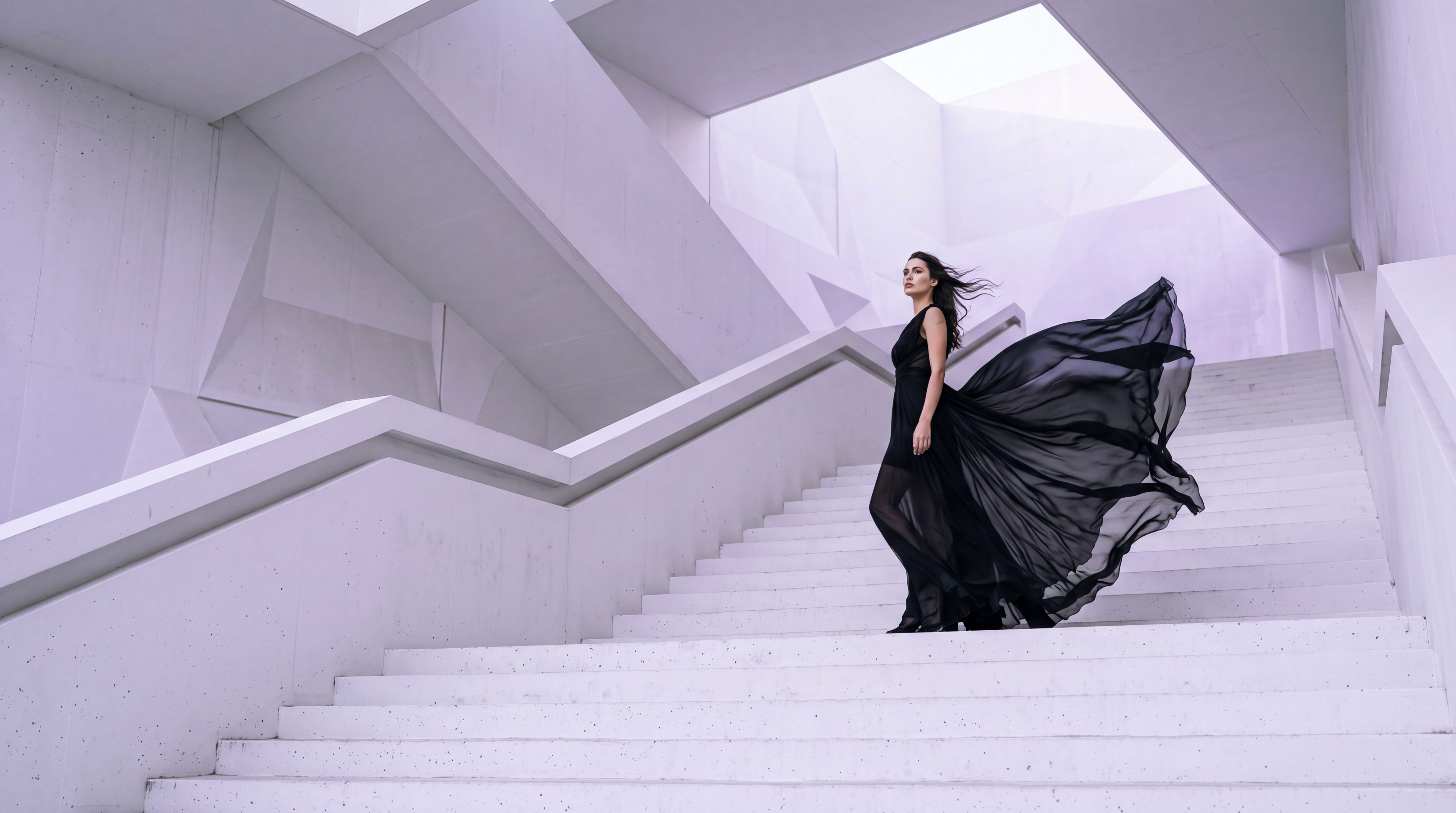
- Location Scouting & Art Direction: Locations are treated as characters. Whether shooting in a brutalist concrete building or an overgrown meadow, the environment must interact with the garment's texture and silhouette.
What Makes a Photography Style Read as Editorial
A handful of visual and structural qualities consistently distinguish editorial-style imagery from straightforward commercial or catalog photography:
- Narrative over clarity. The image prioritizes mood, story, and emotional engagement over pure product visibility or accuracy.
- Styled, specific environments. Rather than a neutral studio backdrop, editorial imagery typically places its subject in a considered location or set that reinforces a concept or season.
- Expressive, directed poses. Editorial photography tends to use more dynamic, emotionally expressive posing than the straightforward, consistent poses typical of catalog photography.
- Deliberate art direction. Color grading, lighting mood, and composition choices work together toward a specific creative concept rather than simply presenting the subject clearly.
Real-World Examples of the Editorial vs. Commercial Distinction
- A magazine feature on a Canadian fashion week showcasing winter street style is editorial. The goal is storytelling and cultural commentary, not selling a specific product.
- A local brand's social ad promoting a seasonal sale on the same style of outerwear is commercial. The same visual subject matter, but the goal has shifted entirely to driving a purchase.
- A rock climber photographed mid-ascent for a magazine article about the sport is editorial. The identical image, licensed for a climbing gear advertisement, becomes commercial the moment its purpose changes, even though the photograph itself never changes.
Professional photographers frequently blend both approaches in practice, borrowing editorial storytelling technique to create polished, high-quality commercial images that still evoke genuine emotion rather than reading as purely transactional. This is exactly what fashion brands are doing when they commission "editorial-style" campaign photography.
Editorial Photography vs. a Lookbook
Editorial photography as a general style is worth distinguishing from a fashion lookbook specifically, since the two get conflated often. Editorial photography is the broader creative category, storytelling imagery, whether for a magazine feature, a campaign, or press coverage. A lookbook is one specific deliverable that borrows editorial visual language but is anchored to a buyable collection rather than existing purely as story or press content.
How to build a fashion lookbook covers the practical, deliverable-focused version of this, and editorial fashion photography ideas for your next campaign covers mood and location ideas specifically for a fashion-branded editorial shoot.
Producing Editorial-Style Photography Without a Traditional Shoot
The primary reason editorial photography has traditionally been out of reach for independent or scaling fashion brands is the cumulative cost of pre-production. Booking a unique location, paying permits, hiring an art director, securing high-tier talent, and paying for travel can easily turn a single editorial story into a five-figure expense.
Generative tools and specialized AI platforms narrow this gap by allowing creators to synthesize complex environmental lighting, location depth, and expressive posing directly from existing catalog or mannequin inputs. However, translating a simple product shot into a convincing editorial visual requires shifting from technical garment descriptions to cinematic and environmental syntax.
When prompting for an editorial aesthetic versus a commercial catalog look, the structure of your visual instructions changes completely:
-
Catalog Prompting Syntax (Focuses on Accuracy & Isolation):
"Full-length commercial studio photograph of a model wearing a charcoal wool overcoat. Clean, seamless light grey backdrop. Soft studio softbox lighting, perfectly balanced exposure, sharp focus on fabric weave and button detail, neutral posture, straight-on camera angle."
-
Editorial Prompting Syntax (Focuses on Atmosphere, Mood, & Physics):
"Cinematic editorial fashion photograph for a winter campaign. Model in mid-stride walking down a rain-slicked Tokyo street at dusk. Wearing a dramatic oversized charcoal wool coat with lapels catching a soft breeze. Dynamic low-angle framing, 35mm film texture with subtle grain, deep moody shadows with warm golden hour reflections from shop windows, natural motion blur in the background, high-fashion editorial styling."
By instructing the generator on lens choice (35mm, 85mm portrait), lighting temperature (golden hour, dramatic rim lighting, overcast diffusion), and physical atmosphere (rain-slicked, wind-blown, dappled sunlight), you can generate high-impact narrative imagery around a
Related Fashion Photography Resources
For tools that can produce editorial-style imagery without a traditional location shoot, the best AI fashion model generators of 2026 compares nine platforms directly, and what an AI fashion model actually is explains the underlying technology and addresses realism skepticism.
Conclusion
Editorial photography is defined by intent and creative freedom as much as by any specific visual style. It tells a story rather than selling a product, and it follows a different ethical and usage framework than commercial work, one that requires proper releases the moment editorial-style imagery gets used commercially.
Fashion brands regularly borrow its visual language for campaigns and lookbooks, even when the underlying purpose is commercial. AI Fashion Studio's editorial mode makes that visual language producible from the same workflow used for catalog shots, without the location, creative team, and talent costs a traditional editorial shoot requires.
Frequently Asked Questions
What is the main difference between editorial and commercial photography?
Editorial photography exists to tell a story or communicate a concept, without a direct commercial purpose. Commercial photography exists specifically to promote or sell a product, service, or brand, and typically involves closer alignment with a client's marketing goals and brand guidelines.
Can editorial photography be used in advertising?
Generally not without additional releases. Editorial photographs typically require a model release and/or property release before being used in advertising, and images containing recognizable branding or logos are often restricted to editorial use only.
Do I need a model release for an "editorial-style" brand campaign?
If you intend to use the images commercially, in ads, on product pages, in paid social, yes. The visual style being editorial doesn't grant editorial legal protection. Secure model and property releases at the time of the shoot regardless of the creative style.
Is fashion photography always editorial?
No, but it frequently borrows editorial visual language. A magazine feature showcasing seasonal fashion trends is genuinely editorial. A brand's campaign or lookbook imagery may use an editorial style and mood while ultimately serving a commercial purpose.
Why has editorial-style photography traditionally been harder for small brands to produce?
Editorial shoots typically require a creative director, a specific location, a stylist, and talent, all of which make each shoot expensive and time-consuming compared to a standard catalog session. This has historically limited editorial-style content to brands with larger production budgets.
Arooj Ishtiaq
Arooj is a SaaS content writer specializing in AI models and applied technology. At ImagineArt, she creates sharp, product-focused content that helps creators and businesses understand, adopt, and get real value from AI tools.