
Tooba Siddiqui
August 3, 2026 • Updated August 3, 2026
10 mins Read
You have less than three seconds. That is how long it takes someone to decide whether your ad is worth watching or worth skipping. Not the offer. Not the price. Not the call to action. Just the opening line or the first frame.
This is why meta ads hooks matter more than almost any other part of your creative. A weak hook buries a great offer before anyone sees it. A strong hook can carry a mediocre offer further than you would expect. If you are running campaigns on Facebook or Instagram and your ads keep getting scrolled past, the hook is almost always the first place to look.
This guide breaks down what makes meta ads hooks work, the formulas that consistently perform, and how the approach shifts depending on whether you are selling a physical product to consumers or software to a business buyer. You will also get a simple process for writing, testing, and scaling your hooks so you are not guessing every time you launch a new campaign.
What Are Meta Ads Hooks and Why They Matter
A hook is the first two to three seconds of a video ad, or the first line of copy above an image ad. It is the single moment where your ad earns the right to keep someone's attention. Everything else, the product demo, the testimonial, the offer, the call to action, only gets seen if the hook does its job first.
Meta's delivery system rewards ads that hold attention early. When your hook underperforms, your ad gets less reach even if your targeting and budget are set up correctly. This is why marketers track thumb-stop rate and 3-second view rate as leading indicators, often before they even look at click-through rate or cost per result. If you want a deeper breakdown of that specific metric, what is hook rate covers the formula and current benchmarks.
The takeaway is simple. Good meta ads hooks are not a nice-to-have layer of creativity on top of your strategy. They are the gatekeeper that decides whether the rest of your strategy gets a chance to work at all.
The Anatomy of a High-Converting Hook
 Generated by ImagineArt AI Image Generator
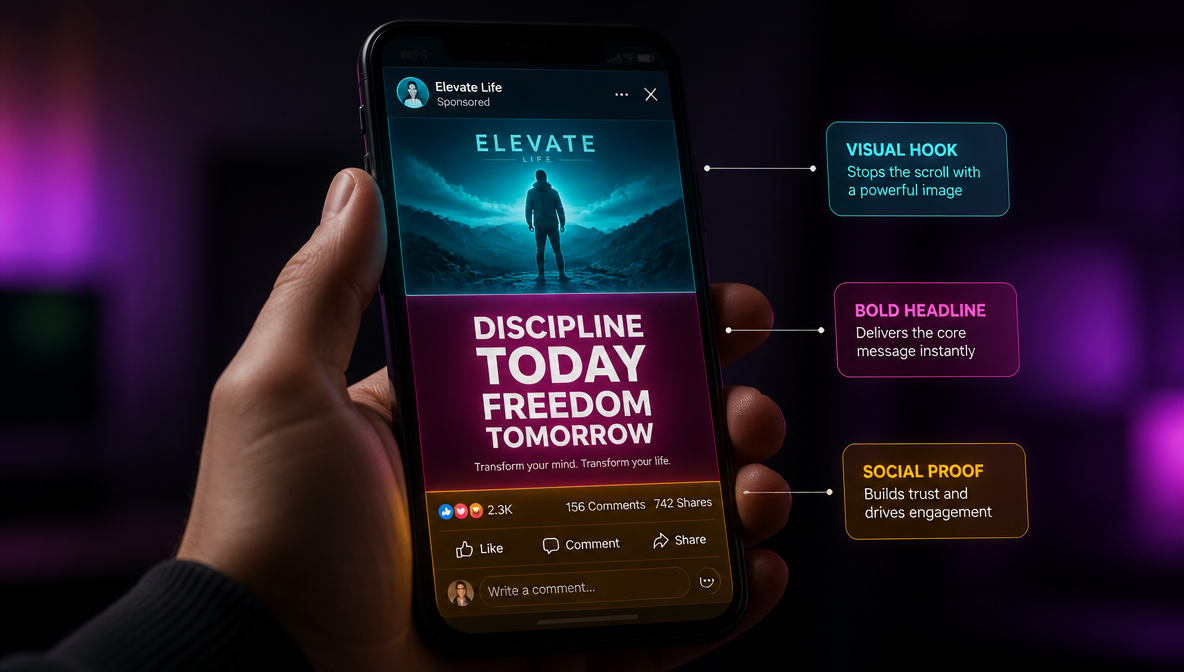
Every meta ads hook that performs well is built from three parts working together. Missing any one of them weakens the whole ad.
The Visual Hook
This is the first frame someone sees, whether that is a video thumbnail or a static image. It needs to interrupt the scroll pattern. Bright contrast, unexpected motion, or a close-up that does not immediately explain itself all work well here. A logo or polished studio shot in the first frame tends to signal "ad" instantly, which is the opposite of what you want.
The Verbal Hook
This is the spoken line in a video or the headline text in a static ad. It should name a specific situation your audience recognizes in themselves, not a generic benefit. "Save time on reporting" is forgettable. "If you are still exporting spreadsheets every Friday night, this is for you" creates instant recognition.
The Emotional Trigger
Underneath the visual and verbal layers, every effective hook taps a specific emotional driver. That might be curiosity, mild fear of missing out, identity ("people like me"), or plain frustration with a known problem. Naming the trigger you are going after before you write the hook makes the writing process much faster.
Best Hooks for Meta Ads: Proven Formulas
If you want a starting point instead of a blank page, these formulas cover most of what makes meta ads hooks perform well across categories. For a longer reference list, 50 best ad hooks for social media breaks down dozens more by platform and format, and advertising hook examples shows real ads using each mechanism.
- Problem-agitate hook. Name the problem, then twist the knife slightly before offering relief. "Your ad spend is climbing and your results are not. Here is why."
- Bold claim or stat hook. Open with a specific, provable number. "We cut our cost per lead by 62% in three weeks."
- Direct callout hook. Speak straight to the audience. "If you run a Shopify store doing under $50K a month, watch this."
- Question hook. Ask something your audience is already asking themselves. "Why does your best-performing ad suddenly stop working?"
- Before and after hook. Show contrast immediately, visually or verbally, without needing an explanation.
- Myth-busting hook. Challenge a common belief in your category. "More ad spend is not what is killing your ROAS."
- Social proof hook. Lead with a number or a name that establishes trust fast. "1,200 marketers switched to this last month."
- Pattern interrupt hook. An unexpected visual or action that has nothing obviously to do with the product yet, which buys a second or two of attention before the pivot.
None of these formulas work in isolation forever. The best-performing accounts rotate through several of them and let the data decide which one earns its place in the budget.
What Hooks Work Best for DTC Meta Ads in 2026
Consumer brands are seeing the strongest results from hooks that do not look like ads at all. Native, low-production, UGC-style openings consistently outperform polished studio content because they match what people expect to see from a friend or a creator, not a brand.
A few patterns worth testing:
- Founder or customer-led hooks. A real person speaking directly to camera about a specific result, not a scripted testimonial, feels more credible.
- Discovery-style hooks. A creator reacting to a product for the first time, or explaining where they found something, mirrors organic social behavior.
- Urgency hooks tied to a real moment. Seasonal timing or a genuine stock or promotion deadline gives urgency without sounding manufactured.
For more formats built specifically for feed and carousel placements, best carousel hooks and Instagram ad hooks both go deeper into DTC-specific structures, including how to open a carousel so people keep swiping instead of stopping at slide one. These are the meta ads hooks earning the strongest engagement in DTC campaigns right now.
What Hooks Work Best for B2B SaaS Meta Ads
B2B SaaS buyers are more skeptical of anything that feels like a consumer ad, so meta ads hooks for this audience need to establish credibility faster than a DTC hook does. Emotional hooks still matter, but they need to be paired with a clear, practical payoff almost immediately.
What tends to work:
- Pain point and ROI hooks. Name the exact operational problem, then hint at the measurable fix. "Your team is still manually tagging support tickets. Here is what that is costing you."
- Data and credibility hooks. A specific case study number, an integration name, or a stat from your own product usage builds trust in the first line.
- Workflow hooks. Show a familiar daily frustration, like a cluttered dashboard or a repetitive manual task, before introducing the fix.
The pacing also tends to be slightly slower than DTC content, since B2B viewers are processing a more complex value proposition. If you are building out video-first campaigns for this audience, best hooks for video ads has platform-by-platform breakdowns that apply directly to longer-form SaaS explainer content.
How to Create Meta Ads Hooks Step by Step
Step 1: Research Your Audience's Actual Language
Pull language directly from customer reviews, support tickets, and comments on your best-performing posts. Real phrases from real customers almost always outperform anything written from a marketing brief for meta ads hooks, because they carry the exact framing your audience already uses to describe their own problem.
Step 2: Draft More Variations Than Feels Necessary
Write at least ten hook variations per concept before you start filming or designing. Most of the strongest hooks show up after the first five obvious ones are already out of the way. If you are stuck, ad hook templates offers a set of fill-in-the-blank formulas that speed up this stage considerably.
Step 3: Match the Hook to the Format
A hook written for a 15-second Reel will not automatically work as a static image headline. Video hooks lean on motion and pacing. Static hooks need the entire idea communicated in a single glance, since there is no first frame to build tension with.
Step 4: Produce Meta Ads Hook Variations Quickly
Once you have your strongest concepts, production speed becomes the bottleneck. Tools like ImagineArt AI ad studio let you turn a single hook concept into multiple visual treatments without booking a shoot for every idea, which matters when you are testing several formulas at once. Try the AI video generator or an AI image generator to create ad creatives for multiple campaigns.
Step 5: Test and Measure Your Meta Ads Hooks
Launch with a small budget across your top hook variations, watch thumb-stop rate before anything else, and cut what underperforms early. Hook performance alone does not guarantee conversions, so pair it with downstream metrics before scaling spend. Hook rate vs hold rate walks through how to read both metrics together instead of optimizing for one at the expense of the other.
Tools and Workflows to Scale Hook Production
Writing one great meta ads hook is manageable. Producing enough hook variations to test properly, week after week, is where most teams fall behind. This is usually a production bottleneck rather than a creative one.
An AI video editor or AI image editor can turn a single approved concept into several platform-ready cuts without re-editing from scratch every time. Teams running consistent creative testing tend to build this into a repeatable AI workflow, so new hook ideas move from brief to live ad without a manual bottleneck at every stage.
For agencies or in-house teams managing high ad volume across multiple accounts, an AI Enterprise setup adds the governance and scale needed to keep testing consistent across a whole portfolio of campaigns, rather than relying on one person's manual process.
Common Mistakes to Avoid When Writing Meta Ads Hooks
-
Burying the hook after branding. If your logo, name, or slogan opens the ad, you have already spent your most valuable second on something the algorithm and the viewer both read as "this is an ad."
-
Hooks that do not match the offer. A curiosity hook that overpromises will lift your thumb-stop rate while tanking everything downstream, since viewers feel misled once the offer appears. This is one of the clearest patterns in hook rate versus hold rate data: a high hook rate paired with a low hold rate almost always means the opening promised something the ad did not deliver.
-
Copying competitors instead of testing your own angles. A hook that works for another brand is tied to their specific audience and product. Treat competitor hooks as inspiration for mechanism, not as a script to reuse.
-
Ignoring native formatting. Most Meta videos are watched with sound off. If your hook depends entirely on spoken audio with no supporting text or visual, you are losing a large share of your audience before they even register what you said.
Final Thoughts
Meta ads hooks are not something you get right on the first try and then leave alone. They are tested, measured, and rewritten constantly, based on what your specific audience actually stops for. Start with the formulas above, write more variations than feels comfortable, and let the data tell you which mechanism is working this month, because it will likely be different from what worked last quarter.
Frequently Asked Questions About Meta Ads Hooks
What hooks work best for B2B SaaS meta ads?
Pain point hooks paired with a specific, measurable payoff perform best for B2B SaaS. Naming an exact operational frustration, then backing it with a real number or case study result, builds credibility faster than emotional or curiosity-only hooks, which tend to underperform with more skeptical business buyers.
What hooks work best for DTC meta ads in 2026?
Native, UGC-style hooks are outperforming polished studio content. Founder-led testimonials, discovery-style reactions, and urgency tied to a real seasonal moment all consistently outperform traditional product shots as opening frames.
How long should a meta ads hook be?
On Meta, aim for two to three seconds of video or a single scannable line of copy for static ads. The goal is to earn attention fast enough that the algorithm registers early retention before the viewer scrolls away.
How many hooks should you test per campaign?
Most accounts see the clearest signal testing five to ten hook variations per concept at once. Fewer than that makes it hard to isolate what is actually driving performance, and far more becomes difficult to budget and read cleanly.
Do meta ads hooks matter more than the offer?
The hook determines whether the offer gets seen at all. A strong offer behind a weak hook rarely gets enough impressions to prove itself, which is why hook testing usually comes before offer testing in a mature creative process.
Tooba Siddiqui
Tooba Siddiqui is a content marketer with a strong focus on AI trends and product innovation. She explores generative AI with a keen eye. At ImagineArt, she develops marketing content that translates cutting-edge innovation into engaging, search-driven narratives for the right audience.