
Arooj Ishtiaq
July 27, 2026 • Updated July 27, 2026
9 mins Read
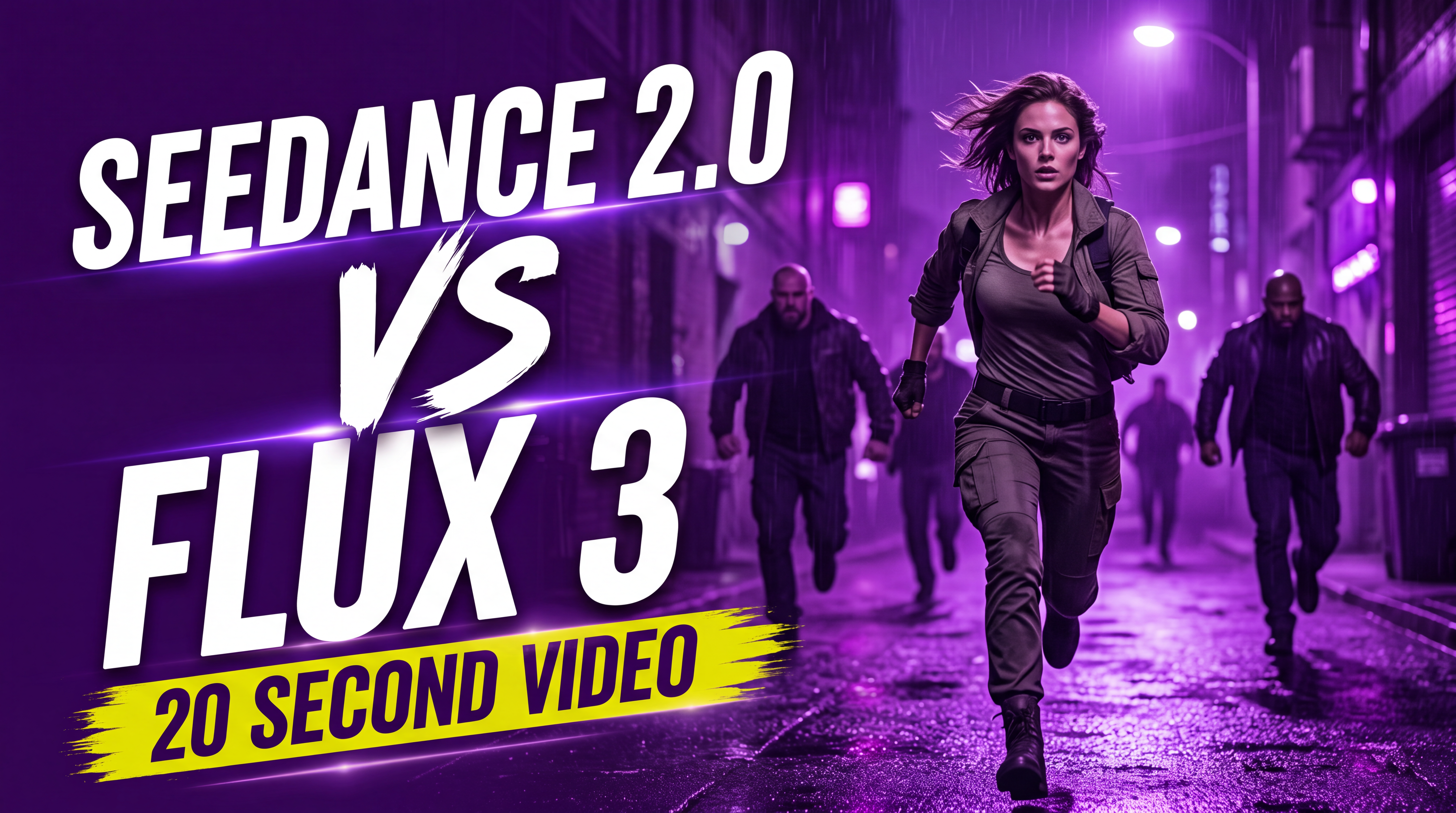
FLUX 3 and Seedance 2.0 are the two most talked-about multimodal video models of 2026, and they arrived seven months apart with genuinely different strengths. This guide compares FLUX 3 vs Seedance 2.0 across every spec that matters: clip length, native audio, reference inputs, editing tools, and how each one actually performs once you feed it a demanding prompt. Neither model wins every category, and knowing which one fits your workflow depends on what you’re building.
FLUX 3 vs Seedance 2.0 at a Glance
| FLUX 3 Video | Seedance 2.0 | |
|---|---|---|
| Released | July 23, 2026 | February 12, 2026 |
| Built By | Black Forest Labs | ByteDance Seed Team |
| Maximum Clip Length | Up to 20 seconds | Up to 15 seconds |
| Resolution | 720p (Early Access) | Up to 4K |
| Native Audio | Yes, single-channel generation | Yes, dual-channel stereo generation |
| Reference Inputs | Images and video clips | 9 images, 3 video clips, and 3 audio clips |
| Editing Tools | Video-to-Video and Keyframe-to-Video | Video Edit and Video Extend |
| Multilingual Dialogue | Yes | Yes, supports 8+ languages |
| Public Access | Gated early access only | Fully available |
| Pricing | Not yet announced | Available across multiple platforms |
What Is FLUX 3?
FLUX 3 is Black Forest Labs’ first multimodal foundation model. It’s built on an architecture called Self-Flow that trains jointly on images, video, and audio in one system, rather than treating each as a separate task.
The pitch is a single model that eventually covers content generation and physical action prediction together. FLUX 3 Video, the part available in early access now, generates clips up to 20 seconds with native audio. For the full feature FLUX 3 breakdown, see everything FLUX 3 can do.
What Is Seedance 2.0?
Seedance 2.0 is ByteDance’s next-generation video model, launched through the company’s Seed research team in February 2026. It’s built on a unified multimodal audio-video architecture that accepts four input types at once: text, image, audio, and video.
Where FLUX 3 is brand new, Seedance 2.0 has had months in production use. It generates multi-shot sequences up to 15 seconds with dual-channel stereo audio, and it supports editing an existing clip rather than only generating from scratch. For a full walkthrough of accessing and prompting it, see how to use Seedance 2.0. You can access it directly through a Seedance 2.0 workspace alongside the newer Seedance 2.5, which extends the same architecture to native 30-second clips.
FLUX 3 vs Seedance 2.0: Video Length and Resolution
Clip length and resolution are the first specs most creators check, and the two models split this category.
- FLUX 3 wins on duration. Its 20-second single-pass clips are longer than Seedance 2.0’s 15-second cap, and FLUX 3 chains individual clips into multi-minute sequences using visual references to hold characters and style consistent across cuts.
- Seedance 2.0 wins on resolution. It renders natively up to 4K, while FLUX 3 Video is capped at 720p during its current early access phase. Black Forest Labs hasn’t confirmed when higher resolution will roll out.
If your output needs to hold up on a large screen or in a broadcast-quality deliverable, Seedance 2.0’s resolution ceiling matters more right now than FLUX 3’s extra five seconds.
FLUX 3 vs Seedance 2.0: Reference Inputs and Multimodal Control
Both models accept more than a text prompt, but they don’t accept the same things in the same volume.
Seedance 2.0’s reference system is the more generous of the two. A single generation accepts:
- Up to 9 reference images
- Up to 3 video clips
- Up to 3 audio clips
- Natural language instructions layered on top.
That’s enough simultaneous input to reference a character from one image, a location from another, a camera move from a video clip, and a mood from an audio file, all in one request.
FLUX 3’s reference system is narrower at launch. It supports image-to-video (continuing from a starting frame or using an image as a style reference) and video-to-video (carrying an element like a character from a source clip into a new scene), but Black Forest Labs hasn’t published a maximum reference count comparable to Seedance 2.0’s explicit limits.
For projects that need to lock multiple assets- a character, a product, a set, a soundtrack- into a single generation, Seedance 2.0’s reference ceiling currently gives you more simultaneous control.
FLUX 3 vs Seedance 2.0: Native Audio Generation
Both models generate audio in the same pass as the video rather than bolting on sound afterward, but the implementations differ.
- FLUX 3 generates native synchronized audio that matches the physical events on screen, plus multilingual dialogue with lip-sync.
- Seedance 2.0 generates dual-channel stereo audio across three simultaneous tracks, background music, ambient sound effects, and character voiceover, all aligned to the visual rhythm, with lip-sync accuracy across 8 or more languages including Mandarin, Cantonese, Japanese, Korean, and several European languages.
Seedance 2.0’s multi-track separation is the more production-ready system here. Being able to adjust music, effects, and dialogue as distinct layers matters for anyone finishing audio in a separate editing pass, something a single blended audio track doesn’t allow as cleanly.
FLUX 3 vs Seedance 2.0: Editing and Extension Tools
Generating a clip is only half the job. Both models let you keep working on what you’ve already made.
- Seedance 2.0 offers video-edit, for targeted changes to a specific clip, character, or action, and video-extend, which continues an existing shot with a new prompt rather than starting over.
- FLUX 3 offers keyframe-to-video, for controlled transitions between two defined moments, and generative video-audio continuation, which extends existing footage and its audio together.
Functionally, these solve a similar problem from different angles. Seedance 2.0’s framing is closer to a traditional edit; FLUX 3’s is closer to defining endpoints and letting the model fill the transition.
FLUX 3 vs Seedance 2.0: Real-World Output Quality
Specs only tell part of the story. Independent early testing surfaced a meaningful difference in what each model is actually good at once you push it with a demanding prompt.
- Seedance 2.0 has the edge on kinetic, high-energy action. In one documented side-by-side test using a rapid-cut, hyperpop-style sequence, Seedance 2.0 produced faster camera work, fisheye trick shots, and a more frantic action rhythm than FLUX 3 managed on the identical brief.
- FLUX 3 holds up well on dialogue and dramatic scenes. The same testing found FLUX 3 hitting every element of a demanding prompt for slower, performance-driven content, including a community-generated clip with convincing rapid-fire dialogue and believable delivery.
The practical read: Seedance 2.0 is currently the stronger choice for fast-paced, visually chaotic content, while FLUX 3 is a legitimate option for dialogue-heavy or dramatic sequences where 20 seconds of runway matters more than frantic camera movement.
FLUX 3 vs Seedance 2.0: Availability and Pricing
This is the category with the clearest gap between the two models.
- Seedance 2.0 is fully live. It’s been in production use since February 2026, with public API access and no waitlist.
- FLUX 3 Video is gated to early access only. Access requires an application that Black Forest Labs must individually approve, and there’s currently no public API for any FLUX 3 tier.
No pricing has been announced for FLUX 3, though early commentary expects generation costs to eventually land below Seedance 2.0’s, which currently sits toward the higher end of the video model market. Until FLUX 3 reaches broader availability, that comparison remains a prediction rather than a fact.
Which Should You Choose?
Choose Seedance 2.0 if:
- You need access today, without an approval wait.
- Your project involves fast action, complex choreography, or rapid camera movement.
- You want the widest simultaneous reference control (9 images, 3 videos, 3 audio clips in one request).
- You need native 4K output for broadcast or large-format delivery.
Choose FLUX 3 (once you have access) if:
- Your content is dialogue-driven or dramatically paced rather than kinetic.
- You want the extra five seconds of single-pass runway for a slower scene.
- You’re already inside Black Forest Labs’ ecosystem and want one model spanning image, video, and eventually action prediction.
Use both, if you can. Several early testers frame FLUX 3 as a complement to an existing Seedance or Kling workflow rather than a replacement, testing FLUX 3 on dialogue scenes while keeping Seedance 2.0 for action-heavy shots. On a video generator hub covering multiple models, you can run the same prompt across Seedance 2.0, Kling 3.0, Veo 3.1, Gemini Omni Flash, and Hailuo 3.0 to see which model fits a specific shot before committing.
For getting more precise, repeatable results out of either model, a guide to JSON prompting for AI video covers a structured prompting approach that improves consistency regardless of which model you’re generating with. Once you have footage from either model, an AI video editor handles the trims and final polish before publishing.
Conclusion
FLUX 3 vs Seedance 2.0 isn’t a contest with one clear winner. Seedance 2.0 is live, higher-resolution, and stronger on fast action; FLUX 3 offers longer single-pass clips and holds up well on dialogue, once you can get access to it. For most creators today, Seedance 2.0’s availability alone makes it the practical starting point, with FLUX 3 worth testing as a complement the moment your early access request clears.
Frequently Asked Questions
Is FLUX 3 better than Seedance 2.0?
Neither model is better across every category. FLUX 3 generates longer single-pass clips (20 seconds vs. 15) and handles dialogue-driven scenes well, but Seedance 2.0 offers higher resolution (4K vs. 720p), a wider reference input system, and is fully available today while FLUX 3 remains in gated early access.
What’s the difference between FLUX 3 and Seedance 2.0?
FLUX 3 is Black Forest Labs’ first multimodal model, built on a Self-Flow architecture that also extends toward robotics and physical action prediction. Seedance 2.0 is ByteDance’s dedicated video model, built specifically for cinematic multi-shot generation with a more mature reference and editing system. FLUX 3 launched in July 2026; Seedance 2.0 has been live since February 2026.
Can I use FLUX 3 right now?
Only through gated early access, which requires an application that Black Forest Labs approves individually. Seedance 2.0, by comparison, is fully public with no waitlist.
Which model has better audio?
Seedance 2.0’s dual-channel stereo audio with separate tracks for music, effects, and dialogue is more production-ready than FLUX 3’s single native audio pass, though both generate audio automatically in the same pass as the video rather than requiring separate sound design.
Does Seedance 2.0 support more reference inputs than FLUX 3?
Yes. Seedance 2.0 explicitly supports up to 9 images, 3 video clips, and 3 audio clips per generation. Black Forest Labs hasn’t published an equivalent maximum for FLUX 3’s image-to-video and video-to-video modes.
Arooj Ishtiaq
Arooj is a SaaS content writer specializing in AI models and applied technology. At ImagineArt, she creates sharp, product-focused content that helps creators and businesses understand, adopt, and get real value from AI tools.