
Zahida Misher
November 21, 2026 • Updated November 21, 2026
10 mins Read
Merriam-Webster dates "avatar" in English to 1784, from the Sanskrit for a god's descent to earth in bodily form. About 240 years later it means something far less divine: a face that reads your script so you don't have to film it.
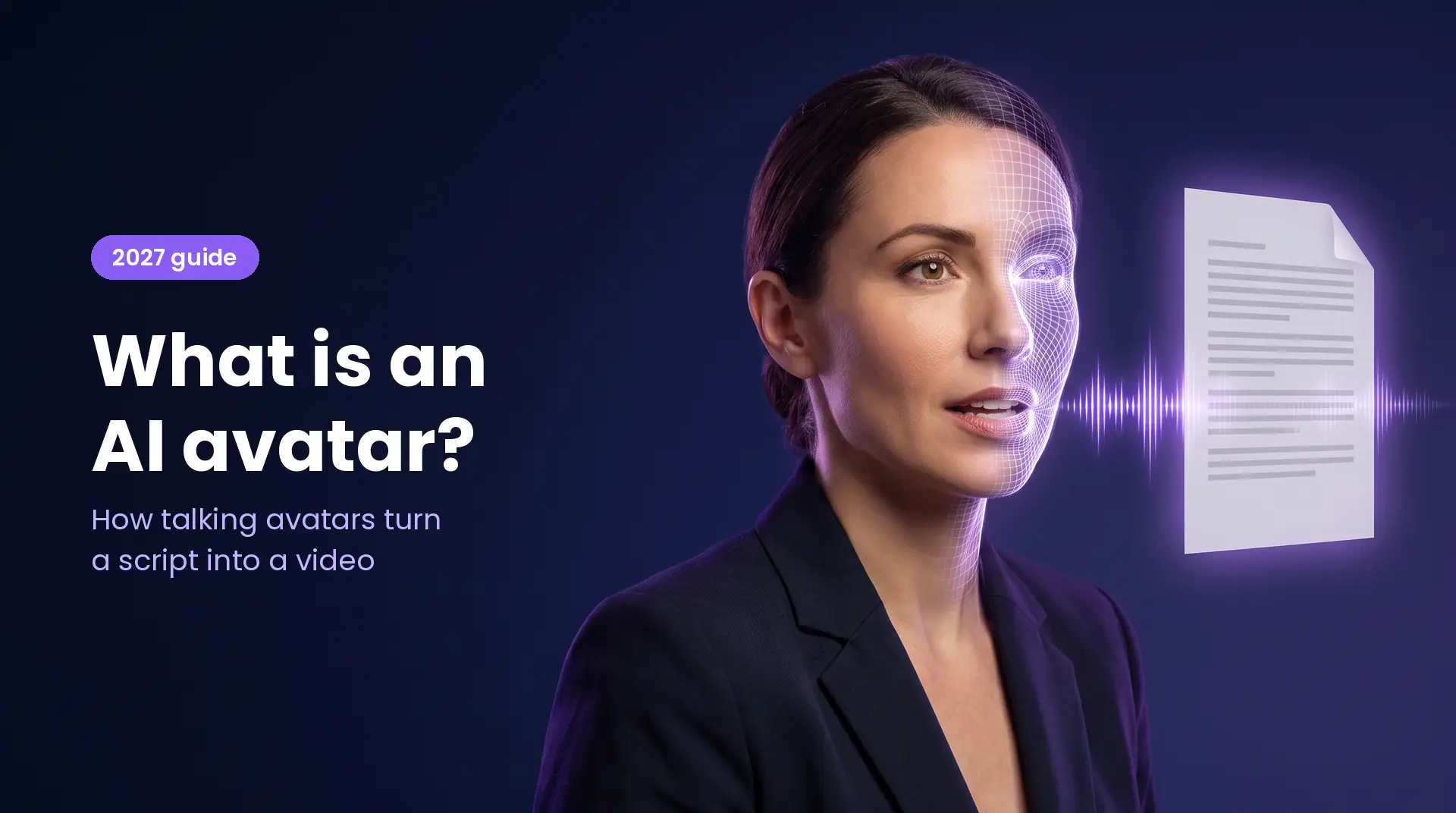
What is an AI avatar, exactly? It's a digital person, made or animated by AI, that speaks and moves on screen from text or audio you give it. This guide covers how a talking avatar is built step by step, the six kinds you'll run into, where they still slip, and the labelling rules that started applying in 2026. If you'd rather make one than read about one, ImagineArt's AI avatar video generator turns a photo and a paragraph into a talking video.
What is an AI avatar?
An AI avatar is a digital character, often modelled on a real person, that AI animates to speak and move from a script or an audio track. You type the words, the AI produces the voice, and the face moves its lips, head and expression to match, without a camera or an actor on the day.
So what is AI avatar technology doing differently from the avatars you already know? A game avatar is a character you steer. A profile-picture avatar is a still image. An AI avatar performs: it delivers lines, in a voice, with timing a viewer reads as speech.
Most people searching the term mean the talking kind, the presenter in a training video or the founder reading a weekly update. That's the focus here. A reusable version of one specific person is usually called a digital twin; ImagineArt's AI digital twin page describes one built from about 30 seconds of recording.
How do talking AI avatars work?
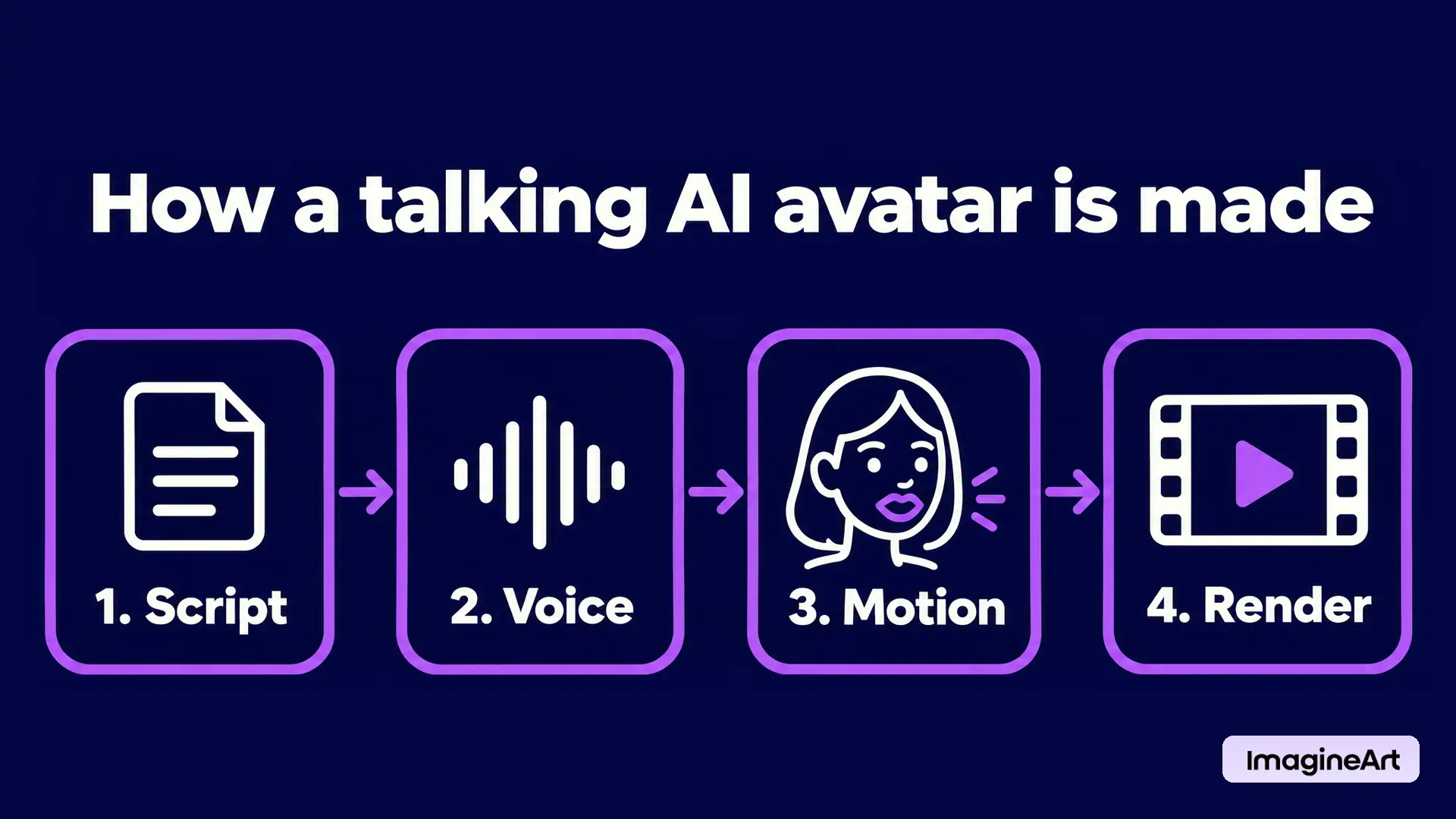
A talking AI avatar is built in four stages: a script, a synthetic voice reading it, face and body motion driven by that audio, and a render to video. Each stage is a separate model, and the quality of an AI avatar talking on screen depends on the weakest of the four.
 how talking ai avatar is made
1. The script
Everything starts as text. The script sets the length, the pacing and the words the voice will stumble on, so names, numbers and brand terms deserve a second read before you generate.
2. The voice: text to speech or a clone
Neural text to speech turns the script into audio. The modern approach dates to DeepMind's WaveNet paper from 2016, which generated raw audio waveforms and beat older systems in listener ratings for English and Mandarin. For a deeper look at how these voices are made, see ImagineArt's guide to neural TTS.
A cloned voice needs a sample of the real person. ElevenLabs' instant voice cloning guide recommends 1 to 2 minutes of clean audio, with 10 seconds as the bare minimum. Its professional cloning asks for at least 30 minutes. Past about 3 minutes, ElevenLabs says extra audio adds little and can even hurt stability, and no amount of it fixes a noisy recording.
3. The motion: lip sync and expression
This is the part that makes a face believable. The audio drives the mouth, then the head, eyes and expression. Two research lines got us here:
- Lip sync on existing video. Wav2Lip, published in 2020, re-times the lips of any speaker in a video to a new speech track. It's the idea behind dubbing a filmed person into another language.
- A whole performance from one photo. Alibaba's EMO (February 2024) turned one reference image and a vocal track into a talking or singing video. Microsoft's VASA-1 (April 2024) did it at 512 by 512 pixels and up to 40 frames a second, per its paper. ByteDance's OmniHuman-1 (February 2025) extended it to half-body and full-body shots, trained on 18.7K hours of human video.
Microsoft never released VASA-1 as a product. OmniHuman-1 started as a research paper, though ByteDance now runs OmniHuman models in its Dreamina app. Commercial avatar tools build on the same ideas with their own models.
4. The render: 2D video or a 3D head
Commercial talking-avatar tools mostly render straight to 2D video with generative models: the output is frames, not a 3D object. A second branch builds an actual 3D head. NeRF (2020) learned a scene from photos and rendered it from new angles; 3D Gaussian Splatting (2023) rendered that kind of scene at 30 frames a second or more at 1080p. GaussianAvatars (2023) attached those splats to a 3D face model so a head could be animated.
What about motion capture? It's the older route, and it still works. Epic's MetaHuman Animator records a real actor's face with an iPhone or a head-mounted camera and maps the performance onto a 3D character. The difference is the driver: with mocap, a person performs every take; with an AI avatar, a script does.
What types of AI avatars are there?
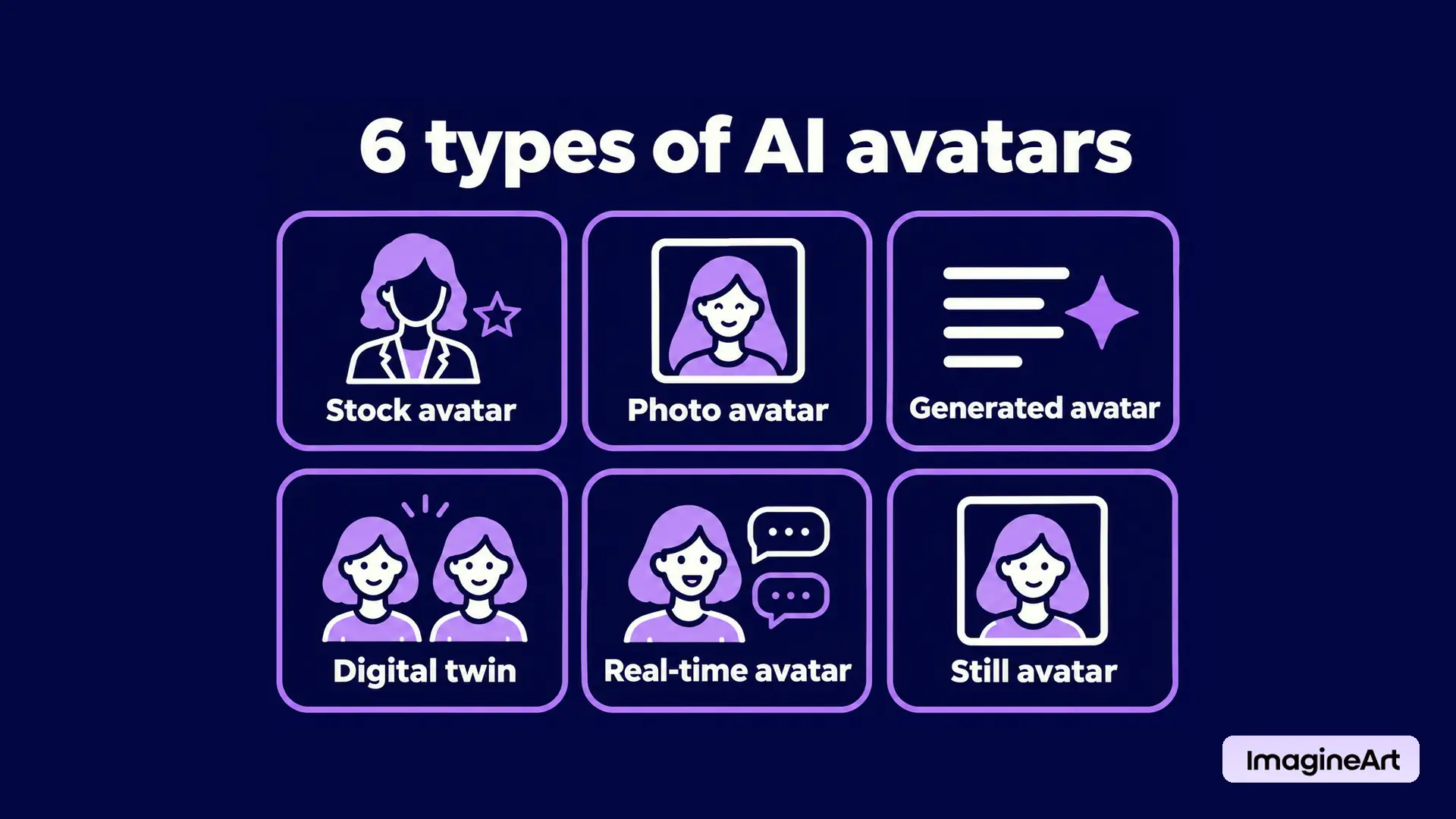
There are six common types of AI avatar, split by what you feed in: a stock presenter, a photo, a written description, a recording of yourself, a live conversational agent, or a still image with no motion at all. The type decides how close the likeness is and how long setup takes.
| Type | What you give it | What you get | Typical use |
|---|---|---|---|
| Stock avatar | Nothing but a script | A presenter the vendor filmed (VEED and Colossyan say with paid, consenting actors) | Explainers, ad tests |
| Photo (instant) avatar | One portrait | A talking video of that face, in minutes | Quick personal videos, characters |
| Generated avatar | A written description | A face that doesn't exist, then animated | Brand characters, virtual creators |
| Digital twin | A short recording plus consent | A close likeness of you, plus your voice if you add a clone | Founders, coaches, course creators |
| Real-time avatar | A connection to a chatbot | A face that answers live in conversation | Support, sales, kiosks |
| Still avatar | Selfies | Stylised portraits, no speech | Profile pictures |
A few notes on the edges. Real-time avatars are a specialised branch: D-ID made its conversational Agents generally available in February 2024, and they need different engineering from a rendered video. Still avatars had their big moment in November 2022, when Lensa's Magic Avatars went viral. And an AI animated avatar in the cartoon sense is a stock or generated avatar with a stylised look: same pipeline, different face.
One 3D casualty is worth knowing about. Ready Player Me, a popular cross-game avatar maker, was bought by Netflix and shut its public services on January 31, 2026, so older guides that recommend it are out of date.
 types of ai avatars
What AI avatars are used for
AI avatars are used wherever someone has to appear on camera repeatedly with new words each time: ads, training, translated versions of existing videos, creator content and customer support. The shared reason is the cost of a change, since editing one line beats a reshoot.
- Ads and UGC-style videos. Marketers test many hooks with the same face. ImagineArt's AI UGC ad generator page is built around that loop.
- Training and onboarding. Courses go stale when a policy changes. An avatar lesson updates with a one-line script edit, and the presenter, set and pacing come back the same.
- Translation. One video becomes many language versions, with lip sync re-timed per language.
- Creators. Faceless channels and virtual personas post on a schedule without a camera.
- Support and sales. Real-time avatars answer questions on websites, backed by a chatbot.
Where AI avatars still fall short
AI avatars still slip on likeness from a single photo, on how names and numbers are pronounced, on exaggerated gestures and on real-time speed. Rendered video is reliable for scripted delivery; a live, unscripted conversation remains harder.
- Photo likeness. One image gives the model one angle and no movement. ImagineArt's own page says a 30-second recording gives a closer likeness than a photo.
- Pronunciation. Synthetic voices guess at brand names and figures. Listen with sound on before publishing.
- Gestures. Hedra's Character-3 model page warns some users see overly dramatic hand movement, and that lip sync depends heavily on audio quality.
- Speed. Most generations aren't real time. Live avatars exist, but they're a separate, specialised setup.
None of this is a reason to skip avatars. It's a reason to check the first one carefully, the same way you'd check a new hire's first presentation.
Is it legal to make an AI avatar of someone?
Making an AI avatar of yourself is generally fine. Using someone else's face or voice without permission can break likeness laws such as Tennessee's ELVIS Act and every major vendor's terms, and publishing realistic AI video now comes with labelling duties. In the EU, deepfake disclosure applies from August 2, 2026, and US laws target non-consensual and impersonating uses.
The rules that matter in late 2026:
- EU AI Act, Article 50. Anyone who uses an AI system to publish a deepfake, outside purely personal use, must disclose that it's AI-made. Providers must also mark synthetic output in a machine-readable way. The article's text applies from August 2, 2026, though generative tools already on the market before then have until December 2, 2026 to add the marking.
- TAKE IT DOWN Act (US). Criminalises publishing non-consensual intimate images, including AI forgeries. The FTC began enforcing its takedown rules on May 19, 2026: covered platforms must remove reported images within 48 hours, and victims can report platforms that don't through the FTC's TAKE IT DOWN portal.
- ELVIS Act (Tennessee). Signed March 21, 2024, it added voice, including AI imitations of a recognisable voice, to Tennessee's likeness protections.
- NO FAKES Act (US federal). It would create a federal right over digital replicas of voice and likeness. As of November 2026, it hasn't passed.
Platforms add their own rules. YouTube asks creators to label realistic AI content that makes a real person appear to say something they didn't. Meta shows an "AI info" label. TikTok's policy requires creators to label AI content that shows realistic people.
Vendors handle consent at the door. ElevenLabs makes you confirm you have the right to clone a voice. Synthesia asks for a live consent clip with a passcode. ImagineArt binds a studio avatar to the consent recording that created it.
How to create an AI avatar
You can create a talking AI avatar in three steps: make or pick the avatar, give it a voice and script, then generate and review. Here's how it runs in ImagineArt's AI avatar studio, following its own walkthrough:
- Make or pick the avatar. Choose a library avatar, upload one portrait, describe a person and pick from four, or record about 30 seconds of yourself. A photo avatar is ready in under a minute, according to ImagineArt.
- Set the voice, script and set. Type the script, then pick a voice in the language the avatar should speak, clone your own, or upload a recorded voiceover for it to follow. Place it on a preset, a generated background or an image you upload.
- Generate, listen, export. Watch once with sound. Fix any line by editing it and regenerating, then export 9:16, 4:5, 1:1 or 16:9 from the same take.
Comparing tools before you commit? Our list of the best AI avatar generators puts 11 side by side on free plans, prices and languages.
What is an AI avatar, in one line
An AI avatar is a script turned into a performance: text becomes a voice, the voice drives a face, and the face renders to video. Lip sync research from 2020 made existing footage speak new lines, the 2024 and 2025 papers made one photo enough, and the rules on consent and labels caught up in 2026.
Three things to remember. A recording beats a photo for likeness, listening before you publish catches the mispronounced names, and permission comes before any face or voice.
Ready to see it work on your own face? Start in ImagineArt's AI avatar studio with one photo or a 30-second clip.
Frequently asked questions
How much does an AI avatar cost?
From free to about $30 a month for an entry plan. Most tools have a watermarked free tier, D-ID's Lite plan starts at $5.90 a month for personal use, and HeyGen's Creator plan is $29 a month, per the vendors' pricing pages in November 2026. ImagineArt's AI avatar studio is free to start with no credit card, and paid plans add commercial use.
Is an AI avatar a deepfake?
Technically it uses the same family of methods, but intent and consent separate them. An avatar of yourself, or of a stock actor who agreed, is a production tool. The EU's definition of a deepfake turns on content that would falsely appear authentic, which is why disclosure labels matter.
Can an AI avatar speak a language I don't?
Yes. The script is turned into speech in the target language and the lip sync is re-timed to that audio. With a cloned voice, the avatar still sounds like you. Our AI avatar generator lists 50+ languages for its avatars.
Is an AI avatar the same as a digital human?
Close, with a difference in scope. "Digital human" usually means a realistic, often 3D or real-time character, while "AI avatar" covers anything from a stock presenter to a cartoon face that talks.
Zahida Misher
Exploring how AI transforms marketing, I help businesses unlock growth and future-proof their presence.
View all articlesRecent posts
The Best AI Avatar Generators In 2027: 11 Tools Compared And Ranked
50 Types of Art Styles: Definitions, Examples and AI Prompts
How to Edit Images With Ideogram 4.6: 38 Edits, Prompts and Results