
Arooj Ishtiaq
July 1, 2026 • Updated August 4, 2026
11 mins Read
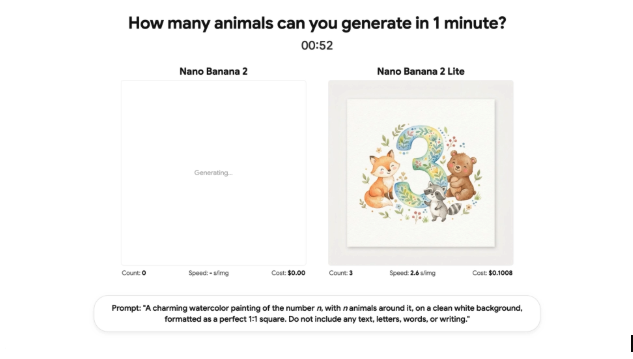
Google released Nano Banana 2 Lite on June 30, 2026, as the speed-optimized tier in its Nano Banana image generation family. The model generates 1K-resolution images in approximately four seconds and maintains subject consistency across batch generations with native multi-language text rendering.
The Nano Banana 2 Lite guide covers the model's core features, how it compares within the Nano Banana family, and where it fits on the AI image generator platform alongside Ideogram 4.0 and other generators.
What Is Nano Banana 2 Lite
Nano Banana 2 Lite (official model ID: gemini-3.1-flash-lite-image) is Google's fastest image generation model, built on the Gemini 3.1 Flash Lite architecture. It accepts text-to-image prompts and reference images for editing and style transfer workflows. The model prioritizes generation speed and batch consistency over maximum visual fidelity, positioning it as the entry tier for teams requiring rapid iteration and high-volume production rather than individual hero images requiring maximum detail.
Access flows through the ImagineArt web interface (no code required) and the Gemini API (for developers). On ImagineArt, Nano Banana 2 Lite appears as a model option in the AI image generator dropdown alongside Ideogram 4.0, Flux, and other image tools.
Core Features of Nano Banana 2 Lite
The Nano Banana 2 Lite guide identifies four major capabilities that define the model and enable specific production workflows.
 Core Features of Nano Banana 2 Lite
Four-Second Generation Latency
Nano Banana 2 Lite generates a standard 1K resolution image in approximately four seconds on average. The typical latency range is 3 to 8 seconds, depending on API load and prompt complexity. During peak hours, latency may exceed 10 seconds but rarely exceeds 20 seconds.
This sub-five-second latency is the headline feature and the primary driver of adoption for latency-sensitive workflows. Four-second generation enables use cases impossible on slower models:
- Marketing teams testing product variations in rapid succession
- Customer service chatbots generating reference images in real-time conversation
- E-commerce platforms generating catalog mockups at scale
- Creative teams exploring concepts at ideation speed.
For teams iterating rapidly, the four-second generation removes the friction that normally accompanies batch processing, converting image generation from an asynchronous, fire-and-forget task into an interactive tool where waiting feels seamless.
High-Volume Consistency: Subject and Character Preservation
Nano Banana 2 Lite maintains subject consistency, character identity, and compositional coherence across dozens of rapid-fire generations without quality drift or character morphing. A team generating 200 product mockups with identical angle, lighting, and background can do so in a single batch session with confidence that every image maintains visual consistency.
This consistency at speed is enabled by the model's architecture, which uses a fixed initial frame representation to maintain scene understanding across multiple generations. When a user generates five variations of the same product on different backgrounds, the product itself remains visually identical while only the background and lighting shift. This consistency matters operationally: teams can batch-generate variations without manual review for character drift between generations.
For comparison, see Nano Banana 2 for higher detail consistency and Nano Banana Pro for maximum precision on complex scenes.
Multi-Language In-Image Text Rendering
Nano Banana 2 Lite renders legible, sharp text within generated images in English and 25+ additional languages, including Chinese, Japanese, Spanish, French, German, Arabic, and Hindi. The model generates text at legible quality by default; finer typographic control is available on Nano Banana 2 and Nano Banana Pro.
For more details read: What is Text Rendering in AI Image Generation?
This capability is operationally significant for marketing teams creating localized content: generate a product image with English text, then again with French text, then again with Spanish text, without requiring separate design passes.
For e-commerce teams managing multilingual catalogs, this feature eliminates the manual step of text overlay in post-production. Nano Banana 2 Lite renders text directly in the image at generation time, simplifying the workflow and reducing final asset production time.
Image-to-Image Editing: Style Transfer and Composition Adjustmsent
Beyond text-to-image generation, Nano Banana 2 Lite accepts reference images for style transfer, composition adjustment, and background replacement workflows. A user uploads a product photo and provides an edit prompt like "change the background to marble, keep the product identical," and the model returns the edited image preserving subject identity while applying the requested changes.
Reference image support is limited to up to five images per generation. Nano Banana 2 and Nano Banana Pro support up to 14 references, enabling more complex reference blending and style composition. For typical batch workflows where one base image is edited through five to ten variations, Lite's five-reference limit is sufficient.
| Model | Latency | Cost | Visual Quality | Reasoning |
|---|---|---|---|---|
| Nano Banana 2 Lite (Gemini 3.1 Flash-Lite Image) | Low | Low | Medium | Low |
| Nano Banana 2 (Gemini 3.1 Flash Image) | Medium | Medium | High | Medium |
| Nano Banana Pro (Gemini 3 Pro Image) | High | High | High | High |
Recommended read: [How to Use Nano Banana 2](https://www.imagine.art/blogs/how-to-use-nano-banana-2)
Nano Banana 2 Lite vs Other Google Image Models
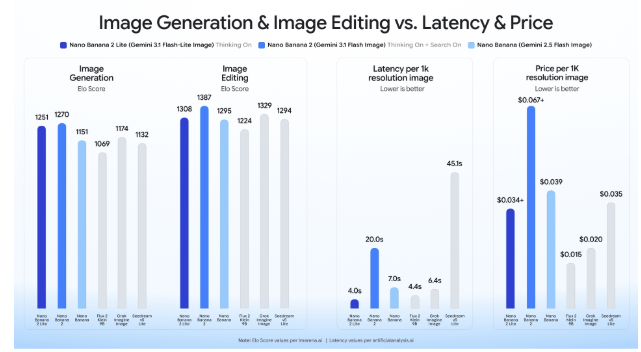
The Nano Banana 2 Lite guide separates the three-tier Nano Banana family to help teams choose the right tier for their workflow and quality requirements.
| Dimension | Nano Banana 2 Lite | Nano Banana 2 | Nano Banana Pro |
|---|---|---|---|
| Generation Speed | 4 seconds per image | 10 to 15 seconds | 20+ seconds |
| Max Resolution | 1K native | 1K, 2K, 4K options | 2K, 4K, 8K options |
| Reference Images | Up to 5 | Up to 14 | Up to 14 |
| In-Image Text Quality | Legible, good | Excellent, refined | Flawless, studio-grade |
| Detail Fidelity | Production-ready draft | High-fidelity generalist | Premium, hero-content |
| Best For | High-volume, rapid iteration | General production | Complex, specialized work |
Nano Banana 2 Lite is purpose-built for speed and batch production. It is not a downgrade of Nano Banana 2; it is a purpose-built alternative optimized for a different constraint set. Understanding the difference between Nano Banana Pro vs Nano Banana 2 vs Nano Banana 2 Lite comes down to what your workflow prioritizes. Lite trades detail fidelity and resolution flexibility for latency. For teams where volume and iteration speed dominate the decision calculus, Lite is the rational choice. For teams producing final deliverables or requiring higher resolution output, Nano Banana 2 or Nano Banana Pro remain the appropriate options.
Recommended read: Nano Banana Vs Nano Banana Pro
 Nano Banana 2 Lite vs Other Google Image Models
Primary Use Cases: Where Nano Banana 2 Lite Delivers Maximum Value
The Nano Banana 2 Lite guide identifies five core production workflows where the model's speed and consistency combination create a genuine operational advantage.
E-Commerce Product Mockups and Catalog Generation
E-commerce teams generate product mockups, lifestyle photos, and catalog assets at scale using Nano Banana 2 Lite. A single product photograph can generate 50 variations rapidly in different angles, styles, backgrounds, colors, and contexts. This batch workflow becomes operationally routine with Lite's speed and consistency.
Teams use the model for product catalog generation from base photographs, seasonal variation creation for promotional periods, and market-specific localization at volume. For larger catalogs requiring final polish, teams draft on Lite, then finalize winners on Nano Banana 2 or Nano Banana Pro for maximum quality.
Recommended read: Nano Banana 2 Prompt Guide
Marketing Asset Variation and Creative A/B Testing
Marketing teams test creative variations using Nano Banana 2 Lite for rapid drafting and iteration. Generate 100 image variations across multiple styles, test in market, identify winners, then finalize top performers on Nano Banana 2 for campaign launch.
This "draft on Lite, finalize on 2" workflow compresses creative iteration and reduces time-to-test. For media buyers and creative agencies managing multiple simultaneous campaigns, this approach enables creative testing as a routine production task.
Rapid Ideation and Visual Prototyping
Creative teams use Nano Banana 2 Lite for rapid concept visualization where speed removes the friction normally associated with asset creation.
- Storyboard artists sketch visual narratives quickly.
- UI/UX designers generate component variations for interface mockups.
- Game designers preview environment concepts.
- Product designers prototype visual features.
The four-second latency eliminates waiting, converting image generation from an asynchronous task into an interactive tool where ideation flows without interruption.
Conversational Image Generation in AI Agents and Chatbots
Chatbots and conversational AI systems that need to generate images on demand require sub-five-second latency for a responsive user experience. Nano Banana 2 Lite's four-second average generation window is the fastest option available on ImagineArt, making it suitable for customer service workflows where visual reference needs to be generated in real time during a conversation without breaking the interaction flow.
A customer service chatbot might generate a reference image showing "what your product looks like with a blue finish" or "this item in a different size" in response to a customer question, all within the conversational context. The four-second latency makes this experience feel nearly instantaneous to the end user.
Localized Content Generation for Multilingual Markets
Teams producing content for multiple geographies use Nano Banana 2 Lite to generate product images with text in different languages: English, Spanish, French, Arabic, Chinese, and more. The model renders legible in-image text natively in 25+ languages, eliminating manual post-production text overlay.
For multinational brands, this capability compresses the localization workflow and reduces production time, enabling rapid market-specific content creation without design tool post-processing.
Specifications of Nano Banana 2 Lite
The Nano Banana 2 Lite guide covers the technical specifications that determine compatibility with production workflows.
Supported Input Types:
- Text-to-image: Accepts text prompts describing composition, style, mood, subject, and action
- Image-to-image: Accepts reference images for style transfer, composition adjustment, and background editing
Output Specifications:
- Primary resolution: 1K (1024×1024) native
- Aspect ratios: 1:1 square, 16:9 widescreen, 9:16 vertical (via image-to-image routing)
- Format: PNG, JPG, WebP
- Color depth: 8-bit RGB (standard web quality)
Generation Characteristics:
- Latency: 3 to 8 seconds typical, 4 seconds average
- Consistency: Subject and character identity preserved across multiple generations in batch
- Text rendering: Legible, sharp in-image text in 25+ languages including English, Chinese, Japanese, Spanish, French, German, Arabic, Hindi
- Reference images: Up to 5 supported per generation
- Batch limit: No strict per-session limit; API rate limits apply
Output Identification:
- All images include an invisible SynthID watermark
- Watermark persists across standard transformations (compression, resizing, cropping)
- Watermark is detectable by Google's SynthID detection tool
- Watermark cannot be disabled by users
Conclusion
Nano Banana 2 Lite is Google's speed-optimized image generation model with four-second generation and subject consistency across batches, positioned as the entry tier in the Nano Banana family.
Access it on ImagineArt's AI image generator platform for high-volume production workflows requiring rapid iteration. For teams needing higher detail fidelity or 4K output, compare Nano Banana 2 and Nano Banana Pro. The Nano Banana 2 Lite guide updates as new features extend through 2026.
Frequently Asked Questions About Nano Banana 2 Lite
How long does Nano Banana 2 Lite take to generate an image?
Approximately four seconds per image on average. Latency varies depending on API load and prompt complexity, with a typical range of 3 to 8 seconds. During peak hours, latency may exceed ten seconds but rarely exceeds 20 seconds.
What resolution does Nano Banana 2 Lite support?
1K (1024×1024) is the native resolution. Nano Banana 2 Lite does not support 2K, 4K, or 8K output. For higher resolutions, use Nano Banana 2 or Nano Banana Pro.
Can I use Nano Banana 2 Lite images commercially?
Yes. All generated images are yours to use commercially, provided you comply with Google's usage policies. Generated images cannot be misrepresented as authentic photography or used to violate platform policies.
How many reference images can I use with Nano Banana 2 Lite?
Up to five reference images per generation. Nano Banana 2 and Nano Banana Pro support up to 14 references, enabling more complex reference composition.
Does Nano Banana 2 Lite include the SynthID watermark?
Yes. All generated images include an invisible SynthID digital watermark by default. The watermark is automatic and cannot be disabled by users.
Is Nano Banana 2 Lite better than Nano Banana 2?
They optimize for different priorities. Lite prioritizes speed and consistency for batch production. Nano Banana 2 prioritizes detail fidelity and resolution options. Choose Lite for high-volume, time-sensitive workflows requiring rapid iteration. Choose Nano Banana 2 for final deliverables or 4K output.
Can I batch generate images on Nano Banana 2 Lite?
Yes. The Gemini API supports batch processing, and ImagineArt's interface also supports sequential generation of multiple prompts. You can generate 100 images in a single batch request, with total completion time depending on queue depth.
Arooj Ishtiaq
Arooj is a SaaS content writer specializing in AI models and applied technology. At ImagineArt, she creates sharp, product-focused content that helps creators and businesses understand, adopt, and get real value from AI tools.