Arooj Ishtiaq
July 29, 2026 • Updated July 29, 2026
13 mins Read
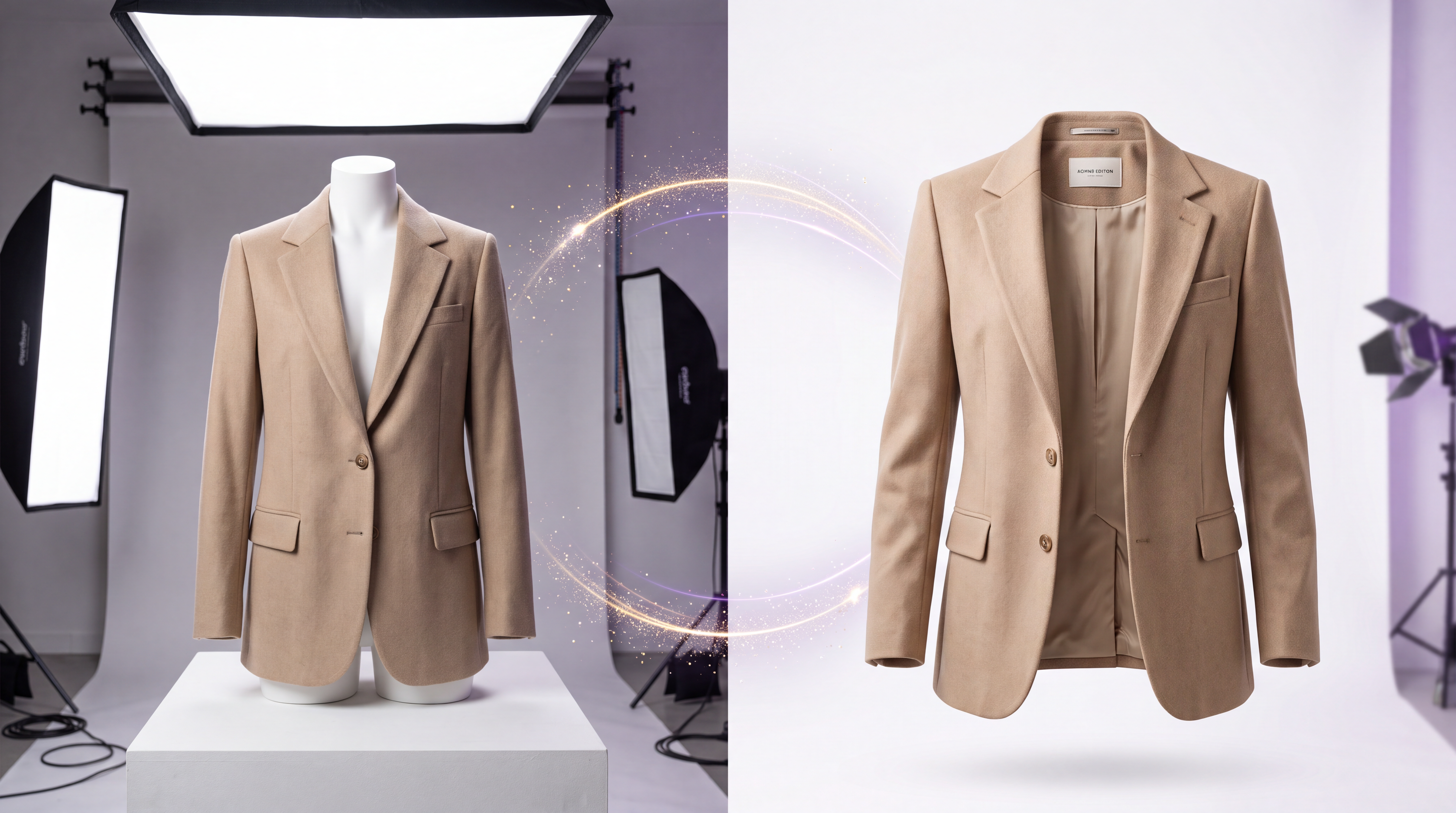
Ghost mannequin photography is the technique behind nearly every floating shirt and hovering jacket you have seen on a product page. A garment gets photographed on a mannequin, and then the mannequin is digitally removed so the clothing holds its own three-dimensional shape with no body visible inside it.
This guide covers four things:
- How the traditional technique actually works, step by step
- What ghost mannequin service costs at every tier
- Which garments the technique handles well, and which it does not
- How ghost mannequin AI now produces the same result from a single photo, with no mannequin required
What Is Ghost Mannequin Photography?
Ghost mannequin photography is a product-imaging technique. A garment is photographed on a mannequin or dress form, then the mannequin is removed in post-production so the clothing keeps its three-dimensional shape with nothing visible inside it.
The result goes by a few names depending on who you ask:
- The invisible mannequin effect
- The 3D mannequin effect
- The hollow-man effect
In every case, the idea is the same. A shirt keeps its collar structure, its shoulder line, and its sleeve shape as though a body were still inside it, even though the space is empty.
It is worth separating the effect from the technique, since that distinction matters more now than it used to:
- The technique is the production process: shoot the garment on a form, retouch the form out.
- The effect is simply the visual result a shopper sees on the page.
AI can now produce that effect without any of the traditional production process behind it, which means the term increasingly describes a style of image rather than one specific way of making it. For the foundational lighting and setup skills this technique builds on, clothing photography 101 covers the fundamentals directly.
Ghost mannequin sits between two other formats. A flat lay shows the garment on a surface but loses most of its volume and drape. A full on-model photo shows real fit and movement, but adds the cost of a model, a stylist, and a full shoot day. Ghost mannequin delivers real structure without either cost, which is why it became the default for so many ecommerce catalogs, and why Amazon explicitly permits ghost mannequin images for apparel main photos while banning visible mannequins in that same placement.
Where Ghost Mannequin Photography Is Used
- Marketplace listings. Many platforms require clean, white-background shots where a visible mannequin is not allowed, but a hollow, structured presentation is expected.
- Category and product pages. Structure matters to the buying decision, but a full model shoot per SKU rarely justifies the cost.
- Wholesale and B2B line sheets. Buyers need neutral, consistent garment images across a range, without a lifestyle shoot's stylistic variation getting in the way.
- Knitwear, outerwear, and tailored pieces. Drape and structure are part of the sale, and a flat lay flattens away the exact detail a shopper is evaluating.
Brands running a full seasonal catalog rather than a single product usually need to plan for this at scale rather than shot by shot. How to shoot a full ecommerce fashion photography catalog covers the budget and consistency side of that planning.
How Traditional Ghost Mannequin Photography Works
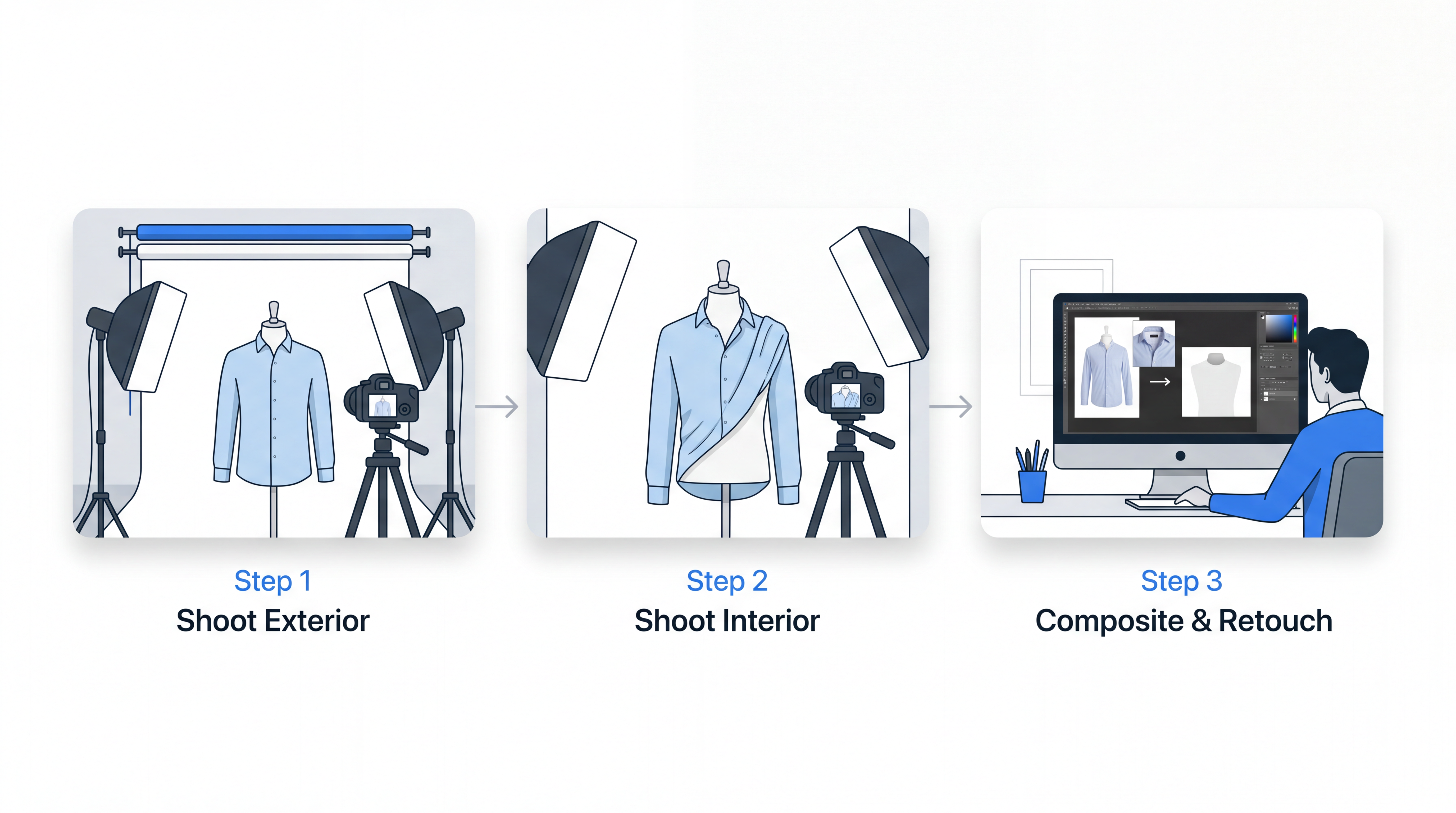
The traditional method uses two photographs and one composite.
Step 1: Shoot the exterior. The garment goes on a mannequin or dress form, photographed to capture its shape, shoulders, and silhouette. White mannequins against white backgrounds make later editing considerably easier.
Step 2: Shoot the interior. A separate shot captures the inside neckline, collar, or lining, usually by lifting the garment slightly on the form. This inner shot creates the illusion of a garment worn by an invisible body rather than one propped on visible plastic.
Step 3: Composite the two images. The inner shot blends into the main image. Every trace of the mannequin gets erased. The collar, cuffs, and hem get rebuilt with clean edges.
 How Traditional Ghost Mannequin Photography Works
Consistent lighting between the two exposures is what makes the composite look seamless. Inconsistent lighting is the single most common reason a shot looks obviously edited, and it is one of several setups covered in fashion photography lighting explained. Most images need only these two source photos, though structured jackets with visible interior lining sometimes need a third angle to sell the illusion fully.
Which Garments Work Best (and Which Don't)
| Garment Type | Performance | Reason |
|---|---|---|
| Shirts, Jackets, Coats & Structured Dresses | Works Well | Their defined structure and silhouette remain stable on a mannequin, making it easier to create a clean invisible mannequin effect. |
| Knitwear & Tailored Trousers | Works Well | The garment's drape and fit are preserved, helping shoppers accurately judge shape, texture, and tailoring. |
| Oversized Hoodies & Unstructured Loungewear | Weak Results | Loose garments lack a defined silhouette, so they collapse around the mannequin and reduce the realism of the final image. |
| Sheer & Lightweight Fabrics | Weak Results | Thin fabrics shift easily during shooting, creating distortions that are difficult to remove during post-processing. |
| Garments with Deep Wrinkles | Costly to Correct | Heavy wrinkles change the garment's natural shape, requiring extensive retouching and increasing editing time and cost. |
| Silk Scarves & Flowy Accessories | Not Suitable | These items lack enough structure for a mannequin to support, making the invisible mannequin technique ineffective. |
Heavy wrinkle correction can add up to 40% to per-image production cost, which is exactly why garment prep, steaming, linting, and correct buttoning are treated as a real production step rather than an afterthought.
What Does Ghost Mannequin Photography Cost?
Pricing splits into three tiers.
- Outsourced editing-only services. If you supply the raw exterior and interior shots yourself, per-image rates run as low as $0.19 to $0.50 at high-volume outsourced shops.
- Full-service studio shoots. Mannequin, shoot, and editing together typically run $50 to $150 per product. Some studios bill hourly instead, around $129 per hour in one commonly cited rate.
- Editing time as a hidden cost. A skilled retoucher finishes one composite in 10 to 20 minutes. Beginners need 30 to 60 minutes, and that time scales with every SKU you add.
AI-generated ghost mannequin effects skip all three tiers. One flat lay or hanger photo in, a finished result in under a minute, no mannequin and no manual compositing. For a broader look at what these costs mean once you scale past a single product, 10 product photography tips for fashion brands covers the volume side of the same budget question.
How AI Replaces the Traditional Ghost Mannequin Workflow
Traditional ghost mannequin photography requires multiple steps. A garment is first photographed on a mannequin, then captured again to expose hidden areas such as the neckline or inner collar. These images are combined during post-production to create the invisible mannequin effect. While this process produces high-quality results, it also increases production costs, editing time, and the need for specialized equipment.
AI streamlines this entire workflow. Instead of requiring multiple photos and manual compositing, modern AI models can generate a realistic ghost mannequin effect from a single flat lay, hanger, or product image. The AI analyzes the garment's structure, identifies missing areas, reconstructs the interior sections, and removes distracting elements such as hangers or mannequins automatically.
This significantly reduces the time required to produce ecommerce-ready product images while maintaining a professional, three-dimensional appearance.
Why AI Is Becoming the Preferred Choice
Compared to the traditional workflow, AI offers several practical advantages for fashion brands and ecommerce businesses:
- Eliminates multiple photo captures: One image replaces the traditional front, back, and neck insert photographs.
- Reduces editing time: No manual compositing or mannequin removal in Photoshop.
- Cuts production costs: Fewer studio sessions, less equipment, and lower post-production expenses.
- Scales effortlessly: Generate consistent ghost mannequin images for hundreds or thousands of SKUs.
- Maintains catalog consistency: Every product follows the same framing, proportions, lighting, and styling.
For standard apparel such as T-shirts, shirts, hoodies, dresses, jackets, sweaters, and knitwear, AI-generated ghost mannequin images are often visually comparable to traditional editing, making them more than sufficient for most ecommerce product pages.
AI isn't perfect, however. It can still struggle with garments where subtle fabric characteristics are the primary selling point. Materials such as satin, silk, velvet, sequins, lace, or heavily textured knits may lose some of their natural reflections and fine surface details. For premium fashion campaigns or luxury products, traditional photography may still provide the highest level of realism.
Ghost Mannequin vs. Other Product Photography Formats
- Flat lay is faster and cheaper, but loses garment volume and drape entirely. Get the technique right in our complete guide to flat lay photography.
- On-model photography shows fit and movement that ghost mannequin cannot capture, at the cost of booking a model and a shoot.
- Ghost mannequin sits between the two: more dimensional than a flat lay, cheaper than a full model shoot.
Most catalogs need all three formats, not just one. Structured jackets benefit from the ghost mannequin's silhouette. Simple basics do fine as flat lays. Hero campaign pieces earn the full on-model treatment. AI Fashion Studio covers all three from the same garment upload, so the choice does not require three separate production pipelines.
Common Mistakes in Ghost Mannequin Photography
- Skipping garment prep. A few minutes of steaming costs far less than fixing wrinkles and misaligned buttons in editing later. Correcting deep wrinkles after the fact can cost up to 40% more.
- Assuming post-production fixes everything. Retouchers clean edges and remove blemishes, but cannot rebuild a warped placket without visibly changing the product.
- Using a colored or patterned mannequin form. White on white makes edge-cleanup significantly easier and faster.
- Inconsistent lighting between the two shots. Still the single most common reason a composite looks obviously edited.
- Forcing the technique onto the wrong garment. Loose, unstructured pieces will not hold a convincing shape no matter how careful the shoot is.
Most of these mistakes trace back to the same root cause covered in clothing photography 101: treating garment prep and lighting as afterthoughts rather than planned production steps.
Ghost Mannequin vs Flat Lay vs Model Photography
Choosing the right clothing photography style depends on your business goals. While all three methods have their place, each serves a different purpose in ecommerce, branding, and marketing. Understanding their strengths and limitations helps you build a more effective visual strategy.
| Photography Method | Best For | Advantages | Limitations |
|---|---|---|---|
| Ghost Mannequin Photography | Ecommerce product pages, fashion retailers, and online marketplaces | Creates a realistic 3D effect that highlights the garment's natural fit and structure without distractions. Produces consistent catalog images, scales well for large inventories, and is more cost-effective than repeated model shoots. | Requires post-production to remove the mannequin and create the invisible mannequin effect. Setup and editing add extra production time. |
| Flat Lay Photography | T-shirts, casual wear, children's clothing, accessories, social media, and lookbooks | Fast and affordable to produce with minimal equipment. Ideal for showcasing colors, patterns, textures, and small product details while allowing creative styling. | Does not accurately show garment fit, drape, or dimensions. Structured pieces like jackets, dresses, and blazers often appear flat and less premium. |
| Model Photography | Fashion campaigns, luxury brands, social media advertising, and lifestyle marketing | Shows how garments fit and move on a real person, helping shoppers understand sizing and styling. Builds stronger emotional appeal and reinforces brand identity. | Most expensive option because it requires models, styling, makeup, photographers, and studio time. Maintaining consistency across large product catalogs can also be challenging. |
Which Photography Style Should You Choose?
There's no single best method—successful apparel brands typically combine all three.
- Ghost mannequin photography is the preferred choice for ecommerce product pages because it highlights the garment's shape, fit, and construction while maintaining a clean, distraction-free presentation.
- Flat lay photography works best for casual apparel, accessories, and social media content where speed and creativity matter more than showcasing fit.
- Model photography is ideal for advertising campaigns, lookbooks, and brand storytelling, where lifestyle imagery helps customers connect emotionally with the product.
For most fashion retailers, the most effective workflow is to use ghost mannequin images for product listings, model photography for marketing and promotional campaigns, and flat lay photography for social media, editorial content, and accessories. This combination provides shoppers with both the technical product details they need to make purchasing decisions and the lifestyle inspiration that builds trust and drives conversions.
Where Ghost Mannequin Fits in a Full Fashion Photography Strategy
Ghost mannequin is one format inside a much larger toolkit.
- If you are comparing which AI tools handle this conversion best, our comparison of the best AI fashion model generators of 2026 benchmarks nine platforms on realism and catalog support.
- If you are newer to the category entirely, what an AI fashion model actually is explains the underlying technology.
- If your garment does not suit a ghost mannequin at all, our guide to AI clothing generators covers what to evaluate in a broader garment-rendering tool.
Conclusion
Ghost mannequin photography solves one real problem: showing a garment's shape and drape without paying for a model or settling for a flat lay's flatness. The traditional two-shot method still works, but it costs a mannequin, careful lighting discipline, and real editing time on every image.
AI now produces the same effect from one flat lay photo, and AI Fashion Studio builds that conversion into the same workflow used for full catalog and editorial shoots.
Frequently Asked Questions
What is ghost mannequin photography used for?
Showing a garment's true shape, fit, and structure on a product page, no visible mannequin, no model. Shoppers get a clearer read on drape than a flat lay gives them, without the cost of a full model shoot.
Is ghost mannequin photography allowed on Amazon?
Yes. Amazon explicitly permits ghost mannequin shots for apparel main photos. Visible-mannequin shots are not allowed in that same slot.
How long does ghost mannequin editing take?
10 to 20 minutes for a skilled retoucher using traditional Photoshop compositing. Beginners need 30 to 60 minutes. AI-generated versions take under a minute per image.
How much does ghost mannequin photography cost per image?
As little as $0.19 to $0.50 per image if you supply your own raw shots to an outsourced editing service. Full-service studio shoots, mannequin shoot, and editing together, typically run $50 to $150 per product.
Does ghost mannequin work for all clothing types?
No. It works best on structured garments: jackets, coats, dresses with a defined silhouette, knitwear. Loose, shapeless, or sheer garments are harder for both traditional and AI methods.
Can AI fully replace traditional ghost mannequin photography?
For most standard garment categories, yes, results now hold up visually against traditional compositing for the majority of ecommerce use cases. Fine fabric detail on satin or heavily textured knits is where a real camera can still hold an edge.
Arooj Ishtiaq
Arooj is a SaaS content writer specializing in AI models and applied technology. At ImagineArt, she creates sharp, product-focused content that helps creators and businesses understand, adopt, and get real value from AI tools.