![How to Build a Content Supply Chain in 2026 [AI Edition]](https://blogs-cdn.imagine.art/How_to_Build_a_Content_Supply_Chain_in_2026_AI_Edition_36009c096b.jpg)

Umaima Shah
March 24, 2026 • Updated August 4, 2026
8 mins Read
The term “content supply chain” belonged to enterprise media companies — broadcasters, publishing houses, advertising conglomerates with dedicated production teams at every stage. In 2026, it belongs to anyone serious about growing online. If you’re a brand, a creator, or a marketing team trying to produce consistent, high-quality content at scale, you need a content supply chain: a system that goes beyond content calendars and publishing schedules.
What Is a Content Supply Chain?
A content supply chain is the end-to-end system that takes a content idea from brief to published asset. It covers every stage: ideation, scripting, asset creation, review, editing, approval, formatting, scheduling, and distribution. Just like a product supply chain manages the flow of physical goods from raw materials to shelf, a content supply chain manages the flow of creative output from concept to audience.
The problem with most content operations, especially for small and mid-sized teams, is that they manage individual pieces of content but not the system. They produce content reactively rather than systematically. Every campaign feels like starting from scratch. Assets get lost. Approvals take forever. The team burns out trying to keep up with platform demand.
A well-built content supply chain solves all of this. It creates repeatable, efficient production cycles where the bottlenecks are designed out rather than managed around.
The Role of Generative AI in Content Supply Chain
The role of generative AI in content supply chain management started from creation, then automation and now it’s compression. Every stage that used to require a specialist, a brief, a handoff, and a revision cycle can now collapse into minutes.
Consider what a single content team used to need:
- a photographer for visuals
- a copywriter for text
- a video editor for clips
- a designer for graphics
- a social media manager to format everything per platform.
Each of those was a node in the supply chain with its own lead time and cost.
Generative AI compresses those nodes. A single operator can now generate campaign imagery, produce video assets, write copy, and format for multiple platforms inside one session. The role of generative AI in content supply chain management is therefore less about replacing individual roles and more about restructuring the entire pipeline — reducing handoffs, shrinking lead times, and enabling one person or a small team to produce at a volume that previously required twenty.
Benefits of an AI Content Supply Chain
The benefits of AI content supply chain adoption go well beyond speed. Here’s what changes structurally when you build generative AI into your production process:
- Volume without headcount: you can produce ten times the creative output without proportionally growing your team.
- Consistency at scale: AI tools maintain brand consistency across every asset because they work from the same inputs.
- Faster iteration: the AI impact on content supply chain management is most visible in revision cycles. What used to require a photographer reshoot now takes thirty seconds.
- Cost compression: production costs that used to scale linearly with output now remain nearly flat.
- Reactive capacity: when a trend breaks or a campaign needs to pivot overnight, an AI-powered content supply chain can respond in hours rather than weeks.
6 Ways to Build Your AI Content Supply Chain in 2026
1. Build an AI Workflow
The foundation of any content supply chain is a repeatable workflow: a defined sequence of steps that turns an input into a finished asset every time, without someone having to reinvent the process from scratch.
ImagineArt AI Workflow designs and saves multi-step creative pipelines.
You define the inputs (a product image, a brief, a reference style), the transformations (background removal, scene generation, style application, upscaling), and the output format and then run that workflow on demand for any new asset.
This is where most teams underinvest. They use AI tools individually, ad hoc, for one-off tasks. The teams that build a genuine content supply chain wire those tools into sequences.
A workflow that takes a raw product photo, removes the background, places it into three different lifestyle scenes, and outputs platform-ready versions at correct aspect ratios for Instagram, TikTok, and Facebook: that’s a supply chain node.
Build enough of those and you have a machine. Copy, paste or simply change specific entities for new campaigns, and you have a content engine.
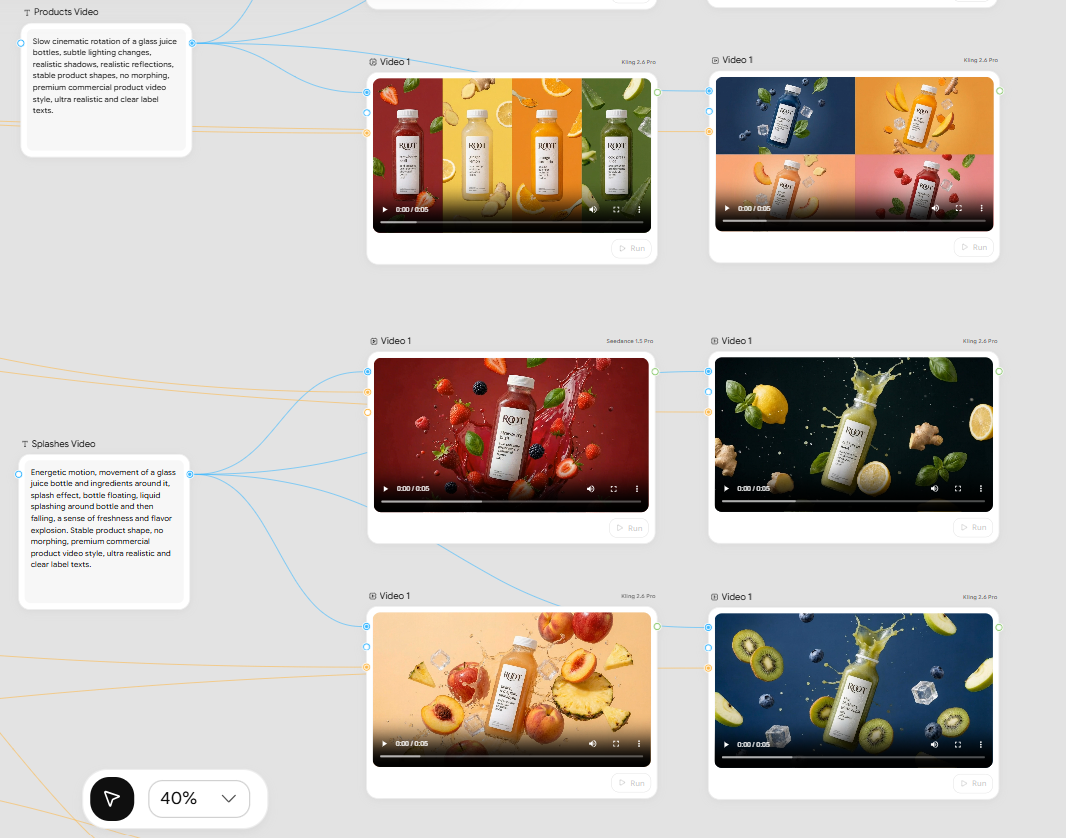 ImagineArt Workflow runs your entire creative brief as a single automated pipeline.
2. Build an AI Influencer
Brand ambassador content is one of the most expensive nodes in any content supply chain. Sourcing influencers, negotiating contracts, briefing them, waiting for content, reviewing it, requesting revisions, and managing usage rights, every one of those steps presents design bottlenecks. And then you have to do it all again for the next campaign.
An AI Influencer removes almost all of that friction. You create a character once, define their:
- look
- personality
- style
- context
Then generate that character in any scene, any outfit, any setting, on demand, without contracts, briefing cycles or revision requests.
For brands producing ambassador content at volume — product launches, seasonal campaigns, weekly social posts, an AI influencer is not just a cost saving. It’s a structural upgrade to the content supply chain. You go from a campaign-by-campaign negotiation model to an always-on, always-available content node.
 ImagineArt's pre-built workflow templates give your content supply chain a running start.
3. Creative Production 5x with AI Ad Generators
Performance marketing is one of the most asset-hungry parts of any content operation. Running ads effectively in 2026 means testing multiple creative directions simultaneously: different hooks, different visuals, different calls to action, and letting performance data tell you which ones work. That requires volume: lots of it.
ImagineArt AI Ad Maker scales that. Rather than briefing a designer for each ad variant and waiting days for a revision cycle, you can generate dozens of on-brand ad creatives in a single session. Different backgrounds, different product framings, different headline treatments, all under minutes.
The AI impact on content supply chain management is nowhere more immediate than in paid creative production. Teams that used to test three ad variants per campaign can now test thirty. That’s more than a speed improvement: it’s a fundamentally different approach to performance marketing that compounds over time as you accumulate data on what works.
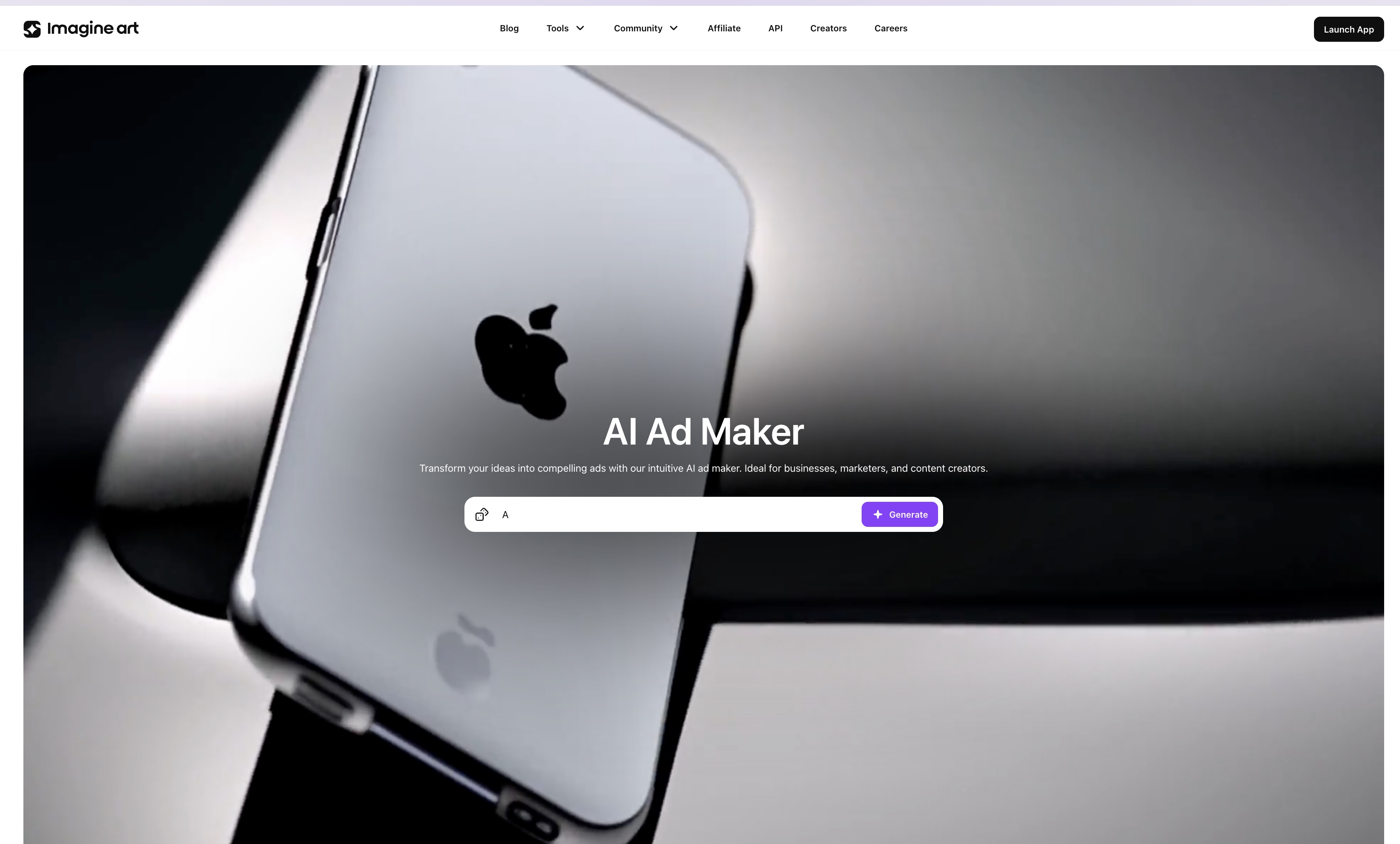 With Imagine Art Ad Maker, you can create professional real estate ads in minutes.
4. Turn Rough Action Footage into Ambassador Videos
Not everything in your content supply chain starts as AI-generated. Most brands have raw footage: product shots from a phone, action clips from an event, behind-the-scenes material that’s authentic but rough.
The traditional approach is to send it to an editor and wait. The AI approach is to transform it.
Kling Motion Control on ImagineArt lets you take rough footage and apply precise motion direction, controlling camera movement, character motion, and scene energy, to produce polished, cinematic ambassador-style video content from footage that would otherwise be unusable.
In supply chain terms, this converts a raw material (unusable rough footage) into a finished asset without the cost of a reshoot or the time of a full edit. It’s the difference between a bottleneck and a throughput.
5. Quick Fixes and Asset Finishing with Specialist AI Apps
The final stage of any content supply chain is finishing: the set of small but critical adjustments that take a near-finished asset to a publish-ready one. In traditional production, this is where things stall. Small fixes queue up behind bigger priorities, assets sit in review waiting for a designer to remove a distracting background or clean up a messy foreground.
ImagineArt app ecosystem automates this stage. For example:
- The AI Image Combiner lets you composite elements from multiple images into one finished asset.
- Nano Banana Pro handles photorealistic image enhancement and detail refinement.
- The AI Image Editor covers inpainting, object replacement, and scene adjustments.
- Video Object Removal takes unwanted elements out of footage in seconds.
These are the tools that sit at the end of your content supply chain and ensure nothing gets stuck at the finishing line. Build them into your workflow as standard final steps — a quality check and finishing pass that runs on every asset before it goes to scheduling.
 Nano Banana Pro App - ImagineArt
6. Run the Whole Pipeline From One Workspace
Every node above is a genuine upgrade, but they are still nodes you have to wire together and remember to run. The last step is putting the whole line behind a single brief. Imagine Computer is a complete AI workspace to run the pipeline: one agent that researches the topic, writes the copy, builds the document or deck, generates the images and video, and can be scheduled to run again next week without being asked. In supply chain terms it is not another node, it is the operator standing over the entire line, which is what turns a set of tools into an actual content engine.
The AI Impact on Content Supply Chain Management
The AI impact on content supply chain management in 2026 is best understood not as a single change but as a compounding one. Each node you upgrade with AI tools produces faster, cheaper, more consistent output. Those gains multiply as they move through the chain — faster asset creation means more assets in review, faster review means more assets in scheduling, more assets in scheduling means more consistent publishing, more consistent publishing means better platform performance.
Teams that have rebuilt their content supply chain around AI tools are not just producing more content. They’re producing better content, more consistently, with smaller teams, at lower cost — and they’re doing it in a way that gets easier over time rather than harder.
 Change the makeup to bold lipstick colors with just one prompt
Building Your Content Supply Chain: The Checklist
Before you scale, make sure each of these nodes is defined in your operation:
- Ideation node: who generates content ideas, at what cadence, using what input (trends, briefs, data)?
- Production node: what tools generate your core assets (images, video, copy) and what’s the standard workflow for each asset type?
- Review node: who approves, what’s the turnaround expectation, and is there a single source of truth for brand guidelines?
- Finishing node: what quality checks run on every asset before scheduling? Which quick-fix tools are in your standard process?
- Distribution node: where does content go, in what format, at what time, and who manages the scheduling pipeline?
- Analytics node: how does performance data feed back into ideation? What signals tell you what to make more of?
Ready to build a content supply chain for your business?
The right time to build your content supply chain was last year. The second best time is now. Start with the node that costs you the most time, whether that's ad creative production, ambassador content, or asset finishing, and build one AI-powered workflow for it. Then connect the next one. ImagineArt has every tool you need and the full app ecosystem for finishing and refinement.
The supply chain won't build itself. But once it's built, it runs.
Umaima Shah
Umaima Shah is a creative content strategist specializing in AI tools, image generation, and emerging technologies. She focuses on translating complex platforms into clear, practical insights for creators, designers, and product teams