
Syed Anas Hussain
May 19, 2026 • Updated June 7, 2026
7 mins Read
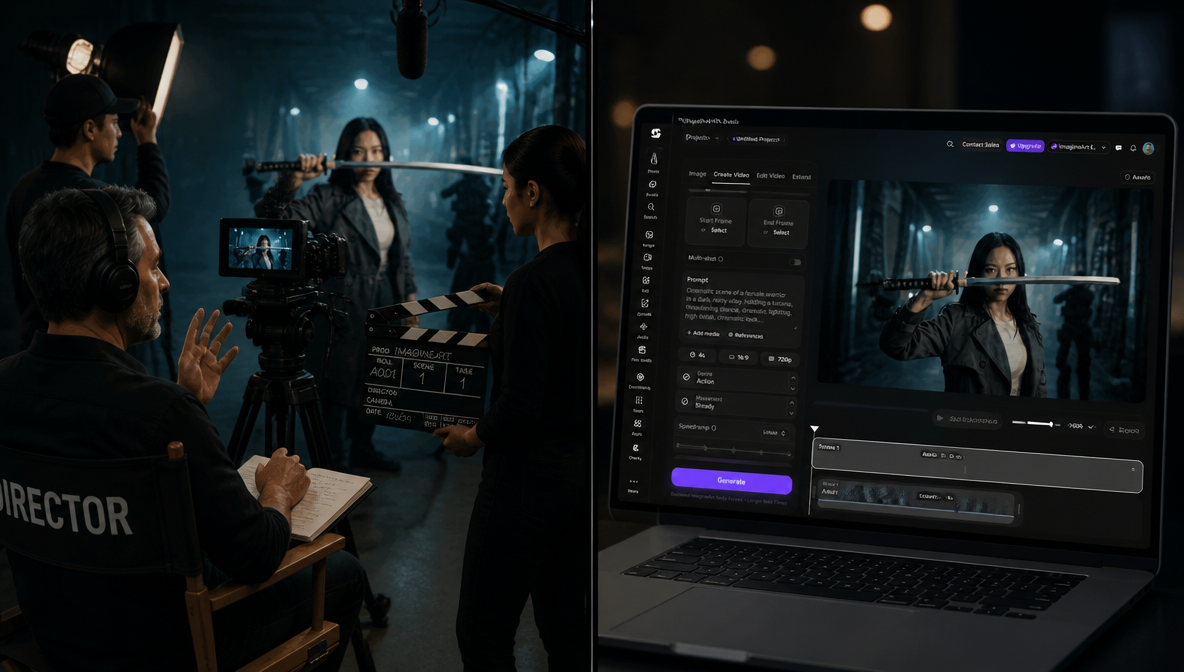
The decision between an AI filmmaking tool and traditional video production used to be simple: if you had the budget, you hired a crew. In 2026, that calculation has changed significantly. Not because AI has gotten good enough to replace professional production in every context, but because it's gotten good enough to make traditional production unnecessary in many of them. This comparison looks at both approaches honestly: what each costs, how long each takes, where quality holds up, and when to choose which.
The Real Cost of Traditional Video Production
ImagineArt AI Film Studio has restructured what video production costs for creators, marketers, and indie filmmakers. To understand how, it helps to see what traditional production actually costs.
Traditional video production costs more than most first-time clients expect. A breakdown of typical costs for a 2-minute branded video or short film scene with a freelance crew:
- Camera and lens rental: $300–$800/day for a cinema-grade setup
- Lighting and grip: $200–$600/day
- Director/DP: $500–$2,000/day depending on experience
- Editor: $500–$2,500 for a 2-minute final cut
- Location fees, permits, catering: Variable, but easily $500–$1,500
- Color grade and sound mix: $500–$1,500
For a single 2-minute video with one shoot day, you’re looking at $3,000–$8,000 at the low end. For anything involving stunts, locations, visual effects, or multiple shoot days, the budget multiplies quickly.
The time cost is equally significant. Pre-production planning typically takes 1–2 weeks. A shoot day runs 8–12 hours. Post-production for a 2-minute video takes 3–7 business days. From concept to final delivery: 3–6 weeks for even a straightforward production.
For established brands and productions where the human element is irreplaceable, this investment makes sense. For content creators, indie filmmakers, marketers, and anyone working at volume, the math increasingly doesn’t.
What an AI Filmmaking Tool Changes About Production
ImagineArt AI Film Studio restructures the production equation at almost every stage:
Pre-production: Concept visualization, mood boards, and storyboards can be generated in hours rather than days. The gap between “we have a script” and “everyone can see what this film looks like” shrinks from a week to an afternoon.
Production: Footage generation happens in seconds to minutes. No camera rental, no location permit, no weather dependency, no crew scheduling. A shot that would have required a production day can be generated in a prompt.
Post-production: Color grading tools, AI audio, and Audio Studio reduce the specialist chain needed to deliver a finished video. Many short productions require only a basic video editor to assemble AI-generated components.
Cost structure: ImagineArt’s AI Film Studio is free to start, with paid plans for higher generation volume. The delta between “free” and “full production” is a fraction of traditional video costs at any comparable output level.
For a breakdown of the full AI production pipeline, the complete AI filmmaking guide covers every stage in detail.
Speed Comparison: Traditional vs AI Film Production
| Production Stage | Traditional Video Production | AI Film Studio (ImagineArt) |
|---|---|---|
| Concept to visual reference | 3–5 days (storyboard artist) | 1–4 hours (Workflow Builder) |
| Pre-production planning | 1–2 weeks | 1–3 days |
| Single scene generation | 1 shoot day (8–12 hours) | 30–120 seconds |
| Post-production (2-min video) | 3–7 business days | 2–6 hours |
| Concept to final delivery | 3–6 weeks | 1–3 days |
| Revision cycle | Reshoots: days + budget | Regenerate: seconds |
The time advantage for AI production is not incremental. It's structural. Revision cycles that required reshoots now require a prompt adjustment. Concept exploration that required a storyboard artist now requires a Workflow Builder run.
Quality Comparison: Can AI Match Traditional Production?
Honest answer: sometimes yes, sometimes no, and the gap is closing.
Where AI matches or exceeds traditional production:
- Atmospheric and environmental shots: landscapes, cityscapes, establishing shots, weather effects
- Abstract and stylized sequences: anything where a distinctive visual aesthetic is more important than photorealism
- Social media content: short-form clips where delivery speed and volume matter more than cinematic perfection
- Concept visualization and pre-production reference work
- B-roll and supplementary footage to support a traditional production
The quality gap in atmospheric and narrative AI video has narrowed significantly as ImagineArt's generation engine has improved. Character motion and subtle acting remain the area where traditional production holds the largest advantage.
When Traditional Production Still Wins
Traditional video production is the right choice when:
- The human element is the product. Corporate interviews, testimonials, on-camera talent appearances, and anything where real people are the deliverable cannot be AI-generated.
- Physical authenticity is required. Real products being handled, real locations being featured, live events being documented. These require cameras and crews.
- The brief demands absolute realism. Some brands and clients have standards that require live-action footage. AI is not yet invisible at the highest scrutiny levels.
- You're scaling a specific talent. If the production is built around a specific actor, athlete, or public figure, traditional production is irreplaceable.
When an AI Filmmaking Tool Is the Better Choice
ImagineArt Video Generator and the broader AI Film Studio platform make the most sense when:
- Speed matters more than traditional production timelines. Marketing campaigns, social content calendars, and content-at-scale use cases benefit enormously from AI production speed.
- Budget is constrained. For indie filmmakers, solo creators, and startups, AI production quality at a fraction of traditional cost is a genuine advantage, not a compromise.
- You’re in concept or pre-production. Using AI to visualize, iterate, and lock a creative direction before committing to traditional production saves time and money at every subsequent stage.
- The content is atmospheric, stylized, or abstract. These are the strongest AI generation contexts — landscapes, establishing shots, genre footage, futuristic or fantasy environments.
- Volume is required. Producing 20 social media video variations traditionally would cost tens of thousands of dollars. With AI, it’s a fraction of that.
- Voice and multilingual audio are needed. ImagineArt Audio Studio adds dialogue and narration to AI productions without casting, recording sessions, or studio time.
What Happens When You Combine Both
The most sophisticated productions in 2026 aren't choosing between AI and traditional. They're combining them. A common hybrid workflow:
- Pre-production in AI: Storyboard and visualize the full film using ImagineArt’s Workflow Builder
- Live-action production for key scenes: Shoot the moments that require real actors or locations
- AI-generated footage for supplementary scenes: B-roll, establishing shots, atmospheric sequences
- AI audio for narration: Audio Studio handles voiceover and narration that doesn’t require on-screen talent
- Assembly and finishing: Traditional editing workflow incorporates both AI and live footage
Frequently Asked Questions
For atmospheric scenes, social content, short films, and stylized sequences, yes — AI film production quality in 2026 is professional-grade. For live-action human performances, branded content requiring real people, or documentary work, traditional production still leads. The right choice depends on what the content requires.
A typical 2-minute traditional video production costs $3,000–$8,000 at the low end. AI film production with ImagineArt starts free, with paid plans for higher volume. For content that AI handles well, the cost difference is significant. For productions requiring live-action, traditional costs remain unavoidable.
ImagineArt AI Film Studio leads in 2026 as a full-pipeline solution: it combines AI image generation, cinematic video generation, Audio Studio for dialogue and narration, and Workflow Builder for automated production, all in one platform, free to start.
For certain production types, yes — atmospheric scenes, short films, and stylized content can be produced entirely with AI tools. For productions centered on live performances, real locations, or physical authenticity, a production crew remains essential. Most advanced productions in 2026 combine both approaches.
A scene that requires a full shoot day with traditional production can be AI-generated in 30–120 seconds with ImagineArt's Video Studio. End-to-end production time — from concept to final video — drops from 3–6 weeks with traditional production to 1–3 days with an AI film studio workflow.
For most social media video use cases — short-form content, branded storytelling, trend-based content, and high-volume campaigns — AI film production with ImagineArt is the more practical choice. Speed, cost, and the ability to iterate quickly outweigh the advantages of traditional production for social formats.
The Verdict: Tools for Different Jobs
AI filmmaking tools don’t make traditional video production obsolete. They make it optional for a much larger portion of productions than it used to be. For indie filmmakers, content creators, marketers, and anyone working at scale or on a budget, an AI film studio is now the starting point rather than the fallback. Traditional production remains essential where it always was: when the human element is the entire point.
The creators building the most interesting work in 2026 are using both. And ImagineArt is the platform that makes the AI side of that equation actually work.
Syed Anas Hussain
Syed Anas Hussain is a computer scientist blending technical knowledge with marketing expertise and a growing passion for AI innovation. Curious by nature, he dives into new AI sciences and emerging trends to produce thoughtful, research-led content. At ImagineArt, he helps audiences make sense of AI and unlock its value through clear, practical storytelling.