Put simply, AI slop is low-quality, high-quantity content made with generative AI. Here's what the word means, where it came from, what the big platforms changed (with dates), and a 10-point checklist for AI video that doesn't qualify. The fix is the person holding the prompt, not the model.
What is AI slop?
AI slop is AI-generated content made fast and in bulk, pushed at people who never asked for it, with little care for whether it's true, useful or good. If you want the short answer to what is AI slop, it's an insult, and an intentional one.
Wikipedia's AI slop entry gathers the definitions in circulation: "digital clutter", "filler content prioritizing speed and quantity over substance and quality", and "shoddy or unwanted AI content in social media, art, books" and search results. It notes the term carries a pejorative connotation similar to spam. That's the most useful AI slop meaning to keep in your head: spam is defined by being unwanted, not by the tool that sent it.
Simon Willison, the British programmer Wikipedia credits as an early champion of the term, put it this way in a May 2024 post: if it's "mindlessly generated and thrust upon someone who didn't ask for it, slop is the perfect term for it." He also wrote that "not all AI-generated content is slop."
So what isn't slop? A made-with-AI video someone asked for or is glad they watched, like a birthday clip starring your mom's actual dog. Same tool, more care.
When did "AI slop" start?
Around 2022. Wikipedia says early use of "slop" for low-grade AI material "apparently came in reaction to the release of AI image generators in 2022", as in-group slang on 4chan, Hacker News and YouTube.
Willison's May 2024 post pushed it wider. He credits a tweet from @deepfates, and has said the word was in use before him.
By 2025 the term had won. The American Dialect Society chose "slop" as its Word of the Year for 2025 in a vote announced on January 9, 2026, "for its widespread use for low-quality, high-quantity content, most typically produced by generative AI." "AI slop" had already been a nominee in its 2024 vote. Merriam-Webster also named "slop" its 2025 word, per Wikipedia. Note the AI slop definition the ADS settled on says "most typically" AI. Slop can be human-made too.
What slop looks like on video
AI slop videos are the short, glossy, interchangeable clips that show up in a fresh feed: a cartoon animal melodrama, a fake disaster, a slideshow with a robot voice reading unchecked facts.
Kapwing's AI slop report (November 2025) set up one brand-new YouTube account and logged the first 500 Shorts it was shown. In that single test, 104 (21%) were AI-generated, by Kapwing's classification, and 165 (33%) were what Kapwing calls brainrot. A single account is a small sample, so read it as a snapshot.
The Conversation's explainer names the famous ones: Shrimp Jesus, the Hurricane Helene girl image, the band Velvet Sundown and AI cat soap operas.
YouTube's own list is the most practical. Its monetization policies rule out image slideshows, templated storylines or scrolling text with minimal or no narrative, and "AI-generated content made with generic or unoriginal templates giving the impression of mass production" without the creator's own insight. If you could swap the channel name and nobody would notice, that's the tell.
How are YouTube, TikTok, Meta and Pinterest each dealing with AI slop?
YouTube, TikTok, Meta and Pinterest are cutting off money for mass-produced content, adding labels and giving viewers a dial to see less of it. None of the four bans AI video. Here's what each changed between July 2025 and January 2026.
| Date | Platform | What changed | Source |
|---|---|---|---|
| July 14, 2025 | Meta (Facebook) | Accounts that keep reusing other people's text, photos or videos lose monetization for a period and get reduced distribution | TechCrunch on Meta's crackdown |
| July 15, 2025 | YouTube | "Repetitious content" renamed "inauthentic content", clarified to cover repetitive or mass-produced videos (always ineligible to earn) | YouTube Help |
| October 16, 2025 | A tuner to see less GenAI content on eligible image Pins in categories like beauty, art and home decor | Pinterest's GenAI controls | |
| November 19, 2025 | TikTok | Testing a "Manage topics" control for how much AI content shows in For You, plus invisible watermarking | TikTok's AI content controls |
| January 21, 2026 | YouTube | CEO letter section "Managing AI slop": building on its spam and clickbait systems | Neal Mohan's 2026 letter |
Labels are the other half. YouTube's AI disclosure rules ask creators to set "AI use" to Yes in YouTube Studio when a video makes a real person appear to say or do something they didn't, alters footage of a real event or place, or shows a realistic scene that never happened. Non-realistic content and minor edits don't need it. TikTok requires labels on realistic AI content and says they've covered over 1.3 billion videos, though a label can drop off when a clip is re-uploaded or edited elsewhere.
YouTube explicitly allows AI used to edit scripts or "generate a unique background visual for your content." Where YouTube draws the line is mass production.
Our side of it: AI video companies make slop easy
ImagineArt turns a prompt, a photo or an existing clip into a video with sound, across 40+ models. So does a slop farm.
Our downloads carry no watermark on any plan, which means the label is your job. If a clip looks realistic, YouTube and TikTok expect you to disclose it, and our own FAQ says plainly that you're responsible for how you use and share your videos.
We can't promise a tool that refuses to make slop. We can show what separates a lazy prompt from a worked one.
How to make AI video that isn't slop: a 10-point checklist
- Start from an idea only you have. YouTube asks for "original, authentic insights or perspective."
- Write the full prompt. Name the subject, action, scene, camera move, lighting and mood, the six parts ImagineArt's video generator page recommends. More examples sit in our guide to AI video prompts.
- Generate several takes and keep one. Run it a few times in the AI video generator, then post only the best.
- Check hands, physics and on-screen text before posting. Warped fingers get screenshotted first.
- Add something of yours. Your voice, your edit, your captions. Here's how to add subtitles to a video.
- Label realistic AI. Use YouTube's "AI use" setting and TikTok's label on anything that could pass for real footage.
- Never make a real person say or do something they didn't. That's deepfake territory, and YouTube requires disclosure for it.
- Don't post one template on repeat. YouTube names templated storylines as non-monetizable.
- Post less, better. Willison calls "don't publish slop" "a useful baseline."
- Check your plan's rights before you monetize. ImagineArt's paid plans include commercial use rights; free plan videos are for non-commercial use.
Here's point 2 in practice: run both on the same model and settings, so the only variable is the person typing. The lazy prompt has a cat, the word "viral" and seven filler words doing no work:
Try this prompt in ImagineArt's AI video generator (Seedance 2.5, text to video, 9:16, 720p, shortest duration): "cute cat doing something funny, viral, trending, 4k, cinematic"
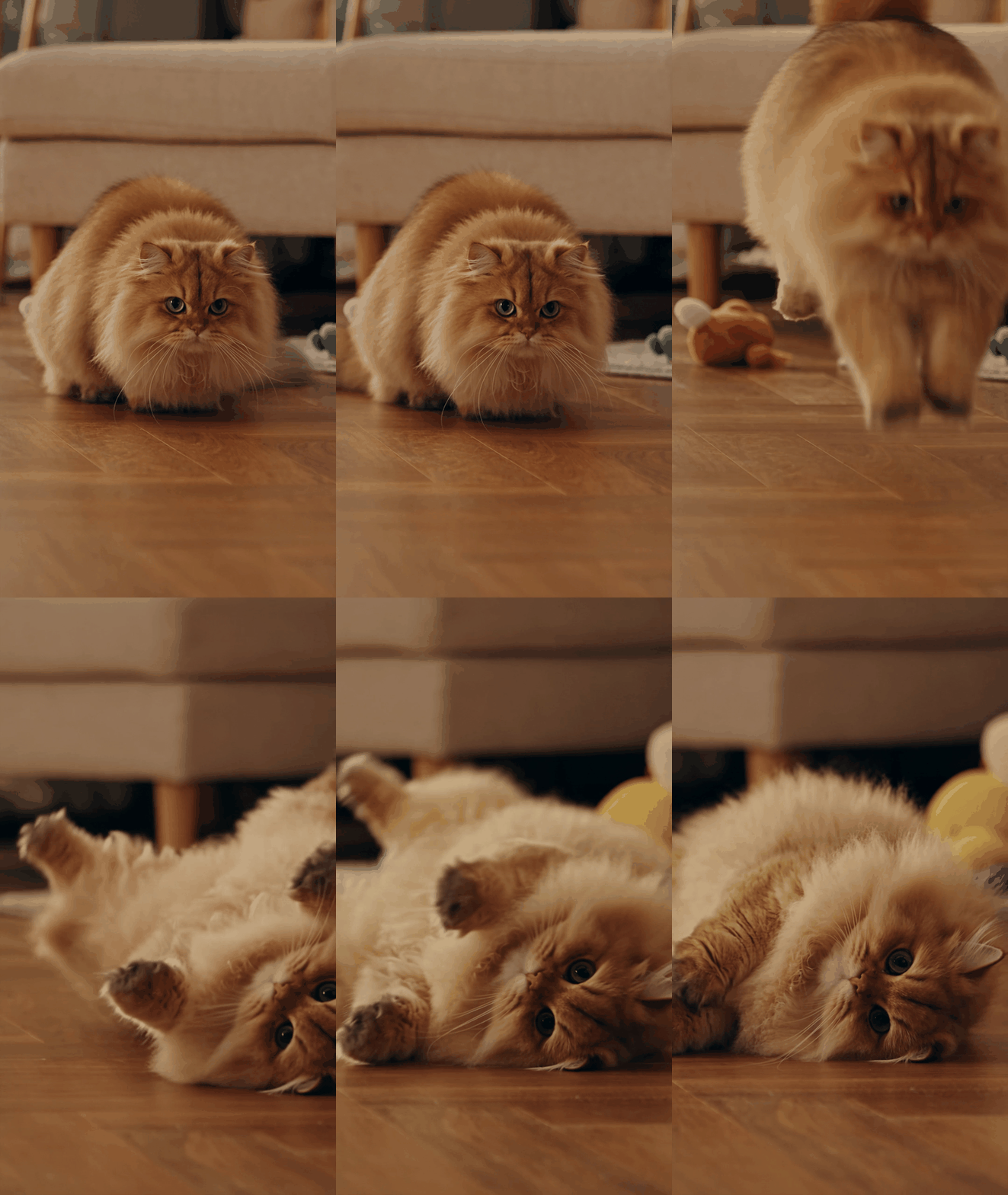 The lazy prompt: "cute cat doing something funny, viral, trending, 4k, cinematic"
The worked prompt names one cat, one action, one camera and one light:
Same settings: "A ginger tabby cat sits on a sunlit windowsill, watching a single soap bubble drift past, then taps it with one paw and flinches when it pops. Static close-up at cat height, soft morning light from the left, quiet curious mood, no text on screen."
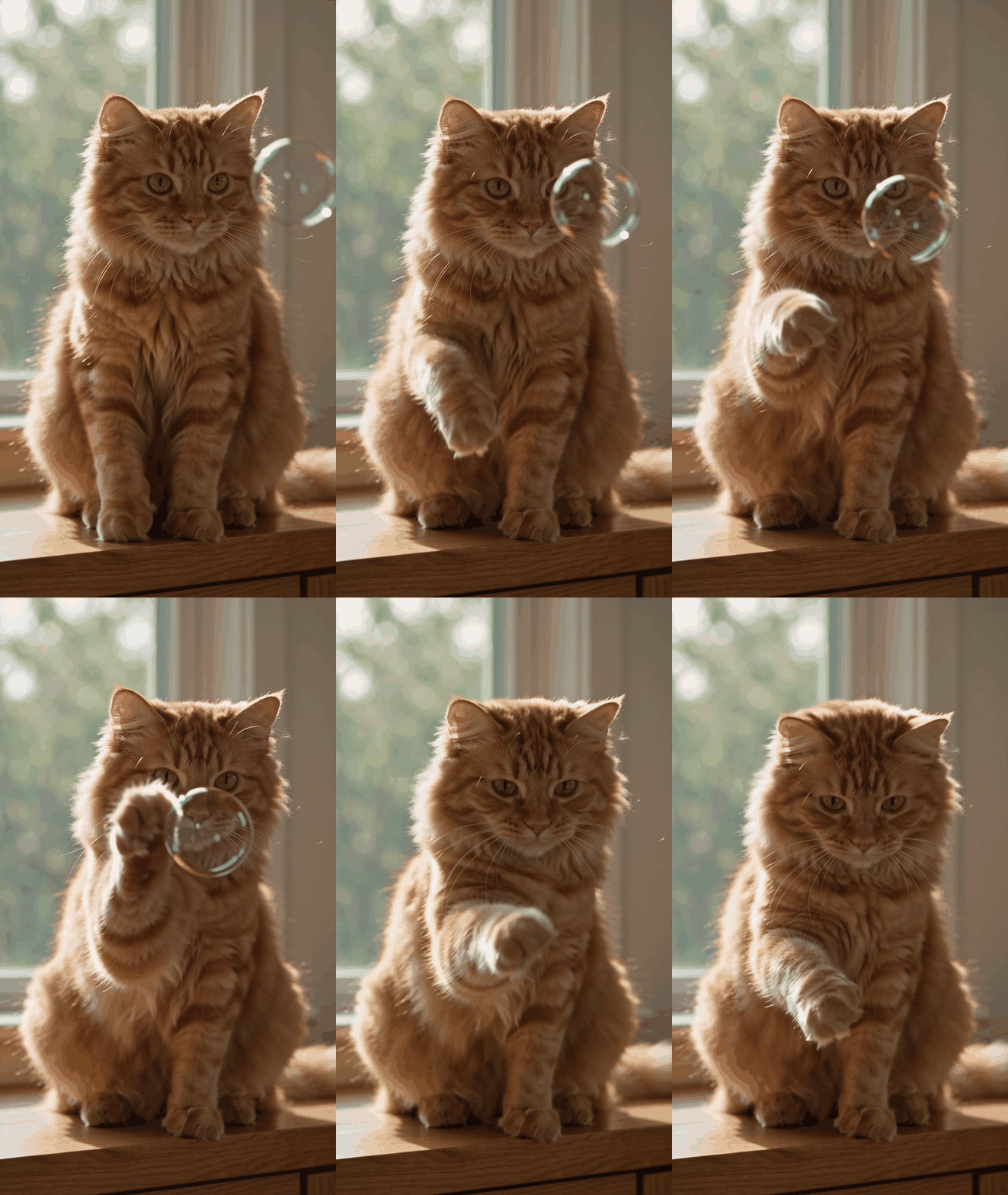 The worked prompt: one cat, one bubble, one camera, one light
Compare: does the cat do one readable thing, and does the bubble pop where the paw meets it? The second prompt leaves fewer blanks for generic choices. It won't fix physics on its own, which is why point 4 exists.
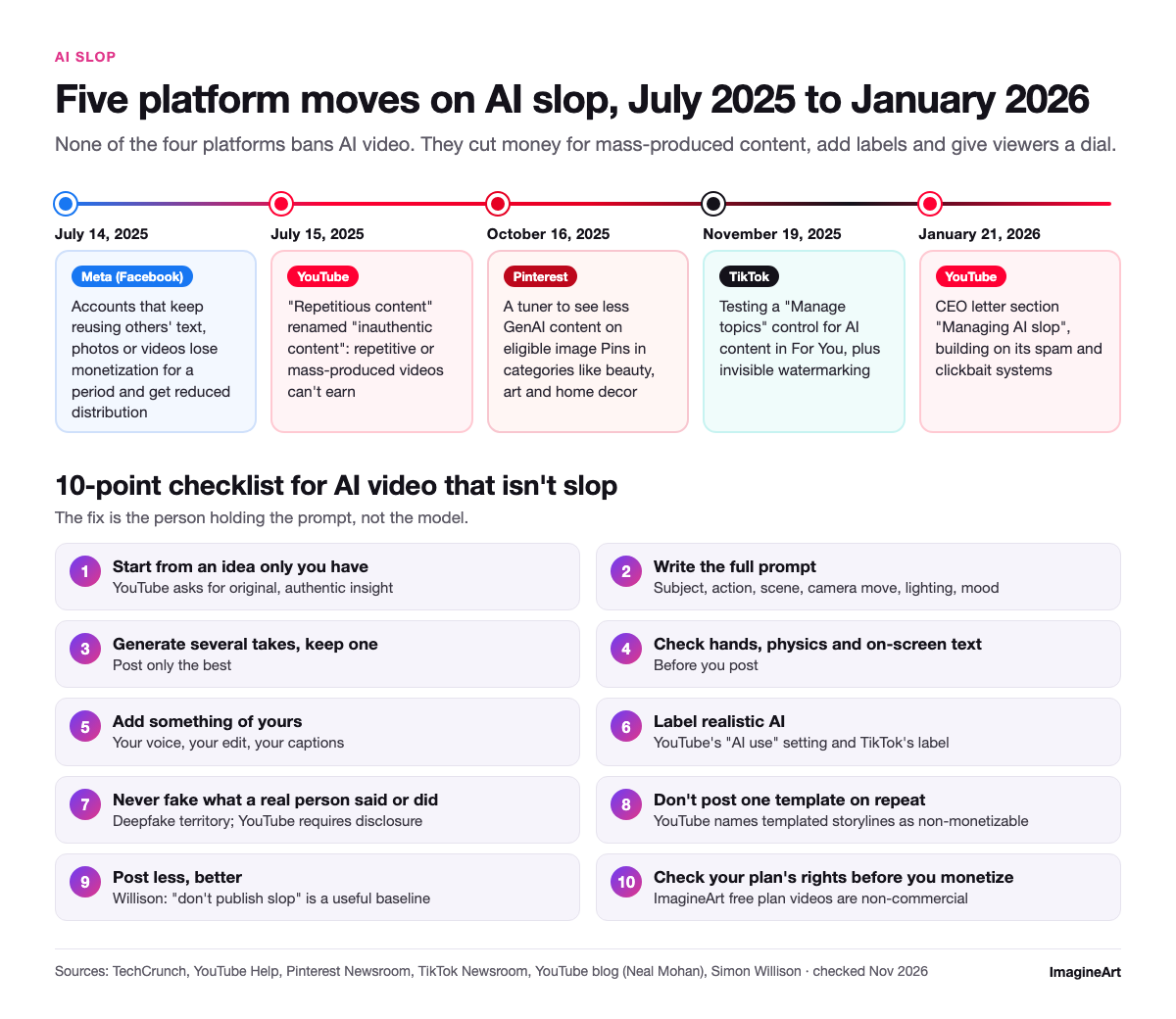 Five platform moves on AI slop, and the 10-point checklist
Frequently asked questions
Look at volume and sameness first: templated storylines and channels posting near-identical clips. Then check for warped hands and broken physics. AI video detectors can help, but treat any detector's verdict as one signal, not proof.
There's no trustworthy figure for that. In October 2025 Pinterest added a setting to see less GenAI content on image Pins in categories like beauty, art, fashion and home decor. Pinterest added food and drink in December 2025.
No. Willison says so directly, and YouTube's rules allow AI used with the creator's own perspective. What tips content into slop is care and volume.
Yes, if the video is original and not mass-produced. YouTube's July 2025 update targets repetitive, templated content, not AI itself. Disclose realistic AI scenes in YouTube Studio.
Wikipedia notes the term's pejorative sense is similar to "spam": content nobody asked for. The American Dialect Society chose "slop" for content that's low in quality and high in quantity, which is exactly the insult intended.
Make the clip only you could make
AI slop is a volume problem with a care problem underneath. Platforms are tightening the rules on mass-produced video and giving viewers dials to filter it. None of it bans AI. It targets lazy, mass-produced AI.
The checklist boils down to three habits: start from your own idea, write a prompt with real detail, and label anything that could pass for real.
To try the two cat prompts side by side, open ImagineArt's AI video generator and run both on one model. ImagineArt has a free plan; check what it includes on the plans page before you start.
Zahida Misher
Exploring how AI transforms marketing, I help businesses unlock growth and future-proof their presence.