
Syed Anas Hussain
May 20, 2026 • Updated July 8, 2026
10 mins Read
AI cinema isn't a filter applied to video. It's a fundamentally different way of creating moving images, one where the cinematographer's decisions (framing, camera movement, light, atmosphere) happen through language rather than through lenses and physical cameras. Understanding how AI cinema actually works changes how you use it. This guide breaks down the models, the camera control system, and what it actually means for output to be “cinematic” in 2026.
What Is AI Cinema? (Definition and How It Differs from AI Video)
AI cinema is the practice of generating cinematic-quality video footage using machine learning models — where visual decisions like camera movement, lighting, depth of field, and film aesthetic are controlled through text prompts rather than physical equipment. Unlike general AI video generation, AI cinema is specifically optimized for narrative storytelling, shot composition, and the visual grammar of film. ImagineArt AI Film Studio is a platform built for AI cinema production, combining cinematic video generation with integrated Audio Studio and workflow tools.
The distinction between "AI video" and "AI cinema" matters more than it sounds. An AI video generator creates footage. AI cinema creates directed shots — footage with intentional camera language, stylistic consistency, and the visual codes that audiences associate with professional filmmaking.
The difference shows up in output. A generic AI video clip looks like a well-rendered scene. An AI cinema clip looks like a frame from an actual film — because it was prompted with cinematographic intent, generated by a model trained on cinematic references, and processed through systems designed to preserve filmic quality.
The AI Models That Power Cinematic Video Generation
The core engine of AI cinema is the video generation model — a deep learning system trained on large datasets of video footage that learns to predict and generate coherent, visually consistent video sequences from text descriptions.
Not all models produce the same results. Model architecture, training data, and optimization targets create meaningfully different outputs — which is why serious AI filmmakers don’t use one model for everything. ImagineArt's AI FIlm Studio leverages the best cinematic models in the same workspace:
Narrative drama and character work. When directed toward intimate scenes, close-ups, and character-driven sequences, the engine produces footage with rich human motion dynamics, strong facial detail fidelity, and the deep shadow rendition essential for dramatic genres. The right output register for any shot where a human subject carries the emotional weight of the scene.
Environmental scale and atmosphere. Wide establishing shots, landscape footage, and documentary-style observation draw on a different dimension of the engine's training. Natural light rendering across overcast, golden hour, and available light conditions produces with high fidelity. The right output register for scenes where scale and environment carry the story.
Stylized and experimental aesthetics. Painterly treatments, abstract motion, and surreal visual sequences are produced by directing the engine toward expressive, non-literal aesthetics. For music videos, experimental shorts, or any project where the visual style is the point rather than the vehicle, this is the strongest output direction.
| Cinematic Output Style | Best Scene Types | Key Characteristic |
|---|---|---|
| Narrative drama & character | Close-ups, dialogue, action sequences | Rich motion dynamics, facial detail, deep shadow rendition |
| Environmental scale & atmosphere | Landscapes, establishing shots, documentary | Natural light fidelity, sweeping motion, atmospheric depth |
| Stylized & experimental | Music video, abstract, artistic sequences | Expressive, painterly, strong with non-literal aesthetics |
| Physical realism | Commercial, product, physical environments | Accurate motion physics, material detail, colour precision |
How Camera Control Works in AI Cinema
This is where AI cinema diverges most sharply from traditional video generation — and where understanding the system changes your outputs dramatically.
In traditional filmmaking, camera control is physical: where you put the camera, how you move it, what lens you attach. In AI cinema, camera control is linguistic: the words in your prompt trigger specific rendering behaviors in the model.
AI video models have been trained on enormous quantities of professionally produced footage, which means they’ve implicitly learned the visual grammar of cinema. Terms like "tracking shot," "Rembrandt lighting," "anamorphic lens," and "rack focus" aren’t just descriptions — they’re instruction sets that activate specific learned behaviors in how the model renders motion, depth, and light.
Shot types and their prompt equivalents:
- Establishing shot — tells the model to prioritize environmental context over subject detail
- Close-up / extreme close-up — triggers shallow depth of field and subject isolation
- Tracking shot — produces lateral camera motion that follows a moving subject
- Dolly in / push-in — generates a slow forward camera movement, psychologically read as increasing intimacy or tension
- Overhead crane shot — produces a descending top-down perspective, typically used for reveals or establishing scale
- Handheld — adds controlled instability that reads as documentary or observational presence
Lighting language as camera control:
Lighting terms function similarly. "Rembrandt lighting" is a specific portrait technique (a triangle of light on the cheek, deep shadow on the other side) that AI models have encountered thousands of times in training data and can reproduce reliably. "Hard side lighting from a single practical source" requires the model to construct the scenario from first principles. Both work — the named technique typically produces more consistent results because the model has learned a precise rendering pattern associated with that term.
Motivated camera movement. The most advanced camera control technique in AI cinema is giving motion a narrative reason: "slow dolly in as she reads the letter — intimacy building" produces different output than "slow dolly in." The psychological intent in the description gives the model context for how to frame the motion, not just its direction.
Output Quality: What "Cinematic" Actually Means in AI Video
The word "cinematic" gets overused in AI video marketing. It’s worth being specific about what it actually refers to as a set of technical and aesthetic characteristics.
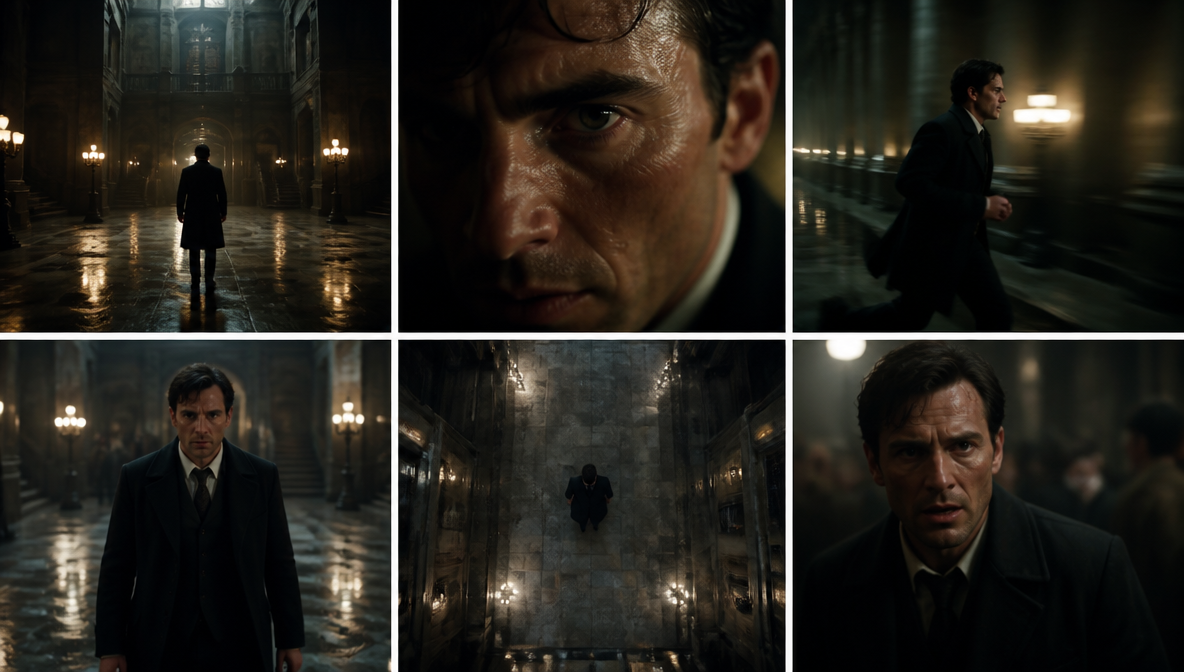
Depth of field. Cinema uses shallow depth of field to separate subjects from backgrounds — the subject is sharp, the background is softly blurred. This creates visual hierarchy that directs attention and reads as professional. AI cinema models reproduce this through depth-of-field description in prompts ("shallow depth of field," "35mm, f/1.8 look").
Film grain and texture. Digital video is clean to the point of artificiality. Film grain adds texture that makes footage feel tactile and temporally grounded. Prompts specifying film stocks ("Kodak Portra 400," "Fuji Velvia," "16mm grain") trigger model behaviors that add this texture convincingly.
Aspect ratio. Standard digital video is 16:9. Cinema uses 2.39:1 (ultra-widescreen anamorphic) or 1.85:1, which produces the letterbox format audiences associate with film. Specifying aspect ratio in prompts creates the compositional expectation of cinema rather than content.
Colour grading. Cinematic colour grades are intentional and stylistically coherent — desaturated teal and orange, warm noir amber, cool documentary neutral. These descriptions work directly in AI cinema prompts and produce consistent grade application across multiple generations when used as part of a fixed style vocabulary.
Motion quality at 24fps. The distinctive motion cadence of film (24 frames per second vs. the smoother 60fps of digital video) is itself a cinematic signal. Specifying "24fps" or "cinematic frame rate" in prompts influences how models render motion.
How ImagineArt’s AI Film Studio Puts It Together
ImagineArt’s AI Film Studio is a complete AI cinema production environment that combines four video generation models (Kling 3.0 Pro, Seedance 2.0, Runway 4.5, and Google Veo 3.1) with integrated voice generation, a workflow automation builder, and social format export tools — all in a single browser-based platform. It is designed specifically for AI cinema production rather than single-clip generation, with tools for maintaining visual consistency, generating audio, and managing multi-shot projects at scale.
ImagineArt AI Film Studio addresses the three main production challenges that make AI cinema difficult on single-purpose tools:
Multi-model access in one workspace. Rather than generating everything through one model’s aesthetic, you select the right model per shot type. Character scenes in Kling 3.0 Pro. Establishing shots in Seedance 2.0. Stylized sequences in Runway 4.5. The model switch doesn’t require leaving the platform or managing separate accounts.
Style reference system. Visual consistency across 20 shots is the central AI cinema challenge. ImagineArt’s style reference feature lets you attach a reference image to generations — locking character appearance, colour palette, and aesthetic across shots that would otherwise drift apart.
Integrated audio. Cinematic output without audio is an incomplete film. ImagineArt’s integrated voice generation handles narration, character dialogue, and ambient sound — so the audio production happens in the same environment as the video generation, with the same style intentionality.
For practical application, see how to use ImagineArt AI Film Studio, the complete AI movie guide, and the workflow automation guide for producing multi-shot projects efficiently.
What AI Cinema Can and Can’t Do in 2026
What it does well:
- Single-shot generation with precise cinematographic control via prompts
- Atmospheric and genre-specific visual output (noir, sci-fi, documentary, drama)
- Character-driven scenes up to 60 seconds per generation
- Stylistically consistent output across shots when style references are used
- Integration with voice and audio in a full production pipeline
- Export at up to 4K resolution for professional and festival distribution
Genuine limitations:
- Character continuity shot-to-shot remains the primary challenge: a character's face, clothing, and physical details can drift across separate generations
- Scenes requiring multiple simultaneous characters in complex interaction are harder to direct than single-character shots
- Fully photorealistic footage that is indistinguishable from camera capture is not yet consistently achievable for all scene types
- Long-form generation beyond 60 seconds per clip requires assembly of multiple generations
The best AI cinema in 2026 works with these characteristics rather than against them — leaning into the medium's strengths (atmosphere, style, mood, scale) and using production technique (consistent grading, style references, visual consistency) to manage the limitations.
FAQ: AI Cinema Questions Answered
AI cinema is the practice of generating cinematic-quality video using machine learning models, where camera movement, lighting, depth of field, and visual style are controlled through text prompts rather than physical cameras. Unlike general AI video generation, AI cinema is optimized for the visual grammar of film — shot composition, narrative framing, and stylistic consistency across sequences.
Cinematic AI video is characterized by controlled depth of field, film grain and texture, intentional colour grading, motivated camera movement, and 24fps motion cadence. These qualities are produced by using cinematographic language in prompts (shot types, lighting names, film stock references) that trigger specific rendering behaviors in AI video models trained on professional film and television footage.
ImagineArt's generation engine produces different cinematic output styles depending on how you direct it. For character-driven narrative sequences, use intimate framing, dramatic lighting, and strong depth of field in your prompts. For atmospheric and landscape footage, direct toward scale and natural light. For commercial and product content, specify physical accuracy and material detail. The engine produces its best output when your prompt includes shot type, lighting language, and a consistent visual style vocabulary.
Camera movement in AI cinema is controlled through text descriptions in the generation prompt. Terms like 'slow dolly in,' 'tracking shot,' 'handheld,' and 'overhead crane shot' trigger specific rendering behaviors in models trained on professionally shot footage. Adding narrative motivation to the movement description — 'slow push-in as she reads the letter' — produces more intentional output than direction alone.
An AI film studio is a complete production platform for AI cinema that handles more than just video generation. ImagineArt's AI Film Studio combines cinematic video generation with integrated Audio Studio, workflow automation, and export tools in one browser-based environment, designed for producing complete films rather than isolated clips.
For films under 10 minutes, AI cinema in 2026 produces genuinely cinematic output that stands on its own as a creative format. The gap isn't a quality limitation — it's a different medium with different visual characteristics. AI cinema excels at atmosphere, style, and scale. Character continuity across shots and fully photorealistic footage for all scene types remain active development areas.
Syed Anas Hussain
Syed Anas Hussain is a computer scientist blending technical knowledge with marketing expertise and a growing passion for AI innovation. Curious by nature, he dives into new AI sciences and emerging trends to produce thoughtful, research-led content. At ImagineArt, he helps audiences make sense of AI and unlock its value through clear, practical storytelling.