![7 Types of Enterprise AI Solutions [And How to Evaluate Each] for Business Operations](https://blogs-cdn.imagine.art/Imagine_Art_Enterprise_a608df5456.png)
This guide covers every major category of enterprise AI solution, organized by function to give you the framework to evaluate the right solution for your organization's specific context.
Why do enterprises need AI?
Large organizations face a specific set of pressures that smaller teams can absorb through speed and informality. At enterprise scale, operational complexity grows faster than headcount.
- Data accumulates across systems that don't talk to each other.
- Decision-making slows as the number of stakeholders increases.
- Personalization expectations rise while the cost of producing personalized content at scale remains prohibitive through traditional means.
Enterprise AI solutions address each of these pressures directly — but only when implemented as coordinated infrastructure, rather than individual tools. The organizations seeing the highest returns from AI investment are those that moved from "we're testing AI" to "our operations run on AI systems." That shift requires understanding which categories of AI belong in your stack and how they interact.
What makes AI "enterprise-grade"?
Enterprise AI solutions should provide organizational scale. Consumer-grade and SMB-focused tools often perform well for individuals or small teams but introduce risk, inconsistency, security and governance gaps when deployed across hundreds or thousands of users in a large organization.
Before evaluating any specific category of AI solution, it's worth establishing what enterprise-grade actually requires.
- Scalability: Performs consistently across teams, regions, and high-volume usage without degradation in output quality or speed.
- Governance and permissions: Centralized controls over who can access what, with role-based permissions and audit trails for compliance.
- Security and compliance: Meets enterprise security standards, SOC 2, GDPR, data residency requirements with clear data handling policies.
- Integration: Connects with existing enterprise systems, CRM, ERP, DAM, identity management rather than creating new silos.
- Collaboration: Built for teams working together, not individuals working in isolation. Shared workspaces, version control, approvals.
- Reliability and support: Guaranteed uptime SLAs, dedicated enterprise support, and a vendor that will still exist and invest in three years.
7 Enterprise AI Solutions
These criteria apply across every category below. A solution that excels at its core function, while inheriting security, compliance, governance, scalable experience and smooth integration.
1. Enterprise Generative AI Solutions
Investment is generative AI addresses one of the most persistent bottlenecks in large organizations: the gap between the volume of content and code, brand assets, and communications the business needs and the production capacity available to create them.
A generative AI solution for enterprise teams should provide multi-modal access in AI vendors, formats. Enterprise teams should be able to fasten design concepts to prototype pipelines — without increasing the headcount.
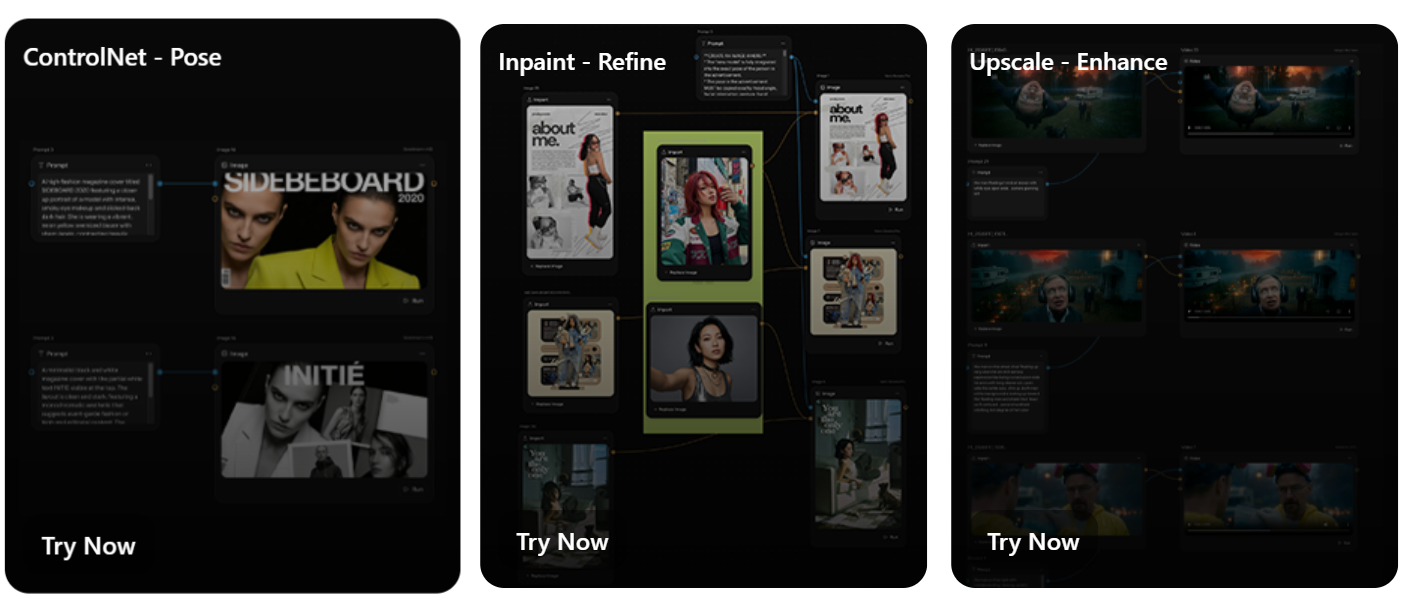 AI Design Workflows
The evaluation criteria for enterprise generative AI are distinct from those for consumer tools. Raw output quality matters, but it's table stakes. What differentiates an enterprise-grade generative AI platform is its:
- ability to enforce brand consistency at scale, so that the thousandth generated asset looks as on-brand as the first
- and its design workflow infrastructure, which determines whether AI generation is a one-off action or a repeatable, governed production process.
For example, ImagineArt, generative AI for Enterprises gives visual workflows while chaining AI models from Google, OpenAI, and ByteDance etc into production pipelines, with governance controls like brand assets, SOC2, and centralized billing that let design teams encode brand standards directly into the workflow.
What to look for when investing in a Generative AI solution?
- Workflow infrastructure: Can models be chained into repeatable pipelines, or is each generation a standalone action with no institutional memory?
- Brand governance: Can style references, lighting presets, and output parameters be locked so all outputs comply with brand standards by default?
- Multi-modal output: Does the platform handle image, video, and audio in one place, or does it require separate tools stitched together by manual handoff?
2. Enterprise Cloud AI Platforms
Cloud AI platforms form the infrastructure layer on which most enterprise AI applications are built. Rather than providing finished AI applications, they offer the compute, storage, model hosting, and API infrastructure that enterprise development and data science teams use to build, train, and deploy AI systems at scale.
The primary use cases are training and fine-tuning large language and vision models on proprietary data, running AI inference at the throughput required for enterprise applications, hosting AI workloads with the security and compliance controls that regulated industries require, and integrating AI capabilities into existing enterprise applications and data pipelines. For organizations building custom AI applications rather than buying finished solutions, cloud AI platforms are the foundation layer — everything else runs on top of them.
Enterprises selecting a cloud AI platform are typically making a long-term infrastructure decision, not a tool procurement decision. The key considerations extend well beyond model quality.
What to look for in enterprise cloud AI?
- Ecosystem lock-in: How deeply does adoption of this platform tie your AI workloads to a single cloud provider's broader infrastructure, and what are the migration costs if that changes?
- Data sovereignty: Where is data processed and stored, and can the platform meet regional compliance requirements for industries like finance and healthcare?
- Developer tooling: How mature is the SDK, API documentation, and enterprise support for teams building on top of the platform?
3. ERP and Enterprise Management AI Solutions
Enterprise resource planning systems have historically been the source of truth for organizational data — financial records, supply chain status, workforce data, procurement. AI embedded in ERP systems makes that data actionable in real time rather than retrospectively.
The core use cases are demand forecasting and inventory optimization (predicting what needs to be produced, sourced, or stocked before shortages occur), financial planning and anomaly detection (identifying variance from expected patterns faster than manual review allows), resource allocation and workforce planning (matching capacity to projected demand across departments and geographies), and supply chain risk assessment (flagging disruption risks before they become operational problems). For enterprises managing complex, multi-variable operations, AI-augmented ERP reduces the lag between data and decision that has historically made large organizations slow to respond to change.
The critical evaluation dimension for AI-augmented ERP is integration depth. AI functionality bolted onto an existing ERP system as a module produces different results than AI built into the core data model.
What to look for:
- Data freshness: Does the AI operate on real-time operational data or on batch exports? The value of predictive capability drops significantly with data latency.
- Explainability: For financial and compliance contexts, can the AI surface the reasoning behind a forecast or recommendation, not just the output?
- Change management requirements: AI-augmented ERP often requires significant process redesign alongside technical implementation — factor this into timeline and cost projections.
4. Enterprise Operations and Automation AI
Operations AI covers the category of solutions that automate high-volume, rule-based, or repetitive processes across enterprise functions. Historically, this was robotic process automation — software bots mimicking human actions in digital systems. AI has expanded both the scope and the sophistication of what can be automated.
Current enterprise use cases include intelligent document processing (extracting and routing structured data from unstructured inputs like invoices, contracts, and forms), IT operations automation (anomaly detection, incident response, and infrastructure management without manual intervention), customer service workflow automation (classifying, routing, and in many cases resolving support interactions without human handling), and back-office process automation across HR, finance, and procurement functions.
The distinguishing factor from earlier RPA is that AI-powered automation can handle variability and exception cases that rigid rule-based systems cannot.
Enterprise automation AI deployments fail most often not for technical reasons but for process reasons — automating a broken process produces faster broken outcomes. Evaluation should start with process analysis, not tool selection.
What to look for:
- Exception handling: How does the system behave when it encounters inputs outside the patterns it was trained on — does it fail silently or escalate to human review?
- Auditability: For regulated processes, can the system produce a complete audit trail of every automated decision for compliance purposes?
- Integration with existing systems: Automation AI that requires significant process redesign often generates less ROI than projected — look for solutions that connect to systems of record rather than replacing them.
5. Enterprise Marketing and Sales AI Solutions
Marketing and sales AI is one of the most mature categories of enterprise AI adoption, in large part because the ROI is relatively direct and measurable.
Enterprise teams are using AI for
- producing localized content at scale: for B2C and B2B campaigns on different platforms
- lead scoring and pipeline prediction : identifying which prospects are most likely to convert and when
- campaign personalization at scale: delivering different messaging, offers, and creative to different audience segments at a volume that manual segmentation cannot support
- customer lifetime value modeling: predicting churn risk and expansion opportunity across the customer base
- and conversational AI for sales support: AI-assisted tools that help sales teams respond to inquiries faster and with greater consistency
For large sales organizations, the most significant impact is often not in individual deal optimization but in the systematic reduction of time spent on low-probability activities.
The evaluation landscape for marketing and sales AI is crowded, and difference between platforms is often less about core capability than about data quality and integration depth.
What to look for:
- CRM integration: Marketing and sales AI is only as good as the customer data it operates on — how deep is the integration with your existing CRM, and how fresh is the data sync?
- Attribution modeling: Does the platform offer multi-touch attribution that gives accurate credit to AI-optimized touchpoints, or does it default to last-click?
- Feedback loops: Can the system learn from outcomes — closed deals, churned customers — in a way that improves predictions over time without requiring manual retraining?
6. Enterprise Data and Analytics AI
Data and analytics AI is the category that makes the rest of the enterprise AI stack more valuable. It turns the outputs of operational systems — transactions, customer interactions, supply chain events, campaign performance — into the intelligence that informs decisions.
Enterprise use cases center on predictive analytics (forecasting revenue, demand, churn, and risk from historical patterns), natural language querying (allowing non-technical stakeholders to ask questions of complex data sets in plain language rather than SQL), automated insight surfacing (flagging anomalies, trends, and opportunities in data without requiring analysts to know what to look for), and real-time dashboarding (keeping decision-makers current on the metrics that matter without manual report compilation).
The organizations extracting the most value from data AI are those that have invested in data infrastructure — clean, connected, well-governed data — before layering AI on top of it.
Data and analytics AI fails most predictably when deployed on top of fragmented, low-quality, or poorly governed data. The technology is not a substitute for data infrastructure.
What to look for:
- Data readiness: Before evaluating analytics AI platforms, assess whether your data is clean, connected, and consistently structured — AI amplifies data quality issues as much as it amplifies data quality.
- Self-service capability: Can business users generate insights independently, or does every query require data engineering support? The former drives adoption; the latter creates a new bottleneck.
- Governance and access control: As AI makes data more accessible, governance becomes more critical — who can see what, and how is sensitive data protected from broad natural language querying?
7. AI for Product Design and Innovation
Product design AI is one of the faster-growing enterprise categories, driven by the recognition that the design and prototyping phases of product development are significant sources of delay and cost.
AI accelerates concept generation (producing multiple design directions from a brief rapidly), UX research synthesis (processing large volumes of user research and behavioral data into design insight faster than human analysis allows), rapid prototyping (turning design concepts into interactive or visual prototypes for stakeholder and user testing without extended development cycles), and visual asset production for product teams (generating imagery, icons, and interface elements without waiting for production design capacity).
For product organizations in competitive markets where speed to validated concept is a meaningful advantage, design AI compresses the distance between idea and tested prototype.
The key evaluation question for product design AI is whether the solution integrates with the design workflow your teams already use or requires a parallel workflow that creates handoff complexity.
What to look for:
- Designer workflow integration: Does the AI work within existing design environments, or does it require exporting and re-importing assets between tools at every stage?
- Fidelity range: Can the system support both rough ideation (low fidelity, fast iteration) and high-fidelity output for stakeholder presentation?
- Collaboration features: Product design involves multiple stakeholders — product managers, engineers, researchers — and the AI tool should support their participation, not create a designer-only workflow.
How enterprises build an AI stack?
The organizations seeing the highest ROI from enterprise AI are the ones that have built the most coherent architecture. The distinction matters because AI tool sprawl, multiple disconnected solutions, each optimized for a narrow function, none of which share data or workflow, is one of the most common and costly failure modes in enterprise AI solutions adoption.
A functional enterprise AI stack typically has a central platform providing the infrastructure, governance, and integration layer, with specialized solutions connected to it for specific functions. The integration-first principle means evaluating every new AI tool not just on its standalone capability but on how it connects to the systems already in place. A superior tool that creates a new data silo is often a worse choice than a good-enough tool that extends existing data infrastructure.
Avoiding tool sprawl requires organizational discipline as much as technical architecture: a clear owner for the AI stack, a defined evaluation process for new tools, and a regular audit of whether existing tools are delivering the ROI that justified their adoption.
Enterprise AI Implementation and Adoption Challenges
The gap between enterprise AI solutions' potential and actual outcomes is real, and it's rarely explained by the technology. The most common AI adoption challenges are:
- Fragmented AI experimentation and change management
- Lack of workflow integration
- Brand and creative governance risk
- Security and compliance concerns
- Inability to scale from pilots to production
- Tool sprawl and operational complexity
- Limited visibility into value realization
- Skills gaps at the team level
Best Practices for Adopting Enterprise AI Solutions
Enterprise AI adoption that produces durable results shares a consistent pattern: it starts narrow, measures rigorously, and scales based on evidence rather than enthusiasm.
1. Start with high-impact, well-defined use cases.
The worst way to begin an enterprise AI program is with a broad mandate to "adopt AI." The best way is to identify two or three specific operational problems — ones with measurable baselines and clear success criteria — and solve those well before expanding scope.
2. Pilot, measure, then scale.
AI solutions that work in controlled pilots often behave differently at scale — with more users, more varied inputs, and more edge cases. Build measurement into every pilot from the start: what does success look like, how will you know you've achieved it, and what's the decision criteria for scaling?
3. Train teams on direction
The value of AI tools is proportional to the quality of the direction given to them. Teams need to develop judgment about how to brief AI systems, how to evaluate and select among outputs, and how to identify when AI is producing plausible-but-wrong results.
4. Establish AI governance frameworks early.
Governance, who can use which AI tools for which purposes, how outputs are reviewed before publication or action, what data can be processed by external AI systems — is much easier to establish before deployment than to retrofit afterward. Build the governance model alongside the technology rollout, not after it.
The Future of Enterprise AI Solutions
The trajectory of enterprise AI is toward deeper integration and less visibility. The tools that are currently distinct, named, and deliberately chosen will increasingly become embedded in the systems enterprises already use — the CRM that surfaces predictions automatically, the creative platform that enforces brand governance without requiring a separate approval workflow, the ERP that flags supply chain risk before anyone has to look for it.
The organizations best positioned for this future are those building AI fluency across their teams now, not just in AI-specialist roles but in marketing, design, operations, finance, and product. When AI is embedded infrastructure, the competitive advantage belongs to the teams that know how to work with it naturally, not the teams scrambling to understand it after the fact.
Regulatory pressure will increase. Compliance requirements around AI transparency, bias, and data use are developing across major markets, and enterprise AI buyers should expect the compliance landscape to become significantly more demanding over the next two to three years. Build with compliance in mind from the start.
Integrate ImagineArt Enterprise in Design and Marketing Workflows
ImagineArt enterprise comes with built-in brand consistency features, SOC2, asset management, centralized billing and activity overview. Teams pay for output and not per seat so you measure ROI in terms of creative production, cost saving, time saving and impact. Most importantly, all your important design and motion tools live in one screen so busy marketing and design teams work together without juggling separate software. SKU to listing imagery, social ad creatives and campaign pipelines come together.
Ready to put this into practice?