
Tooba Siddiqui
Fri Dec 19 2025
4 mins Read
Google’s Nano Banana image models have gained attention for being fast, reliable, and easy to integrate into everyday creative workflows. Now, reports suggest that Google is preparing a new model called Nano Banana 2 Flash, designed to push speed and efficiency even further.
While Nano Banana 2 Flash has not yet been officially released, available information from Google’s model naming patterns and ecosystem direction gives us a clear picture of what this model is meant to do. Unlike Pro-tier models that focus on maximum visual quality, Nano Banana 2 Flash is expected to prioritize speed, throughput, and cost efficiency.
This article breaks down what Nano Banana 2 Flash is, how it fits into Google’s image model lineup, and why it could matter for creators and teams.
What Is Nano Banana 2 Flash?
Nano Banana 2 Flash is expected to be a Flash-tier image generation and editing model within Google’s Gemini ecosystem. It appears to be an evolution of the existing Nano Banana Flash model, which itself is associated with Gemini 2.5 Flash Image capabilities.
The “Flash” naming signals a focus on fast response times and high-volume usage. Nano Banana 2 Flash is not positioned as a replacement for Nano Banana Pro. Instead, it is designed to serve users who need images generated or edited quickly, repeatedly, and at scale.
At the moment, Nano Banana 2 Flash is believed to be in testing. There is no confirmed public release date, pricing information, or official model identifier. These details are typically shared once Google moves a model out of internal or limited preview stages.
Where Nano Banana 2 Flash Fits in Google’s Model Lineup
Google’s image models are structured to serve different needs, and Nano Banana 2 Flash fits neatly into this approach.
The standard Nano Banana model focuses on everyday image generation and editing with fast performance. Nano Banana Pro offers higher visual quality, better compositional control, and more detailed outputs for professional use cases.
Nano Banana 2 Flash is expected to sit between these options in a practical sense. It prioritizes speed and efficiency over maximum visual fidelity, making it ideal for workflows where volume and responsiveness matter more than fine-grained detail.
Rather than competing with Pro, Nano Banana 2 Flash complements it.
Nano Banana 2 Flash vs Nano Banana
Understanding Nano Banana 2 Flash is easiest when comparing it to the models that already exist.
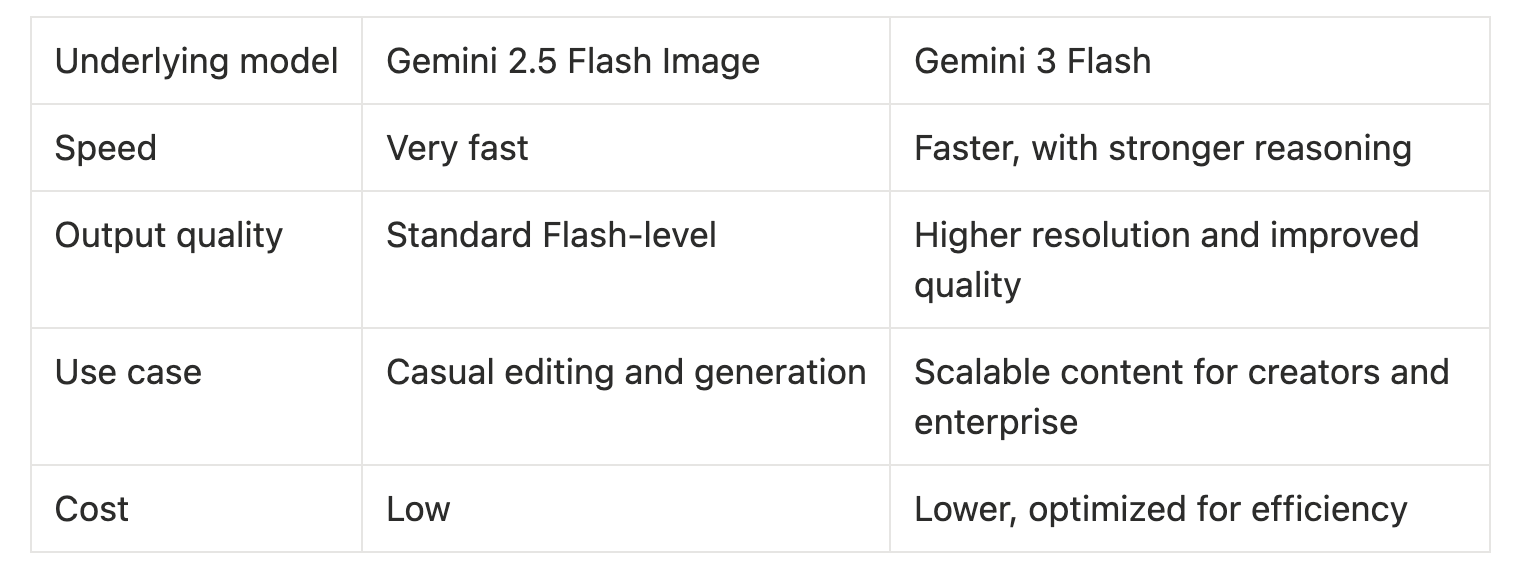 Nano Banana Vs Nano Banana 2 Flash
Nano Banana, based on Gemini 2.5 Flash Image, was primarily designed for low-latency, casual creation. It gained popularity for quick edits, simple transformations, and stylized results that performed well on social platforms.
Nano Banana 2 Flash builds on that foundation. With Gemini 3 Flash underneath, it is expected to offer deeper prompt understanding, higher resolution output options, and more reliable results. This places it between hobbyist-friendly tools and professional-grade workflows.
Why Speed and Efficiency Matter
Speed-first image models are increasingly important. Many real-world creative tasks do not require a single perfect image. They require dozens or even hundreds of usable images produced quickly.
Nano Banana 2 Flash is expected to support use cases such as:
- Generating multiple image variations for marketing campaigns
- Quickly editing product images for e-commerce listings.
- Running rapid design experiments
- Handling bulk image edits without slowing down production
In these scenarios, faster generation times translate directly into better productivity and lower costs.
Expected Capabilities and Focus Areas
While official specifications have not been released, Nano Banana 2 Flash is expected to offer the same core image generation and editing capabilities as other Nano Banana models, with an emphasis on speed.
Key focus areas include:
- Fast image generation
- High throughput for repeated tasks
- Efficient image editing workflows
- Lower compute costs compared to Pro-tier models
The goal is not to create the most visually complex image possible, but to deliver reliable results quickly and consistently.
What We Still Don’t Know about Nano Banana 2 Flash
Because Nano Banana 2 Flash has not been formally announced, several important details remain unclear.
These include:
- The exact release timeline
- Final performance benchmarks
- Pricing and usage limits
- Where it will be accessible, such as Google AI Studio or Gemini APIs
As with other Google models, these details are likely to become available once the model enters a broader preview or public release phase.
How Creators and Teams Might Use It
A fast image model like Nano Banana 2 Flash would be especially useful for teams that work at scale.
Marketing teams could generate large batches of visuals quickly. E-commerce businesses could edit and update product images without delays. Designers could test ideas rapidly without waiting for long render times. Support and documentation teams could create visual assets on demand.
In all of these cases, speed and efficiency matter more than ultra-high detail.
Final Thoughts
Nano Banana 2 Flash represents a clear direction in Google’s image model strategy. Instead of pushing only for higher quality, Google is investing in models that fit real production workflows.
While the model is still in testing, its focus on speed, scalability, and efficiency suggests it could become a default choice for many everyday image tasks once released.
As Google continues to expand the Nano Banana family, Nano Banana 2 Flash may play a key role in making AI image generation faster, cheaper, and easier to use at scale.
Before its release, you can explore Nano Banana Pro on the ImagineArt AI image generator and experiment with different styles, create infographics, build UX designs, and more.
Tooba Siddiqui
Tooba Siddiqui is a content marketer with a strong focus on AI trends and product innovation. She explores generative AI with a keen eye. At ImagineArt, she develops marketing content that translates cutting-edge innovation into engaging, search-driven narratives for the right audience.