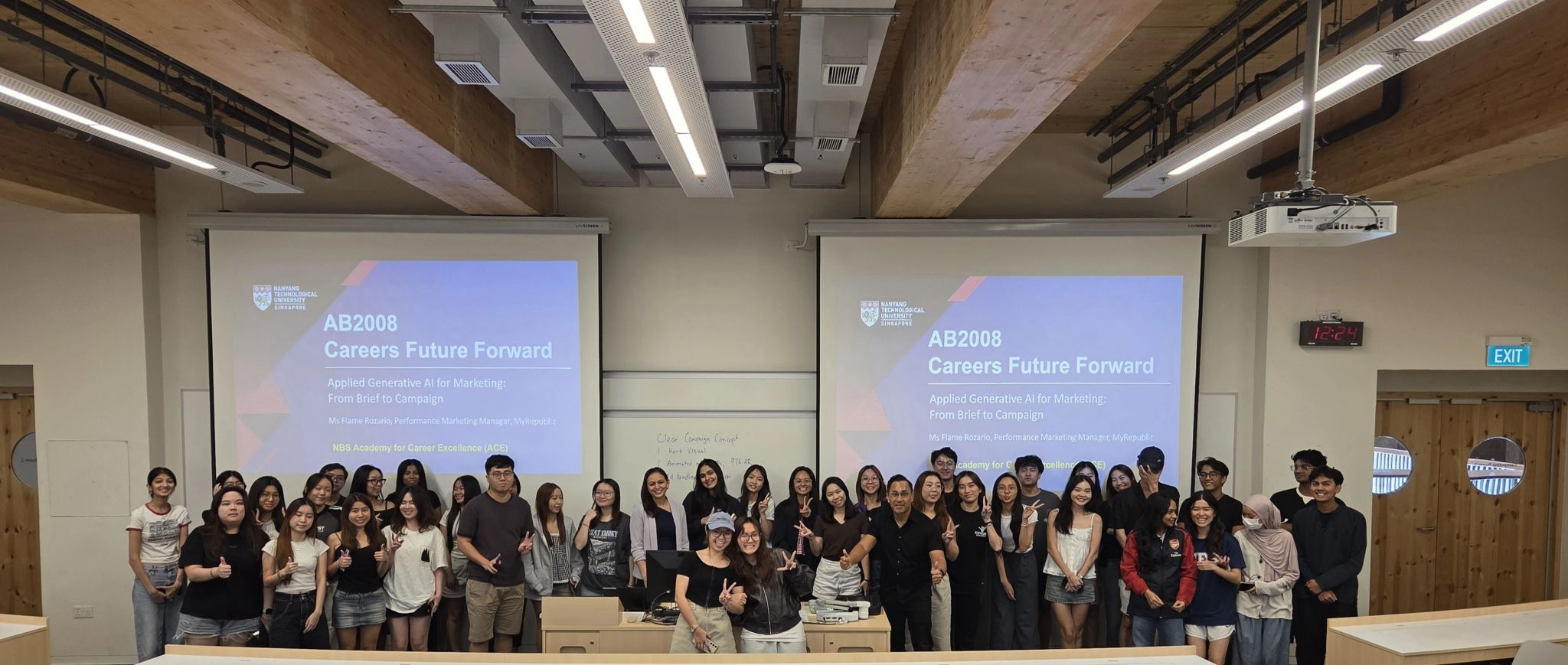
Institution: Nanyang Technological University Singapore School: Nanyang Business School Audience: Year 2 Marketing & Business Students Host: Flame Rozario Format: Hands-on Workshop
ImagineArt brought its platform directly into the classroom at Nanyang Technological University Singapore — and what happened over the course of a single session said something important about where marketing education needs to go next.
ImagineArt inside the marketing classroom
The session, hosted and led by Flame Rozario, was structured around a goal: by the end of the workshop, every student would have built a mini marketing campaign from scratch using ImagineArt, from ideation through to execution.
This format was deliberate. There is a meaningful difference between watching someone use a creative AI platform and using one yourself, under time pressure, with a real output to show at the end. The first produces familiarity. The second produces fluency — or at least the beginning of it. Fluency requires making decisions, encountering limitations, discovering what works, and building an intuition for the gap between what you asked for and what the tool produced.
Workshop stages
1. Ideation
Students defined their campaign brief — audience, message, creative direction, channel mix. The strategic thinking that precedes any production, AI-assisted or otherwise.
2. Prompting and Generation
Translating that brief into ImagineArt’s workflow canvas — learning how to communicate intent to an AI model, how to iterate on results, how to steer generation toward a specific creative outcome.
3. Production
Building the actual campaign assets — images, copy directions, visual formats — within a single session, at a speed that would have been impossible without AI.
4. Execution
Completing the campaign arc: from a marketing problem to a finished set of creative outputs, in the time typically allotted to a single lecture.
The compression of that journey into a single hands-on session was the point. It demonstrated — experientially what it actually means to work with AI in a creative marketing context.
A different kind of classroom for tomorrow
Marketing education has a timing problem. The industry moves faster than syllabuses do. By the time a framework is taught in a lecture hall, stress-tested in assignments, and examined at the end of semester, the tools and conditions it describes have frequently moved on. Students graduate fluent in yesterday’s best practices and spend their first years in industry catching up to today’s.
This gap has always existed to some degree. What’s different now is the scale of the shift. Generative AI in marketing isn’t a new channel or a new platform — it’s a structural change in how creative work gets produced, how campaigns get resourced, and what skills define a competitive marketing professional. The students entering the workforce in the next two to three years will be the first generation for whom AI-native production is the baseline expectation, not an advanced capability.
That’s the context behind ImagineArt’s collaboration with Nanyang Business School. Not a product demonstration. Not a guest lecture with slides and a Q&A. A hands-on workshop where Year 2 Marketing and Business students at one of Asia’s leading universities picked up the tools and built something real.
AI-powered design and marketing beyond the classroom
There is a version of AI education that is fundamentally about awareness. Students learn that AI tools exist, see what they can do, and leave with a general sense of where the industry is going. This is valuable, but not exactly sufficient.
The version that actually prepares students for what the industry demands is about fluency — the ability to use these tools purposefully, to direct them with creative intent, to evaluate outputs critically, and to integrate them into a professional workflow without losing the strategic thinking that makes marketing effective in the first place.
“The future of creative work belongs to those who learn it early.”
This isn’t a prediction. It’s a description of how professional advantages accumulate. The students in the NTU workshop who walked away with genuine hands-on experience of building an AI-assisted campaign are not in the same position as students who read about it. They’ve started building an intuition — about what good prompting looks like, about what AI does well and where it needs human direction, about how to move from a creative brief to a finished output through this new production layer. That intuition compounds with every subsequent use.
The marketing industry is going to have a fluency gap for several years. Organizations will be looking for people who can actually work with AI tools in production contexts — not just conceptually but operationally. The students building that fluency now, as undergraduates, arrive in the workforce at a fundamentally different starting point than their peers.
The gap between those two groups is not going to be obvious on day one. It will be very obvious by year two, when one cohort is iterating at pace and the other is still in the learning curve.
The role universities play in this transition
Nanyang Business School’s decision to bring ImagineArt into the classroom reflects something that the most forward-looking marketing programs are beginning to understand: AI fluency is not a topic to add to an existing curriculum. It is a capability to be developed through practice — and the only way to develop it is to create conditions where students are actually using the tools, making decisions with them, and experiencing the feedback loop between creative intent and AI output.
The challenge for universities is that this requires a different pedagogical model than the one most marketing programs were built on. You can’t develop AI fluency through case studies or lectures alone. You develop it the same way you develop any creative skill — by doing it, repeatedly, in contexts that require real decisions and produce real outputs.
What makes the NTU workshop model effective is exactly that structure. Students were producers. The session ran like a compressed campaign sprint — the kind of working environment they’ll encounter in agencies, brand teams, and startups — with AI tools integrated from the beginning rather than added as an afterthought.
Special Thanks
A particular thank you to Flame Rozario for hosting and leading the session with the kind of energy and pedagogical clarity that makes the difference between a good and great workshop. The hands-on format only works when the facilitation is genuinely good, and it was.
ImagineArt is proud to have been part of a session that put real tools in the hands of the next generation of marketing professionals. We’re looking forward to more of them.
What comes next
The NTU workshop is part of a broader commitment at ImagineArt to close the fluency gap where it matters most: at the point of entry into the profession. Marketing students who graduate with genuine AI production experience don’t just benefit themselves — they accelerate the organizations that hire them and raise the baseline for what “marketing capability” means industry-wide.
The creative industry is in the middle of a transition that is faster and more comprehensive than most educational institutions have yet fully absorbed. The tools available to a Year 2 marketing student today — and the workflows those tools enable — represent more production capability than many professional marketing teams had three years ago. The question is whether the educational environment keeps pace with that capability, or whether the gap between what students are taught and what the industry actually does widens further.
Sessions like the NTU workshop are one answer to that question. Practical. Hands-on. Built around the actual tools and workflows that define the profession students are entering. The students who were in that room built something real. That matters, because the experience of building it is already changing how they think about what marketing work is.
That’s the point of learning early: Not to have seen the tools, but to have already started thinking with them.
Bring ImagineArt into your classroom or program.
We work with universities, business schools, and training programs to build practical AI fluency for the next generation of creative and marketing professionals.
Bring ImagineArt into your classroom or program.
We work with universities, business schools, and training programs to build practical AI fluency for the next generation of creative and marketing professionals.
<a href="https://www.imagine.art/business/enterprise/contact-us"
   style="display:inline-flex;align-items:center;justify-content:center;min-width:220px;padding:12px 18px;border-radius:14px;background:rgba(255,255,255,.12);border:1px solid rgba(255,255,255,.28);color:#ffffff;font-weight:700;text-decoration:none;">
  Get in Touch
</a>
Ready to put this into practice?