
Saba Sohail
February 5, 2026 • Updated March 12, 2026
9 mins Read
Kling 3.0 brings the game-changing features of multi-shot prompting, audio and natural dialogue for characters in group compositions, multi-character coreference, storyboard control, dialects and accents, text rendering in videos and improved O1 video-to-video editing. Yet the success of rendering an AI video exactly like you had imagined lies in how you prompt Kling 3.0. So, here is an exclusive prompt guide that covers:
- How to structure basic and detailed prompts for Kling 3.0
- 16 Prompt Examples across Kling 3.0’s major features
How to write effective prompts for Kling 3.0?
To begin with, a strong Kling 3.0 prompt is a set of production instructions. When you think like a director instead of a viewer, Kling 3.0 delivers like one.
That’s because Kling now responds to cinematic intent. The most effective prompts follow a structured logic that mirrors how a director plans a scene: who is present, what happens, how it’s filmed, and how it sounds.
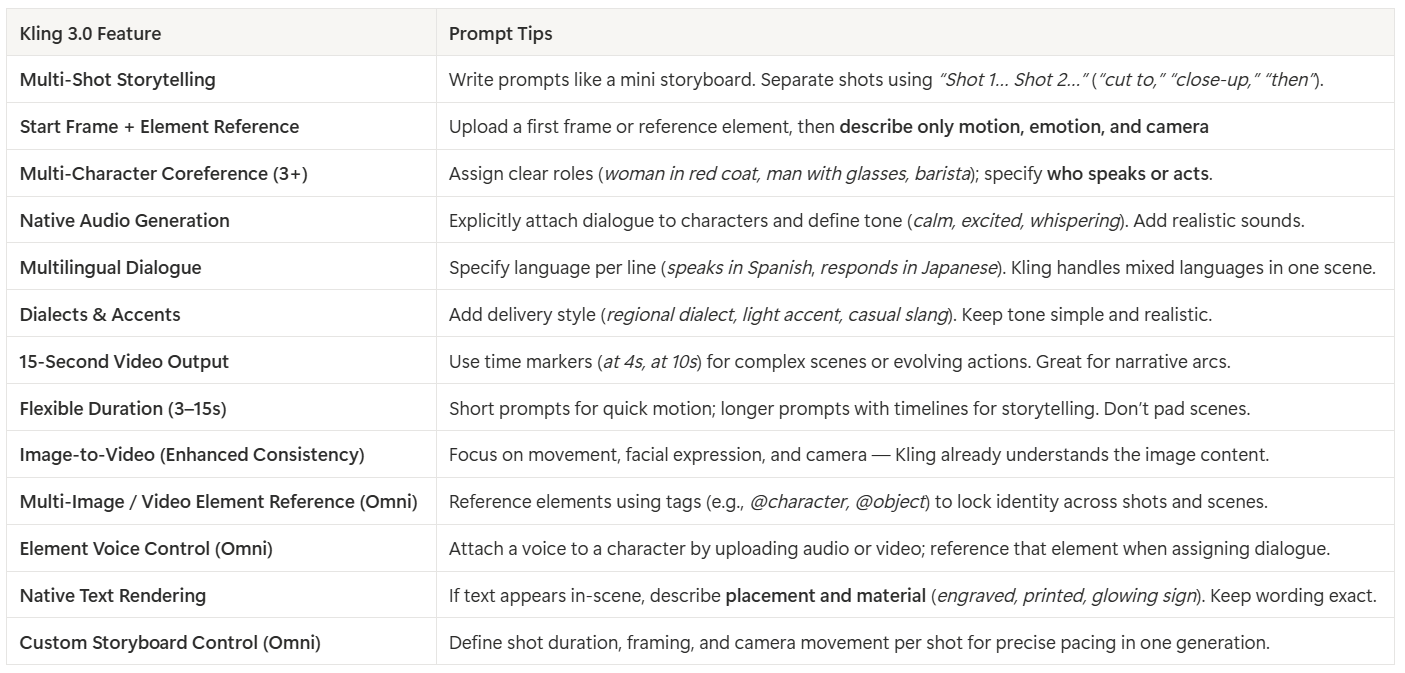 Kling 3.0 Prompt Guide
The Kling 3.0 Prompt Template
Think in five layers, written in this order:
Scene → Characters → Action → Camera → Audio & Style
1. Define the Scene First (Context Anchor)
Always start by grounding the model in a clear environment. This gives Kling spatial and lighting context before anything moves.
- Location (indoor/outdoor, city, nature, room type)
- Time of day or lighting condition
- Overall atmosphere
Example
Quiet rooftop at night with distant city lights and a cool breeze.
2. Specify Characters with Clear Roles
Kling 3.0 supports multi-character coreference, but only if roles are unambiguous.
- Assign identities clearly (woman, man, child, vendor, assistant)
- Reuse the same descriptor consistently
- Reference who speaks or acts explicitly
Good
The woman in a grey coat turns and speaks softly.
Avoid
Someone says quietly.
3. Describe Actions as a Timeline
Kling excels when actions are sequential, not stacked like a summary or compressed like a paragraph. This timeline method will improve motion smoothness and realism.
- Break movement into steps
- Use time markers for longer scenes (especially 10–15s)
- Keep actions physically realistic
Example
She slows her pace, looks back briefly, then continues walking forward.
4. Direct the Camera Like a Cinematographer
Camera instructions are not optional in Kling 3.0 anymore. They are almost necessary for the desired output. They are leverage. Without camera direction, Kling defaults to static framing.
Include:
- Shot type (wide, medium, close-up)
- Movement (push-in, orbit, pan, tracking)
- Transitions (cut, shift focus, pull back)
Example
The camera tracks alongside her, then gently pushes into a close-up.
5. Lock Audio, Dialogue, and Tone Explicitly
Kling 3.0’s native audio is powerful, but only when guided.
- Attribute dialogue to specific characters
- Specify tone, pace, and language
- Add ambient sound for realism
Example
The man replies in a calm, low voice, with faint traffic noise in the background.
This ensures correct lip sync, voice placement, and emotional delivery.
16 Ready-to-Use Prompts for Kling 3.0
1. Multi-Shot and AI Director Prompts
For cinematic scenes requiring multiple perspectives or shot transitions, multi-shot prompts are essential for a seamless output.
Kling 3.0 is truly "one giant leap for AI video generation"! Check out this amazing mockumentary from Kling AI Creative Partner Simon Meyer! pic.twitter.com/Iyw919s6OJ
— Kling AI (@Kling_ai) February 5, 2026
Prompt 1
Cinematic sunset scene on a coastal balcony overlooking the sea. A young woman wearing a light linen dress leans on the railing as waves crash below. The camera slowly dolly-moves forward. She sighs softly and says, “I always forget how loud the ocean can be.”
Shot 2: Cut to a medium close-up of a young man placing two cups of tea on the table, replying calmly, “That’s because you only notice it when you stop running.”
Shot 3: Over-the-shoulder shot from behind the woman as she turns, smiles faintly, and asks, “And you? Do you ever stop?”
Natural lighting, warm color grading, realistic facial expressions, gentle ambient wind and distant seagulls, cinematic realism.
Prompt 2
Shot 1: "A wide shot of the woman walking through the park."
Shot 2: "A close-up as she smiles and waves at a friend."
Shot 3: "A tracking shot as she turns to look behind her, following the camera movement as she keeps walking."
Prompt 3
- Shot 1: "A cinematic shot on a European villa’s terrace. A young Caucasian woman in a blue-and-white striped shirt and khaki shorts sits at a table. The camera slowly pushes in."
- Shot 2: "The woman swirls juice in her glass, gazing at the distant woods, and says, 'These trees will turn yellow in a month.'"
- Shot 3: "Close-up of a young Caucasian man in a white T-shirt, who whispers, 'But they'll be green again next summer.'"
- Shot 4: "The woman turns and smiles, 'Are you always this optimistic?' The man replies, 'Only about summers with you.'"
- Atmosphere: "High-quality, 4K, realistic textures, natural sunlight, with an emotional atmosphere."
2. Multi-Character Coreference:
If multiple characters are involved in a scene, reference them with clear actions and reactions to ensure coherence.
Prompt 4
"The woman smiles as the man, standing beside her, whispers something in her ear. The camera alternates between their faces."
Prompt 5
Interior café scene during a rainy afternoon.
The barista, speaking cheerfully: “Your drinks will be ready in just a moment.”
The woman in the red coat, turning toward her friend, whispers: “I told you this place was worth the wait.”
The man with glasses, smiling quietly, replies: “You were right this time.”
Camera alternates between medium shots and close-ups, rain tapping softly against the windows, ambient café chatter in the background.
3. Multilingual Support and Accents:
Kling 3.0's multilingual capabilities allow you to integrate different languages and accents into the video. Be sure to specify these in the prompt for natural dialogue.
Prompt 6
The woman speaks in fluent French: 'Je t'aime,' as the man responds in English: 'I love you too.' The accent and lip-sync match perfectly."
Prompt 7
A small night market street in Tokyo illuminated by hanging lanterns.
The vendor speaks in Japanese with a friendly tone: “今日は寒いですね。”
A tourist responds in slightly accented Japanese: “はい、でも雰囲気が素敵です。”
Her companion adds softly in English: “This feels like a movie scene.”
Natural mouth movement, accurate lip sync, gentle crowd noise, light wind brushing fabric and paper lanterns.
Prompt 8
Scene: "A cozy indoor home environment with a soft hum of an air conditioner in the background."
- Dialogue:
- Mother (in surprise): "Wow, I didn’t expect this plot at all!"
- Father (calmly): "Yeah, it’s totally unexpected, never thought that would happen."
- Boy (excited): "It’s the best twist ever!"
- Girl (nodding): "I can't believe they did that!"
- Additional Detail: "The dialogue is in clear English with realistic lip movements and expressions."
4. Subject Consistency with Element References:
Lock in key elements in the video, such as characters, objects, or setting, ensuring they stay consistent despite camera movements or scene transitions.
Prompt 9
The woman’s red dress remains the same throughout the video, even as the camera zooms and shifts around her."
Prompt 10: Image-to-Video with Subject Consistency
- Scene: "A close-up of a woman in a red dress standing by a scenic mountain lake. The camera orbits around her, capturing her face as she smiles warmly."
- Subject Consistency: "Throughout the video, the woman’s red dress and long brown hair remain consistent as the camera moves."
- Action: "The woman lifts her head and looks directly at the camera, smiling as if seeing an old friend after years."
5. 15-Second Video Generation with Complex Action
Prompt 11
- Scene: "A low-angle shot of a young woman running at full speed through a moonlit garden."
- Action: "As she runs, her skirt billows in the wind, and she holds a small white flower in her hand. Several people in vintage formal attire run parallel to her, creating a sense of chase."
- Camera Movement: "At the 8-second mark, the camera zooms into a close-up, then tracks her as she glances back at a young man, locking eyes for a brief moment."
- Ending: "In the final 3 seconds, the couple breaks through the crowd and runs toward the starry sky, the camera following their movement."
Prompt 12
Wide tracking shot through a quiet train station at dawn.
0–4s: A young man walks briskly along the platform, breath visible in cold air.
5–9s: The camera accelerates slightly as he spots a woman ahead and slows down.
10–13s: Close-up as their eyes meet; background sound fades.
14–15s: The train doors close behind them as they smile softly.
Muted color palette, cinematic pacing, natural movement, emotional restraint.
6. Native Audio with Voice Attribution
Prompt 13
Modern office hallway with low ambient noise.
The woman in a navy blazer says confidently: “Send the proposal before noon.”
The assistant responds quickly, slightly nervous: “Already queued for delivery.”
Footsteps echo softly, voices clearly tied to the correct speakers, natural reverb and spatial audio.
7. Native-Level Text Rendering (Ads / Branding)
Prompt 14
Morning sunlight fills a minimalist studio kitchen. The camera glides across a marble countertop toward a matte black coffee machine. Clean engraved lettering on the machine reads: “Brew Calm.”
A soft voiceover begins: “Every morning deserves intention.” Steam rises naturally, reflections remain sharp, typography is crisp and readable.
8. Dialects and Accents
Prompt 15
Warm family living room at night.
The grandmother speaks in a slow regional dialect with a soft laugh: “Back in my day, we didn’t rush so much.”
The teenager replies in casual modern slang: “Yeah, but things move faster now.”
The mother chuckles quietly between them.
Subtle background TV hum, realistic pauses, expressive facial movements, cozy lighting.
9. Omni Storyboard Control (Shot-Level Precision)
Prompt 16
Shot 1 (6s): Handheld medium shot on a snowy hillside. @Male lead laughs nervously and says, “Maybe we chose the coldest place possible.”
Shot 2 (9s): Camera pans to @Female lead smiling warmly: “At least we’ll remember it forever.”
Natural camera shake, wind audio, cinematic realism, smooth transition between shots.
Kling 3.0 Prompt Guide: Key takeaways
- One sentence ≠ one idea. Use commas and clauses to layer intent
- Longer prompts are fine if they are logically ordered
- Avoid abstract words (beautiful, cinematic) unless paired with specifics
- For multi-shot scenes, write prompts as mini storyboards
Ready to create stunning videos with Kling 3.0?
With Kling 3.0, you can create highly detailed, cinematic videos with a focus on character consistency, multilingual dialogue, and flexible video lengths. By structuring your prompts with clarity and precision, you can fully leverage the model’s powerful features to produce dynamic, high-quality video content for a variety of creative projects.
Saba Sohail
Saba Sohail is a Generative Engine Optimization and SaaS marketing specialist working in automation, product research and user acquisition. She strongly focuses on AI-powered speed, scale and structure for B2C and B2B teams. At ImagineArt, she develops use cases of AI Creative Suite for creative agencies and product marketing teams.